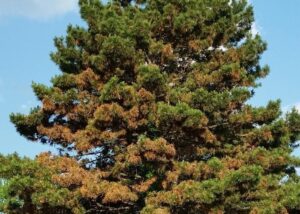

An evergreen turning brown in fall is usually shedding its oldest, innermost foliage, a normal process called seasonal needle drop. Browning at the branch tips, on one side, or at the top, or a crown that thins and yellows overall, is different. Those patterns point to drought damage, winter injury, needle disease, root disease, or bark beetles.
This guide covers the conifers most common in South Sound yards, including western redcedar, Douglas-fir, western hemlock, grand fir, pines, and arborvitae hedges, from Kent and Covington to Maple Valley. It draws on guidance from WSU Extension, the Washington Department of Natural Resources, the U.S. Forest Service, King County, the City of Tacoma, and the Pierce Conservation District.
Expect a heavier shed than usual this year. The Washington Department of Ecology declared a statewide drought on April 8, 2026, the state’s fourth consecutive drought declaration. According to WSU Extension, an extreme summer drought can make conifers start shedding earlier and drop several years of old foliage at once instead of just the oldest year. That heavier shed is a sign of stress, but on its own it does not mean the tree is dying.
Key Takeaways
- Normal: in fall, conifers shed their oldest, innermost foliage and keep several years of newer growth at the branch tips. WSU Extension expects healthy trees to look much better by the end of December.
- Foliage lifespan: historical averages for western Washington are about 2 to 5 years for western redcedar, 4 to 7 years for western hemlock, and 3 to 9 years for coastal Douglas-fir.
- Drought year: an extreme summer drought can make a conifer shed several years of foliage in one fall. Washington’s April 2026 drought declaration is the state’s fourth in a row.
- Not normal: brown tips or dead new shoots, browning on one side or at the top, thinning across the whole crown, mushrooms at the base, and boring dust or resin streams on the trunk.
- Dead: when the entire crown of a conifer other than a larch turns yellow, brown, or red at once, the tree has died.
- Safety first: a browning tree that could cause serious injury or property damage needs a hazard assessment by a certified consulting arborist right away, not a wait-and-see approach.
Is It Normal for Evergreens to Turn Brown in Fall?
Yes, as long as the brown foliage is the oldest, innermost growth. Evergreen conifers keep their foliage for several growing seasons. As older foliage gets shaded by newer growth, it becomes less productive, and the tree sheds it in fall while keeping the newer foliage toward the branch tips. Historical averages cited by WSU for western Washington run roughly two to five years of foliage on western redcedar (Thuja plicata), four to seven years on western hemlock (Tsuga heterophylla), and three to nine years on coastal Douglas-fir (Pseudotsuga menziesii).
How visible the shed is depends on the species:
- Western redcedar turns whole branchlets orange to brown instead of individual needles, a pattern called flagging. WSU Hortsense notes it is often dramatic in early fall after a dry summer, and WSU Extension in Pacific County notes that unless weather or cultural stress is severe, trees with cedar flagging should recover.
- Pines show the shed clearly. WSU notes their longer needles and more open structure make seasonal foliage loss especially noticeable.
- Arborvitae and white pine often drop their two-year-old needles all at once in fall, which looks alarming but is perfectly normal, according to WSU Extension in Pacific County.
- Douglas-fir and western hemlock hide it. Their interior needles turn brown where they are hard to see, so the shed shows up later as dead needles carpeting roofs and streets after the fall winds.
On an otherwise healthy tree, WSU expects the discolored foliage to blow out with the fall winds and the tree to look much better by the end of December.
Normal Needle Drop or a Problem? Symptom Guide
The table matches common browning patterns on South Sound conifers with their most likely cause. Normal patterns come first; the rest are worth a closer look.
| What the browning looks like | Most likely cause | What to do |
|---|---|---|
| Oldest, innermost foliage turns yellow, orange, or brown in fall; foliage at the branch tips stays green | Seasonal needle drop (normal) | Nothing. The tree looks much better by the end of December. |
| Whole branchlets turn orange inside a western redcedar, heavier after a dry summer | Cedar flagging (normal) | Water during dry stretches. The shed drops on its own. |
| Arborvitae drops its two-year-old foliage all at once in fall | Seasonal shed (normal) | Nothing. |
| Young redcedar turns bronze on the sun-exposed side in winter | Winter bronzing from the pigment rhodoxanthin (normal) | Nothing. It greens up again in spring. |
| South or southwest side browns after cold, sunny winter weather | Winter desiccation | Water through fall, mulch the root zone, and prune out only dead wood. |
| East side of an exposed Douglas-fir browns after winter east winds in the Cascade foothills | Winter desiccation from east winds | Usually none. The buds survive and the tree greens up in spring. |
| Newest, outermost needles brown, whole branches die, or only the lower branches thin | Fungal disease | Arborist diagnosis. |
| Stunted, discolored needles on new pine shoots that die back toward the main stem | Tip blight (Diplodia sapinea) on pines such as Austrian, Scots, red, and mugo | Arborist diagnosis and disease management. |
| Tiny yellow spots on current-year Douglas-fir needles in late summer or fall, reddish-brown blotches by spring | Rhabdocline needle cast | Arborist diagnosis and disease management. |
| Tiny black dots under Douglas-fir needles, a sooty look, needle loss in spring and summer | Swiss needle cast (Phaeocryptopus gaeumannii) | Rarely fatal. Arborist diagnosis. |
| Uniform thinning and yellowing, shorter yearly growth, a heavy crop of small cones | Root disease, such as laminated root disease (Phellinus sulphurascens) | Tree risk assessment. Root-diseased trees often fall over easily. |
| Honey-colored mushrooms near the base in fall, white thread-like fungal growth under the bark at the base | Armillaria root rot | Tree risk assessment. |
| Reddish-orange boring dust in bark crevices, resin streaming down the trunk, crown fading yellow and then reddish brown | Douglas-fir beetle (Dendroctonus pseudotsugae) | Arborist inspection and integrated pest management. |
| Pitching, tiny holes, and red or cream-colored boring dust on grand fir or noble fir, often after drought | Fir engraver (Scolytus ventralis) | Arborist inspection and integrated pest management. |
| Dead or dying top (leader) | Drought stress, redcedar dieback, or a top broken in a windstorm | Arborist inspection, especially over a house or driveway. |
| Entire crown turns yellow, brown, or red at once (not a larch) | The tree has died | Removal assessment. |
Browning Patterns That Point to a Real Problem
WSU Extension in Pacific County draws the line clearly: normal shedding is a gradual discoloration and loss of inner needles from the top of the tree to the bottom, while fungal diseases often brown the newest, outermost needles, kill entire branches, or thin the needles on just the lower branches.
Brown Tips and Dead New Shoots on Pines
Stunted, discolored needles on new shoots, with dieback that works back toward the main stem, fit tip blight, a disease caused by the fungus Diplodia sapinea (formerly Sphaeropsis sapinea). The Pacific Northwest Plant Disease Management Handbook lists ponderosa, Austrian, Scots, red, and mugo pines among its hosts. Tip blight normally does not kill trees, but it can let other organisms such as pine beetles gain entry, and the dead needles often stay on the branch through the next spring.
One Side of the Tree Brown After Winter
Winter desiccation dries out evergreen foliage on sunny, cold days when the ground and roots are frozen and the tree cannot take up enough water. WSU Hortsense notes the damage usually shows on the south and southwest side. WSU also describes a Cascade foothills version: unseasonably warm, dry winds from east of the mountains funnel through the passes in winter and brown the east side of exposed trees, especially Douglas-fir. Because the buds usually survive, those trees normally green up again when new growth emerges in spring.
Yellow Spots or Black Dots on Douglas-fir Needles
Two needle diseases cause Douglas-fir needle loss outside the normal fall shed. Rhabdocline needle cast starts as tiny yellow spots on the current season’s needles in late summer or fall, turns into dark reddish-brown blotches by spring, and drops infected needles by late June. Swiss needle cast, caused by the fungus Phaeocryptopus gaeumannii, shows up as tiny black dots on the undersides of the needles that give them a sooty look, with needle loss in spring and summer rather than fall. According to the U.S. Forest Service, the Swiss needle cast fungus is specific to Douglas-fir and causes sparse crowns and reduced growth but rarely kills trees. An arborist can confirm which disease is present and whether tree disease management is worth it for a landscape tree. The field guide to common fungal tree diseases in western Washington covers other fungal problems.
A Thinning Crown, Short Growth, and Small Cones
Uniform thinning and yellowing across the whole crown can indicate root disease, according to WSU. The WSU Pacific Northwest Gardener’s Handbook identifies laminated root disease (Phellinus sulphurascens) as the most common root disease in western Washington. It spreads mainly through root-to-root contact and hits Douglas-fir and true firs hardest; pines are tolerant and western redcedar is resistant. King County describes the same pattern in its own forests, with root rot destroying the roots of Douglas-fir, true firs, and western hemlock as it spreads outward in a circle.
Early symptoms listed in the handbook include reduced yearly height growth, yellowing or sparse foliage, and a heavy crop of undersized stress cones. As the disease progresses, the crown keeps thinning until the tree dies, bark beetles often move in and kill the weakened tree, and because the roots have deteriorated, these trees often fall over easily. Armillaria root disease (Armillaria ostoyae) is more common in eastern Washington but affects all conifers, and WSU Hortsense notes honey-colored mushrooms often grow near the base of infected trees in the fall. A declining fir near a house is a strong candidate for a tree risk assessment before winter storms.
Boring Dust, Resin, or Pitch on the Trunk
Bark beetles leave evidence on the trunk, often before the crown changes color. On Douglas-fir, the U.S. Forest Service describes reddish-orange boring dust pushed out of entrance holes as the first sign of a Douglas-fir beetle attack. Because wind and rain can wash much of it away, the bark crevices need a careful look. Streams of clear resin sometimes flow down the trunk from entrance holes. Several months after a successful attack the foliage may start to fade, and the crown turns uniformly yellow and finally reddish brown, in some trees not until a year after the attack. The WSU handbook notes that several large Douglas-firs downed in a winter windstorm can let the Douglas-fir beetle become established.
On grand fir and noble fir, the beetle to know is the fir engraver (Scolytus ventralis). WSU’s guide to fir engraver damage in western Washington notes it typically establishes only in trees already stressed by drought or root disease, and that severe drought in western Washington often correlates with a spike in fir engraver populations. Signs include pitching, tiny holes about two millimeters across, and red or cream-colored boring dust; cream-colored dust means the beetles have bored into the inner bark. A fir killed at the end of summer may not turn red until the following spring.
Pitch alone is not proof. WSU notes trees also pitch from root disease, physical damage, or normal trunk growth, and red foliage can come from drought. When pitching and red foliage show up together, it is a good indicator of beetle damage.

The bark beetle guide for western Washington conifers covers local species and timing, and integrated pest management covers monitoring and treatment options.
A Dead or Dying Top
A dead or dying top has several possible causes. The City of Tacoma Urban Forest Manual lists dieback on leaders, especially in conifers, among the signs of drought stress. On western redcedar, a dead top is one of the hallmark signs of dieback, covered in the next section. The WSU handbook also notes that windstorms are a common source of tree damage in western Washington and can break tops and branches. The guide to windstorm damage and recovery covers storm-damaged trees. A dead or broken top over a house, driveway, or play area should be assessed before winter storms.
Western Red Cedar Turning Brown: Flagging or Dieback?
Western redcedar (often written western red cedar) shows both the most dramatic normal shed and the most worrying decline in the region. Flagging is the normal part: older, interior branchlets turn orange and drop, often heavily after a dry summer. Young redcedars, seedlings especially, can also turn bronze on their sun-exposed side in winter. According to WSU, the tree produces a pigment called rhodoxanthin as a winter sunscreen; the bronze foliage is not dead, and it greens up again in spring.

Dieback looks different. Washington State Magazine describes it as dead tops, brown canopy, and thinning foliage, sometimes followed by the death of the tree. Washington DNR has reported redcedar dying in places where it should be thriving, such as along streams, and the predominant theory points to a changing climate, including rising average temperatures and drought stress. A U.S. Forest Service fact sheet found redcedar mortality strongly associated with multiple consecutive years of especially warm, dry weather from May to September. It also notes that dieback starts with needle loss, and trees that cannot recover keep losing needles and eventually die. Researchers at the WSU Puyallup Research and Extension Center started the Forest Health Watch program in 2020 to track the problem through community reports.
A redcedar that is still browning after winter, or has a thin or dead top, is worth having an arborist look at before another dry summer. For summer symptoms on cedars and other trees, see the guides to early drought stress signs in cedars and hemlocks and heat scorch, drought stress, and root disease. The guide to removing drought-killed cedars and hemlocks covers trees that are past saving.
What to Do Before Winter
- Water during dry stretches until the rain soaks in. WSU Hortsense recommends watering properly throughout spring, summer, and fall, and checking soil moisture for evergreens and plants under eaves. For trees planted within the last three years, City of Tacoma Urban Forestry advises watering from April to October. The deep root watering guide covers how to soak the root zone, and the watering priority guide by species covers which trees to water first.
- Mulch the root zone, not the trunk. WSU recommends loose organic mulch over the root zone to maintain soil moisture and protect against cold temperatures. Keep it pulled back from the base of the trunk. Fertilization and mulching covers both.
- Leave seasonal brown alone. Shed foliage drops on its own. Where winter damage or disease has killed wood, WSU advises pruning out only dead and severely damaged wood, back to live, green, healthy wood. Tree pruning handles dead wood that is too high to reach safely.
- Skip late-season fertilizing. WSU cautions that fertilizing late in the season can encourage late-season growth that may not acclimate well in the fall.
- Have dead tops and declining conifers near structures checked before windstorm season. Pierce Conservation District puts it plainly: for a tree assessment or tree care, contact an ISA Certified Arborist.
When a Browning Evergreen Needs an Arborist
WSU suggests monitoring an uncertain tree for at least a full year, or even several years, since conifers look their healthiest in late spring and early summer. The exception is a tree that could cause serious injury or property damage, which WSU says should get a hazard assessment by a certified consulting arborist right away rather than waiting. Signs that call for a professional look:
- A dead or broken top, or large dead limbs, over a house, driveway, or play area
- Uniform thinning and yellowing with a heavy crop of small cones
- Honey-colored mushrooms or white fungal growth at the base of the trunk
- Boring dust, resin streams, or pitching on the trunk, especially with fading or red foliage
- Brown tips or dead new shoots spreading through the crown
- The whole crown turning yellow, brown, or red at once
A tree risk assessment from Pacific Arboriculture sorts out which trees can be helped and which should come down, and plant health care covers trees worth saving.
Frequently Asked Questions
Is it normal for evergreen trees to turn brown in the fall?
Yes, when the brown is on the oldest, innermost foliage. Conifers shed their oldest foliage every fall and keep several years of newer growth at the branch tips. Western redcedar shows it most, through orange flagging, and WSU Extension expects healthy trees to look much better by the end of December. Brown tips, one-sided browning, or a dying top are not part of normal shedding.
Will brown needles turn green again?
No. Brown needles stay brown until they fall or blow out of the tree. Recovery comes from new growth pushed out by live buds, which is why bud condition matters more than the brown foliage. The exception is winter bronzing on young western redcedar, a seasonal color change that greens up again in spring.
Why does an evergreen turn brown on just one side?
One-sided browning usually comes from exposure. Winter desiccation from cold, sunny weather damages the south and southwest sides most often, while warm, dry east winds in the Cascade foothills damage the east side of exposed trees, especially Douglas-fir. If the buds are still alive, the tree usually greens up from new growth in spring.
Why is the top of an evergreen turning brown?
A browning top on a conifer can come from drought stress, western redcedar dieback, or a top broken in a windstorm. The City of Tacoma lists dieback on leaders, especially in conifers, as a sign of drought stress, and Washington State Magazine describes dead tops as a hallmark of redcedar dieback. A dead top over a house or driveway should be assessed before winter storms.
Why are arborvitae turning brown in the fall?
Arborvitae often drop their two-year-old foliage all at once in fall, which WSU Extension in Pacific County describes as alarming but perfectly normal. Inner foliage hidden from light is usually the first to drop, while the green foliage at the tips stays. Browning at the tips or on one exposed side of a hedge points to drought or winter desiccation instead.
Why are pine needles turning yellow and brown in the fall?
Inner pine needles turning yellow to brown and dropping in fall is normal seasonal shed, and pines show it more than most conifers because of their longer needles and more open structure. Stunted, discolored needles on new shoots point to tip blight instead, a fungal disease the Pacific Northwest Plant Disease Management Handbook lists on ponderosa, Austrian, Scots, red, and mugo pines.
Why are Douglas-fir needles turning brown and falling off?
In fall, Douglas-fir sheds its oldest interior needles, which mostly shows up as needles carpeting roofs and streets. Needle loss in spring or early summer points to a needle disease: Rhabdocline needle cast drops infected needles by late June, and Swiss needle cast causes needle loss in spring and summer. Reddish-orange boring dust in the bark crevices points to the Douglas-fir beetle.
How can you tell if an evergreen tree is dead or stressed?
Check a few twigs. WSU Extension recommends gently scraping a tiny section of bark with a knife or a fingernail: live tissue underneath is white or green, while dead tissue is brown or even soggy. Start at the outer branch tips and work toward the trunk, because young twigs can be dead while older wood is still alive. If the whole crown has turned yellow, brown, or red at once, the tree has died. The guide to dormant versus dead trees covers more checks.
How long should you wait before deciding a browning evergreen is dying?
WSU suggests monitoring a tree for at least a full year, or even several years, to tell a sustained decline from normal seasonal changes, since conifers look their healthiest in late spring and early summer. The exception is any tree that could cause serious injury or property damage, which needs a hazard assessment by a certified consulting arborist right away.
Is it too late to water evergreens in late October?
Not if the soil is still dry. WSU’s guidance is to water properly throughout the fall and to check soil moisture around evergreens, especially plants under eaves. Once steady rain has soaked the root zone, extra water is not needed until the next dry stretch.
Does a browning evergreen need to come down?
Usually not. Seasonal shed, cedar flagging, and winter bronzing are normal, and Swiss needle cast rarely kills trees. Removal makes sense when a tree is dead, when root disease or bark beetles have compromised it, or when a dead top or large dead limbs hang over a house, driveway, or play area. Root-diseased trees are a particular concern because, as WSU notes, they often fall over easily. The decision framework for damaged trees walks through the keep-or-remove call.
Pacific Arboriculture is a tree care company in Auburn, WA, with six ISA Certified Arborists serving 21 cities across the South Sound, including Puyallup, Kent, Covington, and Maple Valley. For a browning conifer, the options include plant health care for trees worth saving, a tree risk assessment for trees near structures, and tree removal for trees that cannot be saved. To have a browning evergreen looked at before winter, request a free quote.