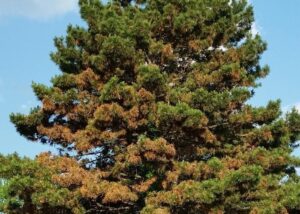

Drought stress in Pacific Northwest trees doesn’t look the way most homeowners expect. By the time branches have gone brown, the tree has typically been water-stressed for two or three months and the damage is at least partially permanent. The earliest signs — scorched needle tips, premature inner-needle drop, an off-color cast, leaves curling slightly upward in midday sun — are the ones that can still be reversed. This guide covers what to watch for on three of the most drought-vulnerable PNW species, and what an ISA Certified Arborist can do before “stressed” becomes “dying.”
Why PNW drought stress is sneakier than homeowners expect
Western Washington’s wet winters create a false sense of security. Trees in residential yards across Auburn, Kent, Renton, and Federal Way rarely develop the deep root systems that forest trees rely on for summer drought. Construction compacts subsoil, strips topsoil, and confines roots to the top 18 inches — a zone that dries out within weeks once June’s rain stops. Shallow roots have no reserve when July arrives.
OPB’s coverage of PNW heat research describes heat plus drought as a “real knockout punch” — western hemlock and western red cedar were among the most affected species after the 2021 heat dome. The lag makes it worse: a tree stressed in June may not show obvious symptoms until September or the following spring. Catching drought stress in late May or June is the difference between a recoverable tree and one two years from removal.

Western red cedar: tip browning, flagging, and the difference between normal shed and drought decline
Western red cedar is among the most drought-sensitive conifers in the Pacific Northwest. Cedar undergoes normal interior foliage turnover each fall, but when shedding appears early, spreads more than usual, or pairs with outer-canopy tip browning, drought is the likely explanation. The PNW Pest Management Handbook’s documentation on cedar drought injury describes damage moving from the top of the tree downward and from the outside of the crown inward — water has the farthest to travel to those points, so they decline first.
Hydraulic failure occurs when transpiration outpaces root uptake, reducing xylem conductivity. Carbon starvation follows: a declining crown produces less photosynthate, limiting energy for root regeneration. WSU Hortsense’s cedar flagging fact sheet recommends supplemental irrigation during summer drought as the primary cultural control. WSU’s Urban Forest Health Lab has monitored western red cedar dieback regionwide and points to hot drought as the underlying cause in the absence of a primary biotic agent.
Cedar bark beetles colonize drought-stressed trees opportunistically; treating beetles without addressing drought does nothing for long-term survival. Pacific Arboriculture’s plant healthcare (PHC) program distinguishes primary stressors from secondary ones during site assessment. The intervention window for cedars in Tacoma and communities like Puyallup, Sumner, and Covington typically opens in late May and closes by mid-July.
Hemlock: inner-needle drop, top-down dieback, and why hemlocks struggle in suburban yards
Western hemlock is an understory species that evolved beneath taller canopy trees in deep, moisture-retentive soil. In suburban yards across Burien, Des Moines, and surrounding communities — compacted soil and turf competition replacing forest duff — hemlocks are out of their niche.
Early drought symptoms on hemlock are inner-needle drop in summer and progressive top-down dieback. The topmost branches thin first because water must travel farthest there; by the time lower branches show decline, the tree has often been stressed for a full season. Research covered by OPB ranked western hemlock as the “most impacted and most susceptible” of major PNW conifers to heat and drought. An arborist consultation that correctly identifies drought as the primary stressor prevents misapplied treatments. For context on how secondary pest pressure compounds stress, see the article on bronze birch borer.

Dogwood: leaf scorch, marginal browning, and the drought-to-anthracnose pipeline
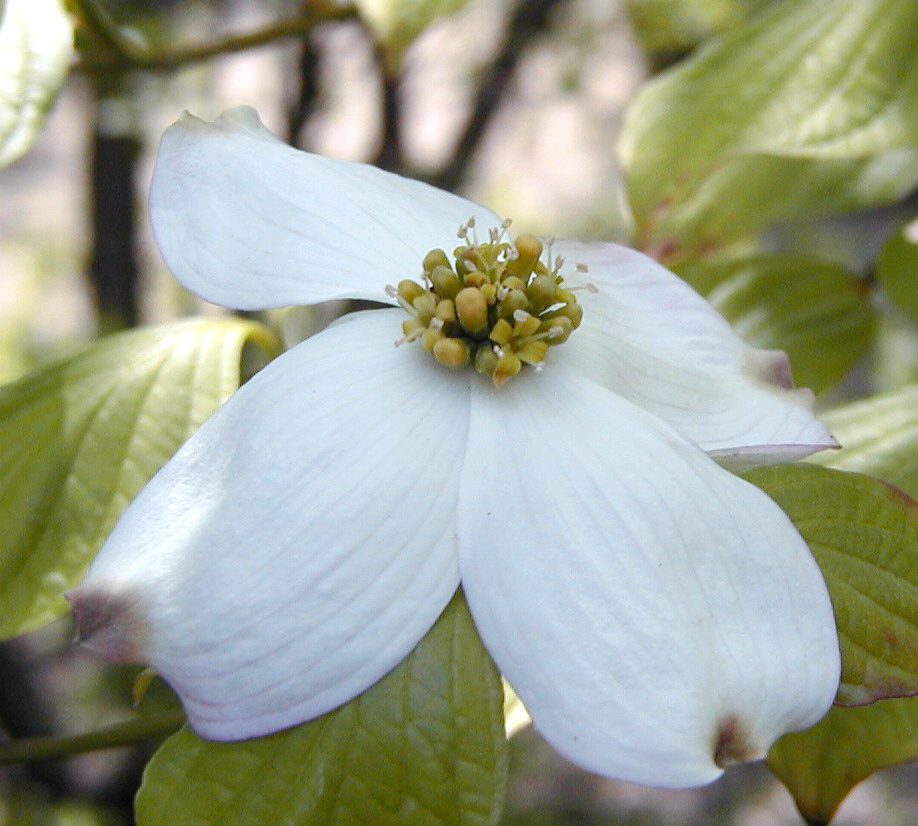
Dogwood drought stress presents differently than cedar or hemlock. Leaf scorch — marginal browning working inward from the leaf edge — appears across the crown, often with leaf curl in afternoon sun. The most damaging aspect is what early-summer drought sets up later: dogwood anthracnose (Discula destructiva) establishes more readily in trees whose stored energy is already depleted. Drought in June and anthracnose in September compound each other in a multi-season decline cycle.
Homeowners in Lake Tapps, Maple Valley, and Bonney Lake noticing marginal leaf scorch in late May or June have a real window to interrupt that cycle. Because chlorosis and iron deficiency can produce visually similar symptoms, a PHC site visit distinguishes drought scorch from a nutrient issue through pattern, timing, and site conditions.
The watering math: how much water a mature PNW tree actually needs
Most homeowners running lawn sprinklers a few times per week are watering at the wrong depth and wrong volume. A widely applied guideline is approximately 10 gallons per inch of trunk diameter per week during peak drought — a mature cedar with a 20-inch trunk needs roughly 200 gallons weekly, far more than a 20-minute sprinkler cycle delivers. Most of what a sprinkler provides is captured by turf before reaching tree root depth.
The PNW Pest Management Handbook is direct: trees require “infrequent, slow, and deep watering to allow water to penetrate soils and be taken up by roots.” The goal is to wet soil to at least 18 inches — achievable through a soaker hose running several hours or a deep root watering probe. For newly established trees, see the companion article on watering newly planted trees in the PNW, as establishment-phase protocols differ substantially.
What an ISA arborist looks for — and treatments that actually help
A professional drought assessment from an ISA Certified Arborist evaluates the tree as a system: soil compaction, root architecture, mulch coverage, and irrigation delivery efficiency. Compacted soil resists water penetration and limits oxygen exchange at the roots — a penetrometer test or soil probe reveals what canopy inspection cannot. Circling or girdling roots restrict water transport and create structural risk that drought accelerates.
A 3-to-4-inch wood chip mulch layer from near the trunk to the dripline reduces evaporation, moderates soil temperature, and suppresses turf competition. WSU Extension’s guidance on arborist wood chip mulch recommends 4 to 6 inches for effective moisture retention.
Deep root watering delivers water at 12 to 18 inches depth via a soil injection probe, bypassing compacted surface layers. Soil decompaction with an air spade fractures compacted soil without cutting roots, improving oxygen exchange, water infiltration, and root expansion — the USDA Forest Service guidance on drought and winter drying damage to conifers emphasizes root zone management as central to conifer resilience. Vertical mulching — drilling a grid of holes through compacted soil and backfilling with a porous organic mix — improves infiltration at lower cost and suits moderate compaction sites.
Fertilization should be withheld during active drought stress. The PNW Pest Management Handbook is explicit: “Do not fertilize during droughts; fertilization increases growth and therefore water requirements.” Address water stress first. See also the guides on Verticillium wilt in PNW maples and scale insects on PNW trees, as secondary pests frequently compound drought stress.
When drought stress is past the point of recovery — and the cost of waiting
Not every drought-stressed tree can be saved. When the entire upper canopy is brown and brittle, no live buds are present at branch tips, and a scratch test reveals no green cambium, the tree is generally beyond recovery. As the PNW Pest Management Handbook notes, roots may still be alive when the canopy appears completely dead — but these trees will not survive.
A dying large tree is a safety liability — dead wood loses structural integrity and falling limbs create risk for people and property. Professional removal is safer and less expensive when planned rather than emergency. A dead tree also opens previously shaded root zones to additional drying and can contribute to pest pressure on neighboring trees. Pacific Arboriculture serves homeowners and commercial properties across Auburn, Renton, Puyallup, Des Moines, Covington, and surrounding communities with written arborist reports that document findings and support defensible tree care decisions.
Frequently asked questions
Why is my cedar tree turning brown from the top down?
Top-down browning is the textbook drought pattern on western red cedar, documented in the PNW Pest Management Handbook. Water travels farthest to the crown top and outermost needle tips, so those areas decline first. Cedar bark beetles often colonize declining cedars but are secondary to the underlying stress. If upper canopy tissue is still partially green, the tree may be recoverable through a PHC assessment and deep root watering. If the crown is uniformly brown with no live tissue, removal planning is the appropriate next step.
How often should I water a mature tree in a PNW summer?
Deep watering once or twice per week is more effective than daily shallow cycles. The goal is to wet soil to 18 inches — achievable through a soaker hose running several hours or a deep root probe. A rough guideline is 10 gallons per inch of trunk diameter per week; a 15-inch trunk cedar needs roughly 150 gallons weekly, more than a standard lawn sprinkler delivers at adequate depth.
Will my hemlock recover if it lost a third of its needles last summer?
Possibly. Western hemlock naturally sheds older interior needles in fall, so interior needle loss at season’s end can be within normal range. The concern is needle loss concentrated at the crown top or branch tips, or limited bud break in spring. A hemlock showing ongoing top-down dieback or sparse bud break in May is in continuing decline. A professional assessment now provides a clearer picture of recovery probability than waiting until August.
Should I fertilize a drought-stressed tree?
No — not while drought stress is active. The PNW Pest Management Handbook is explicit: “Do not fertilize during droughts; fertilization increases growth and therefore water requirements.” Address water stress first; evaluate nutrient supplementation after the tree stabilizes. If yellowing accompanies drought symptoms, the guide on chlorosis and iron deficiency in PNW trees helps distinguish the two conditions.
What does an arborist drought consultation include?
A Pacific Arboriculture drought consultation begins with an ISA Certified Arborist site visit covering canopy condition, soil compaction, root zone coverage, mulch status, and irrigation delivery. The arborist provides targeted recommendations: deep root watering, air spade decompaction, vertical mulching, irrigation adjustment, or removal planning if decline is past recovery. A formal written arborist report is available if documentation is needed for insurance or permits. The WSU Forest Ecosystem Dynamics Lab’s research on western red cedar mortality underscores that early intervention during initial stress — not after widespread dieback — is the decisive factor in tree survival.
Act before the window closes
Late May through mid-June is when drought stress intervention is most likely to produce meaningful recovery. Pacific Arboriculture’s ISA Certified Arborists provide plant healthcare assessments across the South Sound — including Auburn, Kent, Federal Way, Tacoma, Renton, Puyallup, and Covington — diagnosing actual limiting factors rather than applying generic treatments. Homeowners with western red cedar, hemlock, or dogwood showing early stress signs are encouraged to schedule a consultation before symptoms advance. Where decline has progressed to structural risk, Pacific Arboriculture also provides professional tree removal with ISA-certified expertise. Contact Pacific Arboriculture to schedule a PHC consultation or written arborist report for any tree showing drought stress signs this season.