Follow us Online:

When a tree becomes hazardous, diseased, or simply needs to be removed for a project, it’s not a job for just anyone with a chainsaw. At Pacific Arboriculture, our ISA Certified Arborists and NCCCO crane-certified operators deliver safe, efficient tree removal services for homeowners, businesses, and municipalities across the Puget Sound region. We specialize in complex removals, including trees near structures, trees growing next to power lines, and trees weakened by storm damage.
Free on-site assessment · 24/7 emergency response available
Every removal is different. We take the time to evaluate each tree and tailor a removal plan that prioritizes safety, efficiency, and the health of your landscape.
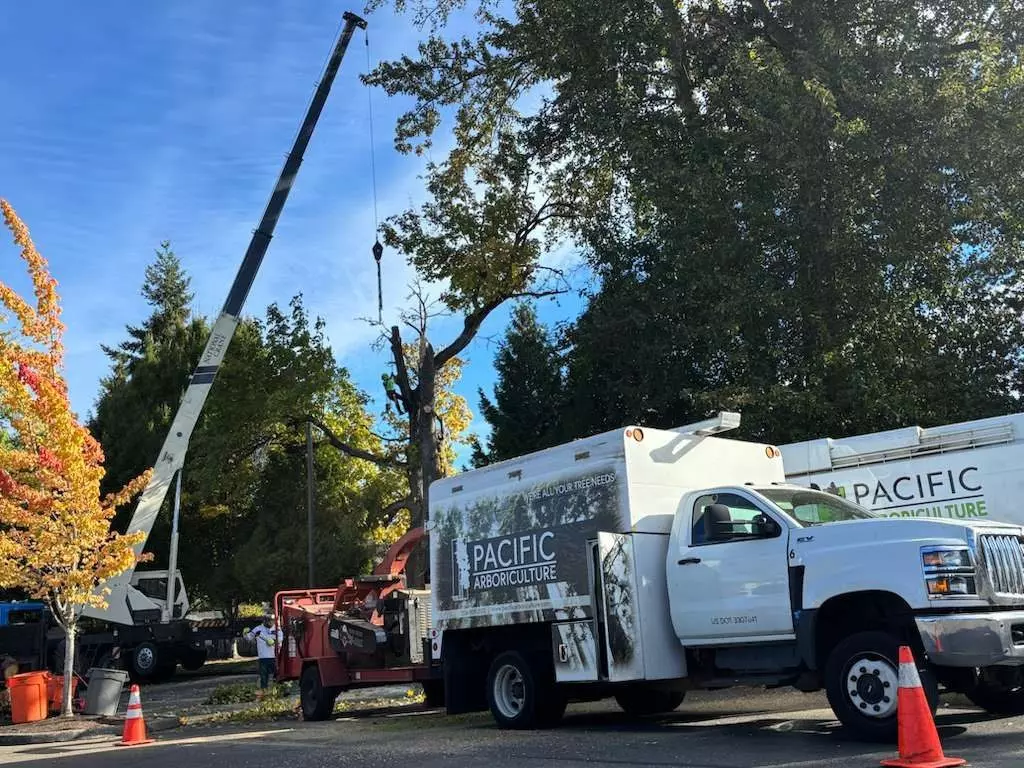
From towering Douglas firs to damaged deciduous trees, we handle full dismantling using ropes, climbers, or cranes when needed. We manage debris, haul-off, and leave your site clean.
We assess for signs of internal decay, root instability, or storm damage and remove the tree before it causes property damage or injury.
For trees in tight quarters or too risky to dismantle manually, our crane-certified operators safely lift and remove large sections without harming nearby structures.
Partial removals for storm damage, road clearance, or safety concerns.
Need the stump gone too? See stump grinding services.
We make the process simple and transparent from start to finish.
Contact us to schedule an on-site visit with one of our ISA Certified Arborists.
We assess the tree, your property, and your goals. If removal is needed, we explain why.
You’ll receive a no-obligation quote with details about equipment, timing, and cleanup.
Our team arrives as scheduled, performs the work safely, and removes all debris.
We confirm you’re satisfied before wrapping up the job.
Every city we work in regulates removal differently. Open the list below to see each city’s rule, linked to the jurisdiction’s own municipal code so you can verify it yourself.
| City | When a permit is typically required | Code |
|---|---|---|
| Auburn | Up to 6 trees per lot in any 12-month period may be removed without a clearing permit | ACC 15.74.050(A)(4) |
| Renton | A permit is required for more than 2 significant trees per calendar year, or any landmark tree (24″+) | RMC 4-4-130 |
| Burien | An annual allowance by lot size: 1 tree under 5,000 sq ft, up to 5 trees at 20,001 sq ft+ | BMC 19.26 |
| Federal Way | On a developed residential lot, trees up to 6″ DBH may be removed without city review | FWRC 19.120.030(9) |
| Kent | Retention rules apply to undeveloped property and new development, at 6″ diameter and above | KCC 15.08.240 |
| Maple Valley | Landmark trees (24″+) need a permit regardless of lot size; significant trees are 12″+ | MVMC 18.40.140 |
| Des Moines | Triggered by area cleared (2,000 sq ft), not tree count. Significant tree removal carries 3:1 replacement | DMMC 16.25 |
| Tacoma | No private-property removal permit unless the tree is in a regulated critical area | TMC 13.11 |
| Puyallup | Significant-tree rules (over 15″ DBH) do not apply to most single-family lots unless in a critical area | PMC 21.06 |
| Bonney Lake | A removal permit is required by default unless a listed exemption applies | BLMC 16.64.010(A) |
Summarised from each city’s adopted code as of August 2026. Codes change, and this table covers the common residential case only.
Three things change the answer regardless of the table. A tree in a critical area — wetland, stream buffer, or steep slope — is regulated almost everywhere, even when the same tree out front would not be. A landmark or exceptional tree, usually 24 to 30 inches depending on the city, needs review no matter your count. And most cities require replacement planting once you cross the threshold.
Genuinely hazardous trees are the exception — most codes let an imminently dangerous tree come down without waiting, though several cities want documentation afterward, which is where an arborist report comes in.
We check the current code for your address before quoting, and we will tell you if a permit is needed.
A straightforward residential removal typically takes 2 – 6 hours from set-up to final cleanup. Large hazard trees, crane-assisted removals, and storm-damaged trees may take a full day or longer.
If you need to remove trees near your home or other structures, Pacific Arboriculture can help. Our team has the expertise to safely remove trees near homes and other structures. We understand the intricacies of safely removing trees in tight spaces, so we take extra precautions to prevent damage to your property. Rest assured, our tree removal services prioritize safety and precision. Contact us for all your tree removal services around the Puget Sound area.
Yes, but the site is inspected for active nests before any cutting starts. If an active nest is found, the work is paused and rescheduled in accordance with the federal Migratory Bird Treaty Act.
Property protection is part of every job. Plywood, matting, and rigging keep the lawn, driveway, irrigation, and landscaping intact. The work area is walked with the homeowner before sign-off.
Pacific Arboriculture works across south King County and north Pierce County from our shop in Auburn. These are the 20 communities we serve and the ZIP codes they cover.
King County
Pierce County
Several of these communities share a ZIP code with a neighbor, so seeing the same number twice is normal. Puyallup includes South Hill, and the Tacoma list covers the Midland, Summit and Parkland areas. Not sure whether you are in range? Call (206) 909-2170 with your address and you will get a straight answer. City-by-city detail is on the areas we serve page.
Storm damage, a tree on a structure, or a failure blocking access — call and a crew is dispatched. Emergency work is quoted on its own hourly structure.
Every removal job is bid based on the specific tree, the site, and the access. The ranges below reflect typical residential removals across Auburn, Kent, Federal Way, Renton, Tacoma, Puyallup, and the surrounding South Puget Sound service area. Every quote from Pacific Arboriculture is free and includes debris haul-off.
| Tree Size | Diameter (DBH) | Typical Cost Range |
|---|---|---|
| Small | Under 30 ft, less than 12" | $500 – $1,000 |
| Medium | 30 – 60 ft, 12" – 24" | $800 – $2,000 |
| Large | 60 – 80 ft, 24" – 36" | $1,500 – $4,000 |
| Very Large / Hazard | 80 ft+, 36"+ | $3,000 – $10,000 |
Pricing shown is approximate. DBH = diameter at breast height (4.5 ft up the trunk). A $500 minimum applies to tree service work. Every quote depends on site access, work zone obstacles, the equipment required, any priority service scheduling, and the removal options you choose — stump grinding, firewood rounds left on site, or leaving a wildlife habitat snag. Debris haul-off is included on every tree removal. Emergency work is quoted on a separate hourly structure.
For a size-by-size breakdown, use the tree removal cost estimator.
Every certification number below links to that arborist’s credential record with the International Society of Arboriculture, so you can verify it before anyone sets foot on your property.
Washington L&I Contractor License PACIFA*813KG · WSDA Pesticide Applicator #109480 · $1M liability insured
Whether you’re dealing with a hazard, planning a renovation, or just want an expert’s opinion, we’re ready to help.
Call Us Now
Superior tree service from planting & pruning to removal & replacement.