Federal Way Tree Service & Certified Arborists

Pacific Arboriculture has cared for trees in Federal Way since 2019: tree removal, pruning and trimming, stump grinding, storm cleanup, and arborist reports for homes, HOAs, and commercial sites. Our yard is in Auburn’s 98001 ZIP code, which also covers part of Federal Way. Six ISA Certified Arborists are on the team, and one of them walks your property before any price is written. That visit also tells you where your lot stands under Federal Way’s tree-density rules.

ISA Certified ArboristsTRAQ Tree Risk AssessorsNCCCO Crane Operators BBB A+ Rated$1M Insured Washington L&I Contractor License PACIFA*813KG · Yard in Auburn 98001, covering every Federal Way neighborhood

Written quotes at no charge · Emergency line answered day and night
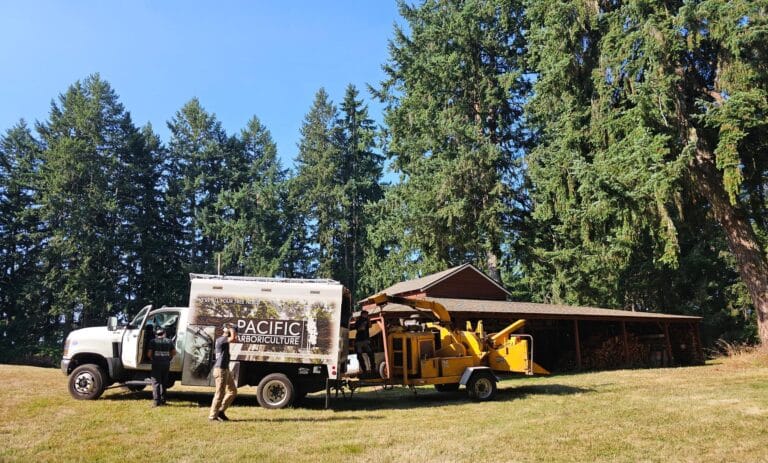
Pacific Arboriculture chip truck and wood chipper parked on a grass lot in front of a stand of tall Douglas-firs

What we do

Tree Services in Federal Way

Our own employees and equipment do all of this work. The links lead to the detailed pages.

Tree Removal

Plenty of Federal Way yards hold Douglas-firs far taller than the house beside them. With nowhere to lay one down, a climber rigs it and lowers it in pieces. Before a removal is booked we add up the tree units left on the lot, because Federal Way regulates by tree density, not by a yearly tree count.

Tree removal service

Tree Trimming & Pruning

We prune to the ANSI A300 standard: dead and broken limbs out, heavy ends shortened, branches lifted off roofs and sidewalks, hedges kept in shape. Federal Way’s code treats topping the same as tree removal, so for height or a view we reduce and thin the crown with proper cuts.

Tree pruning and trimming

Emergency & Storm Damage

A tree on the house, across the driveway, or a broken top left hanging: call at any hour and we send a crew. A tree down across a city street goes to Federal Way Public Works at (253) 835-2700, or 1-800-400-0749 after hours. Where wires are involved, call 911 and the power company first.

Emergency tree service

Stump Grinding

Stumps are ground 4–6 inches below grade, deeper where a new tree is going in. That comes up in Federal Way, because a removal that leaves a lot short on tree units has to be made up with replacement trees. A stump-only visit has a $250 minimum.

Stump grinding service

Crane-Assisted Removal

For lots that fall away toward the Sound, back yards boxed in by neighboring homes, and firs too compromised to climb. An NCCCO-certified operator sets up on the street or driveway and lifts the tree out in sections, so no heavy wood is roped down past the roof.

Crane-assisted tree removal

Plant Health Care

A thinning crown is not always a removal. We find the cause in the roots, soil, insects, or disease and treat what will respond, including trunk injections under WSDA applicator license #109480. A sound tree over 24 inches in diameter is also worth three tree units to a Federal Way lot.

Plant health care

Brush Clearing

Himalayan blackberry, Scotch broom, ivy, and volunteer saplings cut out, chipped, and hauled. On a developed single-family lot, Federal Way lets nuisance vegetation go without city review, but not inside a wetland, stream buffer, or hazard slope. We confirm how the ground is mapped first.

Commercial, HOA & Multifamily

Tree inventories, pruning cycles, and storm call-outs for HOAs, apartment communities, and retail and office sites. These lots do not get the single-family exemption: the city’s retention standard is 20 tree units per acre in the business and office zones the code lists and 30 in multifamily zones.

Commercial tree services · HOA and multifamily

Tree Removal Cost in Federal Way

Quotes are written after an arborist has stood under the tree, and that visit costs you nothing. The tree sets the price: height, trunk size, lean, how near the house and wires are, and whether a truck can reach it. A standalone tree service visit has a $500 minimum. See the tree removal cost page for typical ranges and an estimator. You hear at the start if replacement planting or a written report will be part of the job, and we offer financing and payment plans.


Arborist aloft in a pine inspecting branch unions during an aerial tree risk assessment
ISA Certified Arborists

Arborist Tree Inspections and Risk Assessments in Federal Way

Federal Way writes the arborist into its tree code. The city defines a hazard tree as one that, in the opinion of the city or an expert approved by the city, such as a certified arborist, poses an unreasonable risk of failure and a hazard to a permanent structure or a high-use outdoor area. On a developed single-family lot outside critical areas, a tree that fits that definition can be removed without city review.

So the inspection comes first. One of our ISA Certified Arborists checks the root flare, trunk, branch attachments, and canopy for decay, cracks, dead tops, and lifting soil, then recommends pruning, treatment, monitoring, or removal. The visit and the quote are free. Some findings need to be written down:

  • Hazard tree documentation. An arborist with the ISA Tree Risk Assessment Qualification (TRAQ) records the defect, the likelihood of failure, and what the tree would strike.
  • Critical-area vegetation plans. For hazard tree removal or limited view pruning inside a critical area or its buffer, Federal Way asks for a vegetation maintenance plan prepared by a certified arborist or registered landscape architect, showing each tree’s location, type, and size and any replacement planting.
  • Tree-unit counts and retention plans. For construction, short plats, and commercial sites, we inventory the trees, calculate tree units, and prepare the retention plan the city reviews with the permit.

Written reports are a paid service, separate from the free visit: from $400 for residential and right-of-way trees, from $800 for commercial and development work. A report documents the tree; the decision is the city’s, and no report can promise an approval.

More detail: certified arborist services · arborist reports · tree risk assessment · development arborist reports


Local conditions

Federal Way Trees, Terrain, and Neighborhoods

The City of Federal Way measures its tree canopy at 38 percent of the city, a figure that takes in yards, parks, stream corridors, wetlands, and street trees. A new canopy assessment is underway and will feed an Urban Forestry Plan, according to the city’s Trees in Federal Way page. Where a tree stands decides which rules reach it:

Marine Hills, Buenna, Adelaide, Lakota & Redondo

The west side looks out over Puget Sound, and view lots are common. The city’s Shoreline Master Program applies within 200 feet of the Sound, and erosion- and landslide-prone slopes are regulated as geologically hazardous areas. On those slopes, even pruning for a view calls for a vegetation maintenance plan.

Twin Lakes, West Campus & Dash Point

Established subdivisions where trees have had decades to grow into roofs, driveways, and each other. Twin Lakes is an HOA community, and covenants can carry tree rules of their own on top of the city’s. Dash Point State Park’s forest and beach sit at this corner of the city.

Steel Lake, Mirror Lake, North Lake & Lake Killarney

Lake neighborhoods on both sides of I-5. Steel Lake, North Lake, and part of Lake Killarney are state shorelines, so trees within 200 feet of the water answer to shoreline rules as well as the tree code. Narrow lots and soft ground mean most of this work is climbed and rigged by hand.

Kitts Corner, South Federal Way & the Hylebos

The West Fork of Hylebos Creek drains the central and southern parts of the city, and several tributaries meet at the 120-acre West Hylebos Wetlands. Wetland and stream buffers reach onto private lots, and trees inside them fall outside the single-family exemption.

The trees we are called about most in Federal Way are Douglas-fir, western redcedar, western hemlock, bigleaf maple, and red alder, with Pacific madrone on the slopes above the Sound and cherry and Japanese maple planted closer to the house.


Local regulations

Do You Need a Permit for Tree Work in Federal Way?

On a single-family lot with a house on it, often not. Federal Way’s tree code, FWRC 19.120, does not cap how many trees a homeowner removes in a year. It requires every lot to keep a minimum density of trees, counted in “tree units,” and it exempts many removals on developed single-family lots when three conditions are met. The city’s single-family tree handout (PDF) lays it out, and the Permit Center takes questions at 253-835-2607.

Single-Family Lots: Three Conditions

  • The tree is outside any critical area or buffer regulated under FWRC 19.145.
  • No development permit, such as a subdivision approval, required the tree to be kept.
  • Removing it will not change where stormwater or groundwater enters or leaves the property, or its quality or velocity.
  • When all three hold on a lot in the SE or RS zones with a dwelling, trees under 6 inches in diameter, hazard trees, and nuisance vegetation can be removed without city review.

Trees 6 Inches and Larger: Tree Units

  • These can be removed if the lot still holds at least 25 tree units per acre afterward. Diameter (DBH) is measured 4.5 feet above the ground.
  • Credit per existing tree: 1 unit up to 6 inches, 1.5 over 6 to 12, 2 over 12 to 18, 2.5 over 18 to 24, and 3 over 24 inches.
  • Example: a quarter-acre lot needs 6.25 units, and three firs over 24 inches supply 9.
  • If a removal takes the lot below the minimum, replacement trees must be planted.

When the City Must Approve It

  • Trees in critical areas and buffers: wetlands, streams and habitat areas, and geologically hazardous slopes.
  • Trees a past permit required to be retained, and removals that alter drainage.
  • Developed commercial and multifamily lots, and undeveloped lots, where removal without a development permit goes through Process III review.
  • Removing a tree without required approval carries a civil penalty of $1,000 per tree or up to the tree’s marketable value, plus restoration.

Street Trees and the Right-of-Way

  • The city and adjacent owners share right-of-way maintenance. Planter strips in residential neighborhoods belong to the adjacent owner.
  • Required clearance is 8 feet over sidewalks and 14 feet over the roadway. Abutting owners may prune without a permit.
  • Other vegetation work in the right-of-way needs a right-of-way permit under FWRC 4.35, removed vegetation has to be replaced, and topping a street tree is prohibited.

Power Lines: PSE and Tacoma Power

Puget Sound Energy (PSE) is the electric utility for most of Federal Way, and Tacoma Power serves a portion of the city, so check your bill. For a tree dangerously close to its overhead lines, PSE sends a PSE-certified arborist at no cost (PSE tree trimming FAQs). For the service line between pole and house, PSE performs a safety disconnection so a private crew can do the work; call 1-888-321-7779 at least five business days ahead. Pacific Arboriculture does not perform line clearance; we work on trees adjacent to lines. Keep clear of any downed wire and call 911.

Every lot is different and codes are amended. We check yours during the free site visit, and the city sources linked in this section have the final say.

Frequently Asked Questions About Tree Service in Federal Way

There is no flat Federal Way rate. An arborist prices each tree in person, at no charge, from its height and trunk size, its lean, equipment access, and what sits underneath. Stump grinding, a crane, or a written report are quoted as separate lines. Tree service booked as its own visit has a $500 minimum. Typical ranges are on the tree removal cost page, and financing and payment plans are available.

Often not, if the tree is on a single-family lot that has a house on it. Under FWRC 19.120.030, trees under 6 inches in diameter, hazard trees, and nuisance vegetation can be removed without city review when the tree is outside critical areas, was not required to be kept by a development permit, and its removal will not change drainage. Larger trees can come out as long as the lot keeps at least 25 tree units per acre. Critical areas, commercial and multifamily property, and undeveloped lots need city approval. The Federal Way Permit Center, 253-835-2607, confirms the answer for a specific address.

A tree unit is the credit Federal Way assigns each tree toward a lot’s required tree density. An existing tree up to 6 inches in diameter is worth 1 unit, over 6 to 12 inches 1.5, over 12 to 18 inches 2, over 18 to 24 inches 2.5, and over 24 inches 3. Single-family zones require 25 units per acre, or 6.25 on a quarter-acre lot. When a removal would leave the lot short, replacement trees make up the difference: a large-canopy species earns 1.5 units, a medium one 1, and a small one 0.5. We tally the units during the site visit.

On a developed single-family lot outside critical areas, yes. City code defines a hazard tree as one that, in the opinion of the city or an expert approved by the city such as a certified arborist, poses an unreasonable risk of failure and a hazard to a permanent structure or high-use outdoor area. Because the definition rests on that opinion, we put the assessment in writing and suggest a call to the Permit Center before cutting. Inside a critical area or its buffer, the city requires a vegetation maintenance plan from a certified arborist or registered landscape architect.

The work is shared. The City of Federal Way maintains most landscaping along major arterials, while planter strips in residential neighborhoods are the responsibility of the adjacent property owner. Branches have to clear sidewalks by 8 feet and the roadway by 14 feet. Abutting owners may prune without a permit. Removing or replacing a tree in the right-of-way needs a right-of-way permit, and topping a street tree is prohibited. The right-of-way permit desk is at 253-835-2725.

Yes. Call (206) 909-2170 at any hour, any day of the year. Our yard is in the 98001 ZIP code next to Federal Way, and trees on structures or blocking access go to the front of the schedule. If a wire is down or a tree is leaning on a line, call 911 and the utility first. A tree across a city street should be reported to Federal Way Public Works at (253) 835-2700, or 1-800-400-0749 after hours. City code exempts work needed immediately to head off an imminent threat to safety or property, a determination the city’s director makes, so photograph the tree before it is moved.

We work on trees adjacent to power lines. We do not perform line clearance, which is the utility’s work. Puget Sound Energy serves most of Federal Way and sends a PSE-certified arborist, at no cost, to look at a tree dangerously close to its overhead lines. For the service line between the pole and the house, PSE performs a safety disconnection so our crew can do the work; PSE asks for a call to 1-888-321-7779 at least five business days ahead. Addresses served by Tacoma Power should contact that utility instead.

Yes. Pacific Arboriculture has six ISA Certified Arborists on staff, and each certification number is published on this page with a link to the ISA’s own record. Team members also hold the ISA Tree Risk Assessment Qualification (TRAQ) and NCCCO crane operator certification. The company is a registered Washington contractor under L&I license PACIFA*813KG, holds WSDA applicator license #109480, and carries $1M in liability insurance. A certificate of insurance is sent on request.

The crew on your property

ISA Certified Arborists Serving Federal Way

Six members of our staff are ISA Certified Arborists. Their certification numbers are listed here, and each one opens the matching record on the International Society of Arboriculture’s verification site.

Ryan Seeley, ISA Certified Arborist at Pacific Arboriculture
Ryan Seeley
Founder & Owner
ISA PN-8096ATTRAQ · Climber Specialist · NCCCO
Tom Larson, ISA Certified Arborist at Pacific Arboriculture
Tom Larson
Crew Lead
ISA PN-373405A
Brandon Harber, ISA Certified Arborist at Pacific Arboriculture
Brandon Harber
Crew Lead
ISA PN-384451A
Brandon Danioth, ISA Certified Arborist at Pacific Arboriculture
Brandon Danioth
Training Manager
ISA PN-373406ATRAQ Qualified
Mitch Flannery, ISA Certified Arborist at Pacific Arboriculture
Mitch Flannery
Arborist Consultant
ISA PN-9076ATRAQ Qualified

Washington L&I Contractor License PACIFA*813KG · WSDA Pesticide Applicator #109480 · $1M liability insured

Where we work

Federal Way Service Area

We take jobs in all three Federal Way ZIP codes: 98003, 98023, and the Federal Way side of 98001, which is our own ZIP code. In neighborhood terms: Twin Lakes, West Campus, Marine Hills, Buenna, Adelaide, Lakota, Redondo, Mirror Lake, Steel Lake, Kitts Corner, and the North Lake and Lake Killarney area east of I-5.

Cities close to Federal Way that the same crews cover: Auburn, Des Moines, Kent, Tacoma, Fife, and Edgewood.

Also on our routes: Pacific · Sumner · Puyallup · Normandy Park · SeaTac · Burien · Tukwila · Renton · Covington. Every city is listed on the areas we serve page.
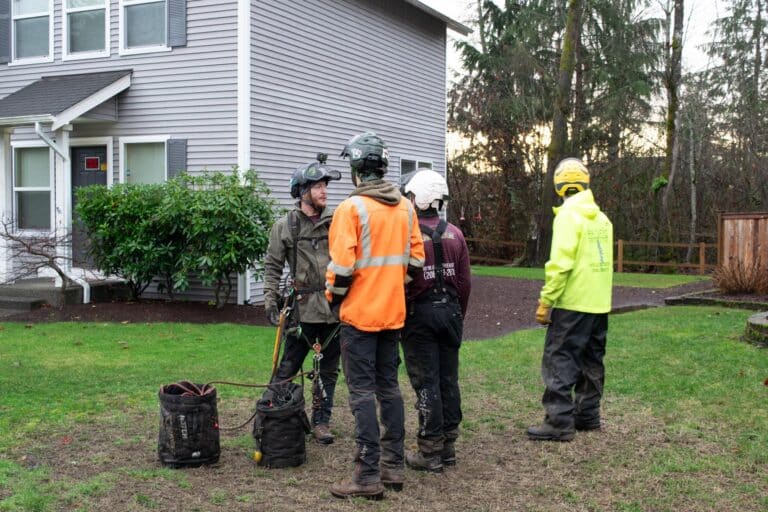
Pacific Arboriculture crew in helmets and high-visibility gear planning a job in a residential back yard

Get a Free Tree Quote in Federal Way

Send a few details online or call. An ISA Certified Arborist comes out, looks at the tree and the lot, counts tree units if a removal is on the table, and puts the price in writing.