A tree with brown leaves in July looks the same whether it is dying from heat, dying from drought, or dying from root rot buried three feet under the yard. Homeowners across Maple Valley, Tacoma, and Normandy Park often reach for the garden hose when the real problem needs a very different fix — sometimes less water, not more.
The three most common causes of summer leaf damage on PNW trees produce almost identical symptoms at a glance. Reading the differences correctly is the difference between saving a tree and killing it faster.
Heat Scorch: The Fast, Uniform Damage
Heat scorch happens when leaf tissue loses water faster than roots can replace it during hot, dry, windy weather. Damage appears within 48 to 72 hours of a heat event and follows a distinctive pattern.
Diagnostic markers:
- Damage appears on the sun-exposed side of the canopy first — often the south and west faces
- Leaf edges and tips brown uniformly, forming a “burnt cookie” ring around each leaf
- Interior and shaded leaves stay green
- Onset is sudden — days, not weeks
- Recovery is possible if the underlying tree is otherwise healthy
Heat scorch responds well to deep watering during the recovery window per the Arbor Day Foundation summer watering guidelines. Broadleaf trees like Japanese maple, dogwood, and hydrangea show it most; conifers can scorch but usually mask the damage in older interior needles.
Drought Stress: The Slow, Whole-Tree Decline
Drought stress is the cumulative effect of weeks or months of insufficient water. Unlike heat scorch, it does not appear overnight. It builds through summer and can take a full season to show clear symptoms.
Diagnostic markers:
- Wilting or drooping across the whole canopy, not just one side
- Premature fall color in July or August — yellow, orange, or red leaves months early
- Early leaf drop while leaves are still partly green
- Dieback progressing from branch tips inward
- Small or stunted new growth compared to previous years
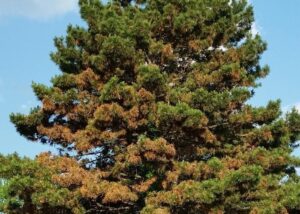
Conifers show drought stress differently. Cedars, hemlocks, and firs fade to a dull yellow-green, then to bronze, before dropping interior needles. See the drought stress on Western Washington conifers guide for species-specific patterns.

Root Disease: The Deceptive, Whole-Tree Killer
Root diseases — Armillaria root rot, Phytophthora root rot, and laminated root rot — attack the tree from underground. Above-ground symptoms often mimic drought stress but do not respond to watering, and the damage progresses steadily even in wet weather.
Diagnostic markers that separate root disease from drought:
- Symptoms persist or worsen after deep watering
- Damage may appear on one section of the canopy corresponding to specific damaged roots
- Small mushrooms or white mycelial fans at the root flare or trunk base (Armillaria)
- Bleeding cankers, sap oozing from lower trunk (Phytophthora)
- Wilting even in cool, wet weather
- Progressive decline over 1 to 3 years — the tree does not recover between seasons
Root disease requires diagnosis by an ISA Certified Arborist. Soil sampling and root-crown excavation are often necessary to confirm. Treatment options are limited — some root diseases can be managed with soil fungicides and cultural changes, but many require removal to prevent spread to nearby trees.
The Watering Trap
The most common homeowner mistake is treating every summer symptom with more water. This works for heat scorch and drought stress. It accelerates death from root disease, because saturated soil favors Phytophthora and Armillaria while suffocating the remaining healthy roots.
Before adding water, test the soil. Push a screwdriver 6 inches into the root zone. If it slides in easily, the soil is moist enough. If it stops abruptly, the soil is dry and watering is appropriate. If water pools on the surface for hours after irrigation, drainage is poor and root disease is more likely than drought.

When to Call an Arborist
Call for a professional diagnosis when:
- Symptoms cover more than 25 percent of the canopy
- Damage has persisted through two or more waterings
- Multiple trees in the same area show similar symptoms
- The tree is large enough that failure could damage property
- Mushrooms, cankers, or trunk bleeding are visible
The WSU Hortsense diagnostic key and Oregon State University Extension both maintain PNW-specific tree health references. For hands-on diagnosis, an on-site plant healthcare visit takes 30 to 45 minutes and rules out the most expensive misdiagnoses.
Frequently Asked Questions
Can a tree recover from heat scorch?
Yes, in most cases. Heat scorch damages existing leaves but does not usually kill the tree. Deep watering during recovery and light shade cloth on young trees speeds regrowth. Full canopy replacement takes one growing season for broadleaf trees. Repeated scorch events year over year signal deeper stress and warrant an arborist consultation.
How much water does a stressed tree actually need?
Mature trees benefit from a slow soak of 10 to 15 gallons per inch of trunk diameter, applied at the drip line rather than the trunk. This should be done every 7 to 10 days during summer drought, adjusting for rainfall. Watering more frequently but shallowly encourages weak surface roots and does not solve the underlying stress.
Are there tests homeowners can do to check for root disease?
The simplest test is soil-moisture inspection with a screwdriver or soil probe. If the soil is wet but the tree still wilts, root disease is likely. Look for mushrooms at the trunk base after fall rains, and check for dark, mushy roots when exposing the root flare. Positive identification requires laboratory culture from soil or root tissue samples.
Should I fertilize a stressed tree?
Do not fertilize during active stress. Nitrogen fertilizer pushes new growth that a struggling tree cannot support, deepening the decline. Wait until the tree shows signs of recovery — new healthy leaves, restored canopy density — before applying any fertility program. A slow-release organic amendment in fall is safer than a spring or summer fast-release synthetic.
Not sure which of the three is affecting a tree? Pacific Arboriculture’s ISA Certified Arborists provide on-site diagnosis for Maple Valley, Tacoma, and Normandy Park — book a plant healthcare visit before treating the wrong problem.