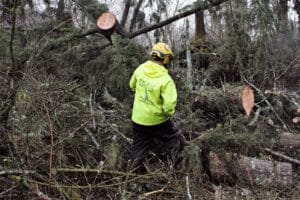

Western Washington’s run of dry summers has left a backlog of drought-killed and severely declining conifers on residential acreage across the South Sound — and many of them sit in places a traditional ground-felled removal can’t safely handle. Tall western red cedars over a home, half-dead Douglas-firs leaning toward a driveway, and snags rising over fence lines, septic fields, or close-packed neighborhoods all push the job from chainsaw-and-rigging territory into crane-assisted territory. For homeowners in Lake Tapps, Puyallup, and SeaTac watching previously healthy conifers brown out, the question is rarely whether the tree comes down. It’s how.
This guide walks through when drought-killed conifers cross the line into crane-removal territory, what the process actually looks like from an arborist’s perspective, and what property owners should expect when scheduling a crane-assisted tree removal in the Pacific Northwest.
Why Drought-Killed Conifers Are Riskier to Remove
A healthy mature Douglas-fir or western red cedar is a predictable rigging target — strong fiber, intact branches, known fall behavior. A drought-killed specimen of the same species is something different. As the tree dries from the top down, internal wood structure changes in ways that matter on removal day:
• Brittle wood fiber. Dead conifer wood snaps unpredictably under rigging loads instead of bending. Standard climbing and lowering techniques that assume green wood behavior raise risk on a snag.
• Hollow zones and cavities. Drought-stressed cedars and hemlocks invite secondary decay fungi and bark beetle galleries. Cavity progression is often invisible from the ground but becomes obvious on a climber rope.
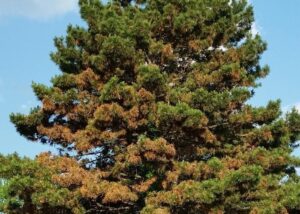
• Top dieback and dead leaders. The characteristic coppery flagging on a dying western red cedar is exactly the part of the tree a climber would normally tie into. When that wood is no longer trustworthy, anchor options narrow fast.
• Bark sloughing. Bark separation in dead conifers makes spur-climbing dangerous and requires alternative access — usually a bucket truck or, when reach and weight demand it, a crane.
According to Washington DNR: Forest Health Highlights, the rate of mature western red cedar dieback across western Washington has accelerated since 2015 — and the trees that die in place often sit close to homes that were built into formerly forested lots.

When a Crane Becomes the Right Tool
Not every dead conifer needs a crane. Plenty of drought-killed trees on open acreage come down with rope-and-chainsaw techniques performed by an ISA Certified Arborist. The decision turns on five overlapping factors that an arborist evaluates during the bid visit:
1. Strike Zone Around the Tree
If the tree’s full height could land on a house, garage, shop, septic field, neighbor’s structure, or main service line, controlled rigging gets expensive and slow. A crane removes the question — pieces are lifted clear and set down in a designated drop zone, regardless of where the tree would naturally fall.
2. Tree Condition
A snag with significant top dieback, hollow main stem, or visible cracking is often unsafe to climb. The same is true for cedars with advanced top flagging. Putting a climber on a structurally compromised stem when the alternative is a crane pick is a risk calculus most professional outfits won’t make. OSHA: Tree Care Operations covers the federal safety guidance most reputable crews train against, including criteria for declining a climb on a structurally compromised stem.
3. Property Access
Crane work needs a setup pad — generally pavement, gravel, or stable ground within reach of the tree. Steep driveways, soft lawns over irrigation lines, and tight residential streets all factor into whether a crane can be staged and what size unit is needed. The bid visit usually includes a quick reach measurement and turning-radius check.
4. Tree Weight and Reach
Mature western red cedar, Douglas-fir, and grand fir in the South Sound regularly hit 80–140 feet tall with single sections weighing 1,500–5,000 pounds. Pick weights and distances drive the choice between a smaller boom truck and a larger lattice or hydraulic crane. The WSU Extension: Pierce County conifer guides include species-level size and growth-rate references useful for estimating pick weights on local trees.
5. Schedule and Soil Sensitivity
A crane-assisted job that takes one full day can replace a multi-day rope-rigging operation. For homeowners with limited driveway access or sensitive landscape, the shorter footprint can be the deciding factor. The trade-off is the day-of staging — utility locates, crane setup pad, and clear airspace overhead.
What a Crane-Assisted Removal Looks Like in Practice
For homeowners who have never seen a crane removal up close, the process can look more controlled than expected. The high-risk moments are managed deliberately, and most of the day looks like staged, methodical lifts. A typical sequence on a drought-killed western red cedar:
Pre-Work and Locates
Utility locates are called 2–3 business days ahead through Call Before You Dig (811) so underground gas, water, and communication lines are marked. Overhead utility coordination is handled separately — for primary power lines near the tree, the utility may need to de-energize or shroud the line.
Crane Setup
The crane is staged on its planned pad, outriggers deployed, and matting laid where the lawn or driveway needs protection. A site walk confirms drop zone clearance and worker positions.
Top Section Pick
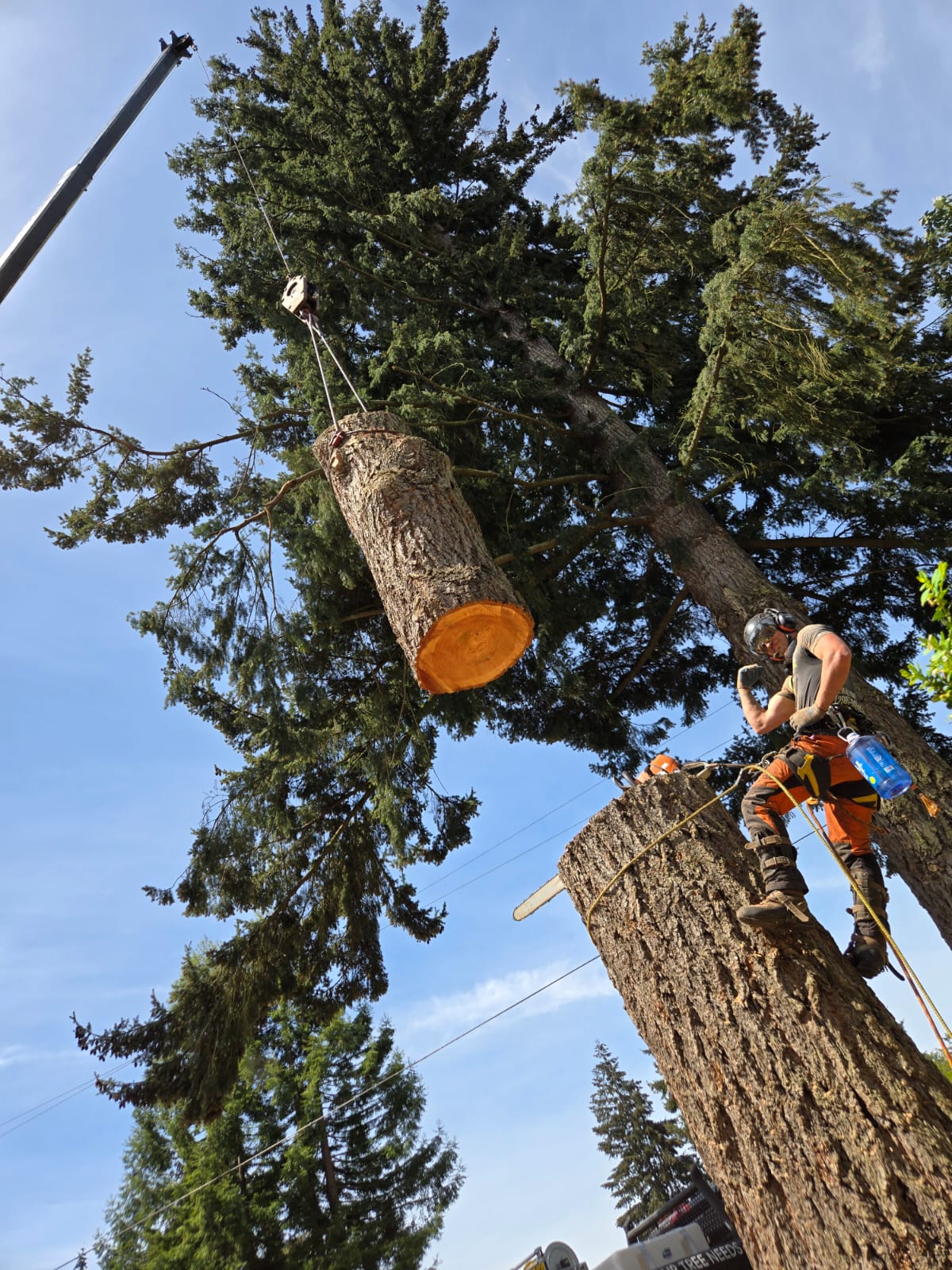
A climber accesses the upper trunk where wood is still sound — often using rigging points well below the dead top. The climber attaches the crane line to the section, makes the cut, and the crane lifts the piece clear of the strike zone before swinging it to the drop area. A ground crew receives, cuts down, and stages the wood.
Successive Picks Down the Stem
The process repeats — the crane lifts each section, the climber descends to the next cut, and the tree comes down in lifts rather than fall paths. On large conifers this often runs 6–12 picks depending on stem diameter and pick weights.
Stump and Cleanup
Stump grinding is usually a follow-up service rather than the same-day job, especially when access is shared with the crane setup. Chip removal, log staging, and final site clean run the rest of the day. Many homeowners opt for additional tree pruning on nearby specimens while the crew is on-site.
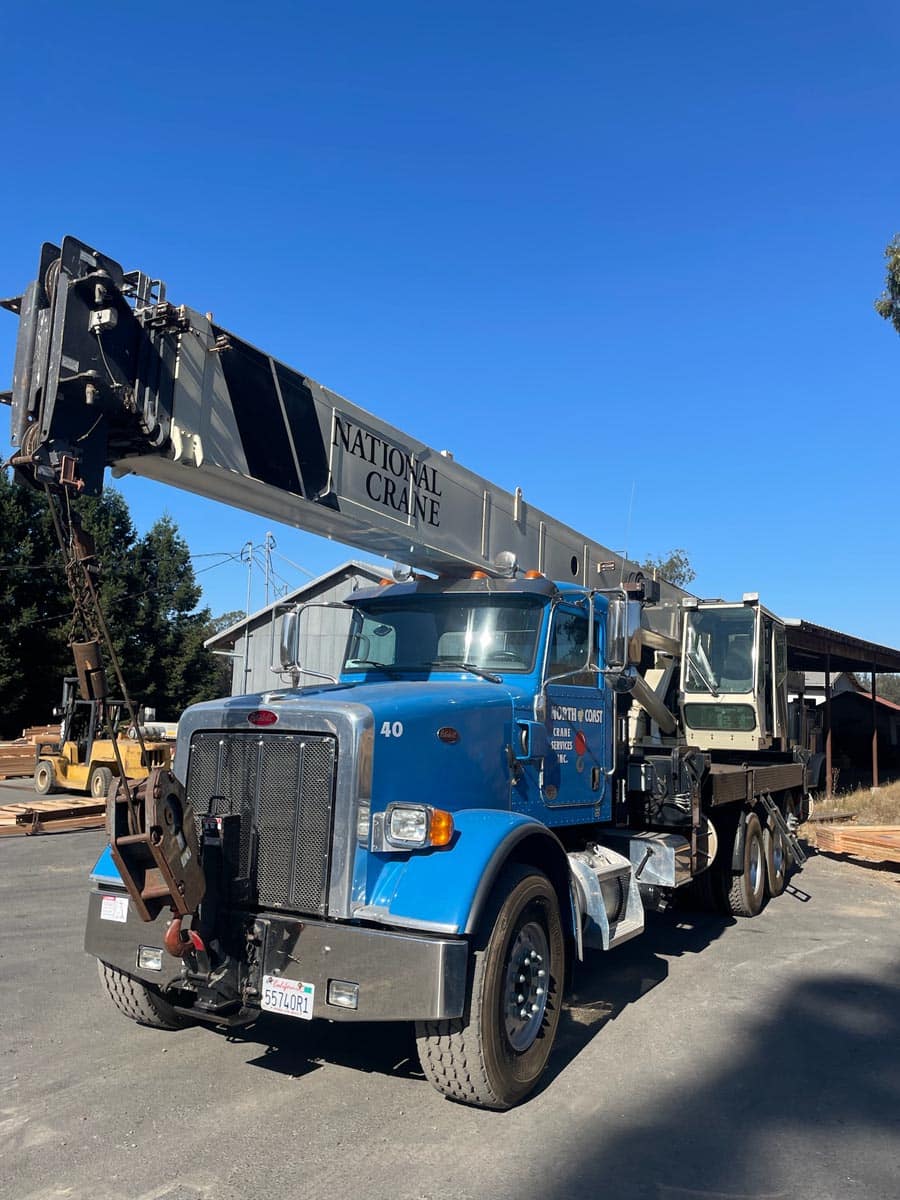
Common South Sound Scenarios
Western Red Cedar Over a House
The most common drought-killed crane job in the region. Mature cedars planted within 20–30 feet of homes in the 1980s and 90s are exactly the cohort showing top dieback now. Removal almost always goes crane-assisted because the strike zone covers the structure.
Douglas-Fir Snags on Wooded Acreage
Properties in Maple Valley, Covington, and Lake Tapps often have multiple snags interior to the lot. Some can be felled traditionally; others sit near outbuildings, septic, or trails and need the lift. Combining several picks across one crane setup spreads the staging cost.
Hemlock Decline Near Hazard Targets
Western hemlocks exposed to full sun after neighboring tree loss often die back rapidly. When they sit over a play area, driveway, or workshop, the crane decision is usually clear.
Storm-Damaged Multi-Stem Conifers
After a wind event, drought-weakened conifers often fail partially — one stem down, another hung up in the canopy. These hung-up removals are some of the most dangerous in the field and routinely go crane-assisted under storm damage and emergency tree response calls.
What Property Owners Should Ask During the Bid
A few questions surface the difference between a contractor who treats crane removal as routine and one who is treating it as a one-off. Homeowners arranging a quote should expect direct answers on:
• ISA certification of the arborist on-site — not just the company. The International Society of Arboriculture: Credential Overview details what each certification covers.
• Insurance certificates — general liability and Washington L&I workers’ compensation, with a current certificate available before work begins.
• Crane operator certification — typically NCCCO or equivalent for the operator.
• Drop zone and matting plan — what gets protected, where wood and chip land, and how lawn or driveway damage is addressed.
• Stump and debris disposition — whether the bid includes stump grinding, log removal, or wood left for the homeowner.
A written arborist report is often part of the bid package on hazard trees — useful documentation for insurance, neighbor notification, and homeowner records. Tree Care Industry Association: Hiring an Arborist covers what to expect from a professional bid.
When Removal Beats Watch-and-Wait
Not every drought-stressed conifer needs to come down. Trees with limited top dieback, sound stem condition, and supportive site improvements (deep watering, mulch, no compaction) often stabilize over a season or two. The crane conversation moves to the front when one or more of these is true:
• Top dieback covers more than 25–30% of the canopy.
• Cavities, cracks, or significant resin bleeding are visible on the main stem.
• Bark sloughing has progressed beyond a few small patches.
• The tree sits within striking distance of a structure or high-occupancy area.
• Repeat windstorms have produced limb shedding from the canopy.
Pacific Arboriculture serves homeowners across Lake Tapps, Puyallup, and SeaTac — and the broader South Sound including Kent, Auburn, Tacoma, Renton, Federal Way, Maple Valley, Covington, and Edgewood — with crane-assisted removals performed by ISA Certified Arborists who specialize in hazard tree work on drought-killed conifers.
The Bottom Line
Drought has reshaped the conifer removal picture in the South Sound. Trees that would have come down with a chainsaw and rigging a decade ago increasingly require a crane because the wood is too brittle, the structure is too compromised, or the strike zone too tight. For homeowners watching a cedar or fir browning out near a house, the next step isn’t a panic call — it’s a planned tree removal assessment, ideally before the next windstorm or snow event makes the decision for them.
Frequently Asked Questions
How does a crane-assisted removal differ from traditional tree removal?
Traditional removal relies on a climber rigging sections down with ropes and lowering devices. Crane-assisted removal uses a crane to lift each section clear of obstacles and set it in a designated drop zone. The crane approach is typically faster, generally safer on structurally compromised trees, and reduces ground disturbance — at the cost of crane staging and a higher day rate.
Do I need a permit to remove a drought-killed tree in the South Sound?
Tree ordinances vary by city. Some South Sound municipalities require a permit for removal of significant trees on residential lots, with exemptions for hazard trees documented by an ISA Certified Arborist. Checking the city’s tree code before scheduling the work is the safe move — most reputable companies will help homeowners navigate the application.
Is a crane removal more expensive than rope-and-rigging?
Day rate is higher because of the crane and operator, but total cost is often comparable or lower because the job takes far less time, requires fewer personnel-hours, and reduces collateral risk to property. The honest answer depends on access, tree size, and what’s in the strike zone — a proper bid visit is the only way to get a real number.
Can the crane lift the entire tree at once?
Almost never on a mature conifer. The picks are sectional — the climber makes a cut at a pre-rigged point, the crane lifts that section clear, and the process repeats down the stem. Whole-tree picks happen on smaller specimens or in tight pruning operations, not large-scale removals.
What happens to the stump after a crane removal?
Stump grinding is usually a follow-up service. On the day of the crane removal, the stump is typically cut as low as access allows. A grinder visit a few days or weeks later reduces the stump below grade. Some homeowners leave the stump intact if it doesn’t interfere with landscaping plans.