Across Western Washington, summer means more than warm afternoons and dry lawns. It means stressed conifers. And stressed conifers attract one of the most damaging tree pests in the Pacific Northwest: bark beetles. From Douglas-firs in Fife backyards to western hemlocks in Pacific greenbelts and Sitka spruces along the Lake Tapps shoreline, the same pattern keeps showing up on arborist site visits — pitch tubes oozing on the trunk, fading needles in the upper crown, and tiny exit holes that look like buckshot. Pacific Arboriculture serves homeowners across Fife, Pacific, and Lake Tapps, and bark beetle activity in those neighborhoods has climbed every summer since the drought stretches of recent years.
This guide explains what bark beetle treatment actually involves in Western Washington — what genuinely works, what doesn’t, and how an ISA Certified Arborist approaches an infestation that has often been underway for months before the first homeowner-visible symptom appears. The goal is to give South Sound property owners enough field-tested information to act quickly when bark beetles arrive, and to know when a tree can be saved versus when removal is the safer call.

What Bark Beetles Are (and Which Species Matter in Western Washington)
“Bark beetle” is not one insect. It’s a family — Scolytinae — and Western Washington hosts more than a dozen species that attack native and landscape conifers. Most are tiny (2–7 mm), brown to black, and spend the majority of their life cycle inside the tree, tunneling through the cambium layer just under the bark. By the time external symptoms appear, the colony has often already girdled significant portions of the trunk or branches.
For South Sound homeowners, the bark beetles that show up most often during arborist inspections fall into four practical groups:
Douglas-fir Beetle (Dendroctonus pseudotsugae)
The most economically important bark beetle on Douglas-fir across the Pacific Northwest. Attacks large, mature Douglas-firs weakened by drought, root disturbance, or recent storm damage. Look for reddish-brown boring dust at the base of the trunk and pitch tubes in the lower bole. Once a tree is mass-attacked, mortality is near-certain.
Ips Engraver Beetles (Ips spp.)
A complex of species attacking pine, spruce, and occasionally hemlock. Ips beetles are notorious for exploding in numbers when drought-killed branches or recently downed conifers are left on a property. They breed in the slash, then move into healthy living trees. The galleries underneath the bark look like engraved Y- or H-shaped channels — hence the name.
Western Pine Beetle and Mountain Pine Beetle
More common in eastern Washington forests, but Western Washington landscape pines — Austrian, ponderosa, Scots — can be hit during prolonged drought summers. Pitch tubes on the trunk are the classic sign.
Hemlock and Cedar Bark Beetles
Several smaller species attack western hemlock and western red cedar, usually as secondary invaders on trees already stressed by laminated root rot, drought, or construction injury. These beetles rarely kill a healthy tree on their own, but they finish off trees the property owner was hoping to save.
Why Western Washington Bark Beetle Pressure Has Climbed
Bark beetles have always been present in PNW forests. What’s changed is the host pool. Repeated drought summers, hotter average temperatures, and large windstorms have produced more stressed and downed conifers across King, Pierce, and South King County — which is exactly the fuel beetle populations need to build past background levels.
Drought is the single biggest driver. A well-hydrated conifer pushes resin out through any beetle attack site, drowning the invaders before they can establish a gallery. A drought-stressed conifer cannot mount that defense — resin pressure drops, the beetle gets in, releases a pheromone, and recruits hundreds more beetles to mass-attack the same tree. This is why bark beetle outbreaks track summer drought patterns so closely. Drought stress on conifers is the gateway problem, and bark beetle attack is often the killing blow.
The same pattern shows up on properties in Auburn, Sumner, and Puyallup where homeowners noticed thinning crowns last summer and then saw rapid decline this spring. Bark beetle activity was almost always the second-stage damage that pushed the tree past recovery.

Field Signs: How to Tell If a Tree Has Bark Beetles
Bark beetle symptoms unfold in a predictable sequence. The earlier a homeowner spots them, the more options remain on the table.
Pitch Tubes
Small popcorn-sized blobs of resin on the bark, usually pink, white, or reddish-brown. These mark active beetle entry points. On Douglas-fir they cluster in the lower trunk; on pines they appear higher up. Pitch tubes that are clear or still wet indicate ongoing activity. Old, dry pitch tubes mean the attack happened earlier in the season.
Boring Dust (Frass)
Fine sawdust-like material in bark crevices, in spider webs on the trunk, or piled at the base of the tree. This is one of the earliest reliable symptoms — sometimes visible before any color change in the crown.
Crown Fade
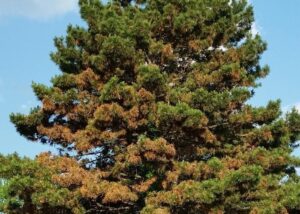
Needles change from green to yellow-green to red-brown, usually from the top down. By the time more than 30% of the crown has faded, the tree is generally not recoverable. This is the late-stage signal, not the early-warning signal.
Exit Holes
Round holes 1–3 mm wide, often described as looking like buckshot. These appear after the new generation of beetles emerges — meaning the tree has already supported a full reproductive cycle and may be releasing beetles to attack neighboring conifers.
Bark Slipping and Galleries
Loose bark that pulls away easily, exposing engraved tunnels in the wood beneath. This is the definitive diagnostic — but it’s also a sign the tree’s cambium is gone in that area and the upper crown is on borrowed time.
Bark Beetle Treatments That Actually Work
Treatment options depend on whether the tree is currently being attacked, has been attacked but is still mostly green, or is being protected against future attack. There is no single product that fits all three situations.
Preventive Bark Sprays (For High-Value, Uninfested Trees)
For specimen conifers that are not yet infested but stand within striking distance of a known outbreak — for example, a mature Douglas-fir near a recently bark-beetle-killed neighbor tree — an ISA Certified Arborist may recommend a preventive trunk spray with a registered residual insecticide. USDA Forest Service guidance and Washington State University Extension generally point to preventive trunk sprays applied before beetle flight begins in late spring or early summer. These sprays prevent landing beetles from establishing a gallery — they do not cure an existing infestation. Timing matters enormously: a spray applied after the beetles are already inside the tree does nothing.
Systemic Trunk Injections
For specific high-value trees, systemic trunk injections can provide several seasons of protection. Trunk injection is most useful on landscape specimens worth the investment — a heritage Douglas-fir near the house, a mature pine framing a property entrance, an Atlas cedar that’s been part of the yard for 50 years. Pacific Arboriculture evaluates each tree individually and only recommends injection where the tree’s structural condition, age, and value justify the cost. Plant healthcare program planning covers when injection makes sense and when it doesn’t.
Removing Brood Trees Promptly
The single most effective bark beetle “treatment” is sanitation. Any conifer already mass-attacked and showing crown fade or active emerging beetles needs to come down and be properly disposed of before the new generation flies. Cutting an infested tree but leaving the trunk on-site does nothing — the beetles will emerge from the felled wood and attack neighboring trees. Brood wood must be removed, chipped to a size smaller than 1 inch, debarked, or buried. Tree removal performed for bark beetle sanitation has to include the disposal plan, not just the cutting.
Removing Slash, Downed Conifers, and Stressed Branches
Bark beetles breed in dead and dying conifer wood. Storm-downed Douglas-firs, drought-killed branches, and freshly cut conifer rounds left stacked on the property all serve as breeding sites. Removing these promptly — within weeks of falling, not seasons — keeps beetle populations from building. This is one of the most powerful preventive measures a homeowner can take on a wooded lot in Maple Valley, Covington, or Renton.
Improving Tree Vigor
A well-watered, well-mulched conifer can usually defend itself against background bark beetle pressure. Supplemental summer irrigation during drought stretches, proper mulching (no volcanoes), and avoiding root disturbance around mature conifers all reduce attack risk. This is slow, unsexy work — but over multiple seasons it shifts the odds.
Bark Beetle “Treatments” That Don’t Work
Several treatments get suggested online or by less-experienced contractors that have no scientific support and no place in a Pacific Northwest bark beetle management plan.
Generic Foliar Sprays on the Crown
Spraying the needles with insecticide does nothing against bark beetles. The beetles are inside the trunk, protected by bark and resin. Foliar sprays cannot reach them and are not registered for bark beetle control.
Soil Drenches
Soil drenches work against some sap-feeding pests like aphids and lace bugs, but research has consistently shown they are not effective against bark beetles. The active ingredient does not translocate to the cambium layer at concentrations high enough to kill beetles burrowing in the bark.
Painting or Wrapping Trunks
White-painting trunks or wrapping with tree wrap does not deter bark beetles. These methods are sometimes useful for sunscald protection on young thin-barked trees, but they do nothing for bark beetle attack.
“Cutting Out” the Infested Area
Carving infested bark off a living tree to expose the galleries underneath is not a recognized treatment. By the time galleries are visible, the cambium under that bark is already dead, and the wounding makes the tree more attractive to future attack.
Anti-Aggregation Pheromone Pouches (For Homeowners)
Verbenone pouches and other anti-aggregation pheromones can work in forest-management contexts to disrupt beetle attacks on specific high-value trees, but the application is sensitive to placement, beetle species, and timing. They are not a homeowner DIY product. A certified arborist should specify whether and how to deploy them.

When a Bark-Beetle-Infested Tree Becomes a Hazard Tree
A bark beetle infestation doesn’t just kill the tree — it creates a structural hazard that develops faster than most homeowners realize. Beetle-killed conifers lose moisture and structural integrity in the upper trunk within 12–24 months. Limbs and tops snap off in normal wind. Whole-tree failures become possible during the next significant storm event.
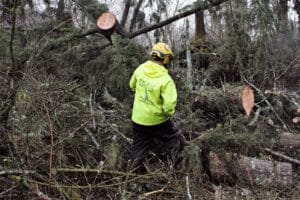
When a beetle-killed Douglas-fir or pine stands within striking distance of a house, driveway, power line, or play area, it crosses the line from a plant health problem into a hazard tree assessment issue. This is when removal moves from optional to time-sensitive. Crane-assisted removal of brittle drought-killed conifers near structures is common across the South Sound — it’s the safest way to take down a tree whose upper trunk can no longer be trusted to hold a climber.
What to Do If You Suspect Bark Beetles on Your Property
The sequence matters. Treatment decisions made in the wrong order waste time and often waste money. A practical homeowner approach looks like this:
1. Don’t Panic, Document
Photograph the trunk at the level where pitch tubes or boring dust appear. Note the species (if known), trunk diameter, and proximity to structures or other conifers. This documentation accelerates the arborist visit and helps confirm bark beetle versus other trunk-boring insects.
2. Schedule a Site Visit With an ISA Certified Arborist
Bark beetle identification, severity assessment, and treatment recommendations are not a DIY decision. The wrong species ID leads to the wrong treatment. An on-site visit confirms the beetle, evaluates the tree’s structural condition, and produces a written recommendation. Pacific Arboriculture’s arborist consultations and reports cover this exact workflow.
3. Act Within the Beetle Life Cycle Window
Timing is everything with bark beetles. Preventive sprays must go on before flight; sanitation removals must happen before new beetles emerge; injections must be timed against the species’ active period. A delay of a few weeks can mean missing the only treatment window of the season.
4. Coordinate With Neighbors If Multiple Trees Are Affected
Bark beetles don’t respect property lines. If a beetle-killed conifer stands on an adjacent property and is releasing brood, treatment of trees on the original property is short-lived. Open conversations with neighbors — and in HOA-managed neighborhoods, with the HOA board — accelerate the larger-scale response that’s often necessary.
South Sound Service Area Coverage
Pacific Arboriculture provides bark beetle assessment, treatment recommendations, sanitation removal, and ongoing plant healthcare across the 21-city South King and Pierce County service area: Auburn, Kent, Federal Way, Renton, Tacoma, Puyallup, Edgewood, Sumner, Pacific, Fife, Lake Tapps, Bonney Lake, Maple Valley, Covington, Des Moines, Burien, Tukwila, SeaTac, Fairwood, and Normandy Park. Conifer health and bark beetle pressure vary by neighborhood — older Douglas-fir stands in Burien face different pressure than the pine landscapes of Lake Tapps or the mixed conifer-deciduous yards of Maple Valley. Local diagnosis matters.
FAQ: Bark Beetle Treatment in Western Washington
Can a bark-beetle-infested tree be saved?
It depends on infestation stage and species. A tree caught very early — boring dust visible but no crown fade — sometimes responds to a combination of trunk injection, vigor restoration, and removal of nearby brood wood. Once more than about 30% of the crown has faded or the beetles have completed a full reproductive cycle in the tree, removal is almost always the right call.
Do I need to remove a dead beetle-killed tree right away?
If the tree is within striking distance of a structure, driveway, power line, or recreational area, yes — beetle-killed conifers become structurally unreliable quickly. If the tree is in an open area away from targets, removal can sometimes be scheduled around the next beetle emergence window so the brood wood is handled at the same time.
How much does bark beetle treatment cost?
Costs vary by tree size, treatment method, and access. A preventive bark spray on a single specimen Douglas-fir is on the low end. Systemic trunk injection on a large heritage conifer is higher. Sanitation removal of a beetle-killed Douglas-fir near a house — particularly one needing crane access — is the highest-cost intervention. An on-site arborist visit produces the actual numbers.
Are bark beetles dangerous to humans or pets?
No. Bark beetles do not bite humans or pets and do not infest structures the way termites or carpenter ants do. The danger is structural — beetle-killed trees fail unpredictably.
Can homeowners apply bark beetle pesticides themselves?
Some over-the-counter products are labeled for bark beetle prevention on individual trees, but proper application requires correct timing, correct species ID, full-trunk coverage on large conifers, and adherence to Washington State Department of Agriculture pesticide rules. Most homeowners are better served by a licensed L&I-registered, ISA Certified Arborist who can verify the diagnosis, choose the correct product, and apply it safely.
Bark Beetle Pressure Is Now a Regular South Sound Issue
A decade ago, bark beetles were primarily a concern for forest managers and eastern Washington property owners. Repeated drought summers have changed that. Today, bark beetle infestations show up regularly on Western Washington residential and commercial properties, often as the final stage in a longer decline that started with drought stress, root disturbance, or storm damage. Catching the problem early — at the pitch-tube and boring-dust stage, not the crown-fade stage — is the difference between treatment and removal. Pacific Arboriculture’s arborist consultations are the starting point for any South Sound property owner who suspects bark beetle activity on a valuable conifer.
WSU Extension: Tree Pest Management Resources
WSU Hortsense: Bark Beetles on Trees and Shrubs
Washington DNR: Forest Health and Resiliency Program
Tree Care Industry Association (TCIA)
International Society of Arboriculture (ISA)