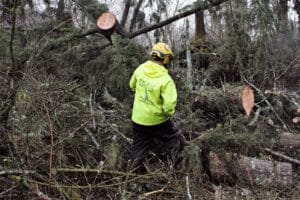

Summer in western Washington brings a deceptively quiet stretch — leaves are full, canopies look healthy from the curb, and the windstorms that took down trees last November feel like a long way off. But June is exactly when the trees most likely to fail this year are already showing the warning signs, and it is the smartest window for a hazard tree assessment before the first dry-air windstorm or wildfire smoke event of the season. For property owners in Kent, Tukwila, and Renton with mature conifers and large hardwoods around the house, a pre-summer walkthrough by an ISA Certified Arborist is often the difference between a $400 inspection and a $40,000 emergency.
This guide explains what a professional hazard tree assessment actually involves, the structural and biological signals an arborist looks for, and why timing the walkthrough now — before summer storms and fire-weather concerns peak — beats reacting after the fact.
What “Hazard Tree” Actually Means
A hazard tree, in the language an arborist uses, is a tree with a structural defect or biological condition that creates a credible likelihood of failure, combined with a target — a house, garage, driveway, play area, road, or other place people and property regularly occupy. Both factors have to be present. A 100-foot Douglas-fir leaning over open pasture is a curiosity. The same tree leaning over a kitchen window is a hazard.
Professional arborists evaluate hazard using a structured framework built around three components: likelihood of failure, likelihood of impact, and consequences of impact. International Society of Arboriculture publishes the Tree Risk Assessment Qualification (TRAQ) standard that most credible PNW arborists work against, and the framework is what separates a documented hazard report from a guess.

Why June Is the Right Window
Late spring through early summer is the highest-value window for a hazard tree assessment in western Washington for several overlapping reasons:
• Foliage is fully out. Crown thinning, dead branches, and dieback are clearly visible against full surrounding canopy. The same tree in February shows nothing diagnostic.
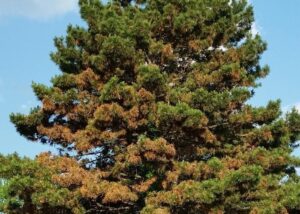
• Drought stress is already expressing. Conifers and hardwoods that struggled through last summer show their symptoms now — top dieback, premature cone or seed production, interior browning. These are the trees most likely to fail in the next windstorm or fire-weather event.
• Schedule capacity is favorable. The arborist calendar gets compressed once storm season returns. June bookings get done thoroughly; November bookings often have to compete with emergency response calls.
• Mitigation work can be planned, not panicked. A hazard identified now can be addressed with a planned tree pruning, structural support installation, or tree removal on a schedule that fits the property — not the day after a limb comes through the roof.
The Structural Defects an Arborist Looks For
A formal hazard assessment walks the property and evaluates each significant tree for specific failure modes. The patterns below come up consistently in South Sound assessments — and most are invisible to a homeowner walking past the same tree every day.
Co-Dominant Stems with Included Bark
When a tree splits into two competing leaders that grow tightly against each other, bark gets trapped in the joint rather than fusing into wood. The union looks tight but is structurally weak — a classic failure mode in big-leaf maples and red alders across the region. A V-shaped crotch with bark in the seam is a textbook hazard.
Decay Cavities and Open Wounds
Old pruning cuts, mower wounds, and storm damage create entry points for decay fungi. Cavities in the main stem of a mature tree reduce load-bearing wood. An arborist with a sounding mallet can identify hollow zones that look fine externally but compromise the trunk significantly.
Lean Without Reaction Wood
Some leaning trees are stable — they grew at an angle and built compensatory reaction wood that supports the lean. A new lean, by contrast, often shows soil heaving on one side of the root plate and is a strong predictor of root failure. An arborist evaluates lean direction, root flare exposure, and recent ground movement together.
Root Plate and Soil Issues
Roots compromised by trenching, grading, root rot pathogens like Armillaria, or soil compaction lose their ability to anchor the tree. Surface signs include exposed roots without flare, fungal conks at the soil line, and shallow surface roots radiating in unusual patterns.
Crown Defects
Dead branches over targets, large limbs with reduced taper (long and thin), and crown asymmetry that loads one side disproportionately all factor into the assessment. Crown defects on Tukwila and Renton properties with mature Norway maples, big-leaf maples, and tall conifers near homes come up routinely.
Biological Conditions That Raise Risk
Drought Stress and Top Dieback
Drought-stressed conifers and hardwoods often fail in storms that healthy trees of the same species ride out. Top dieback on western red cedar, brittle wood in dying Douglas-firs, and crown thinning in maples are the most common findings on summer assessments. The combination of dead wood overhead and an active windstorm is the high-risk scenario. WSU Extension: Drought Effects on Trees documents how moisture deficit cascades into structural failure risk over the following 12–24 months.
Wood-Decay Fungi
Bracket fungi at the base of a tree, conks emerging from cavities, and white-rot at pruning wound sites all indicate active decay. Washington DNR: Forest Health Tracker maps active pest and pathogen outbreaks across the state — useful context for what regional pressures are elevated this year.
Bark Beetle and Borer Activity
Drought-weakened conifers across the South Sound have been showing increasing bark beetle pressure. Visible entry holes, sawdust at the bark line, and woodpecker activity all flag possible infestation that compromises stem strength. USDA Forest Service: Douglas-Fir Beetle in the PNW covers the regional pressure profile and identification cues homeowners can use as a first-pass screen.
Wildfire Exposure
Properties with continuous conifer canopy close to structures factor wildfire exposure into the assessment. Defensible space planning intersects with hazard tree work — removing a structurally compromised conifer near the house often serves both goals. The NFPA Firewise USA Program framework gives homeowners a clear picture of fuel and structural risk in wildfire-prone zones.

What the Walkthrough Actually Looks Like
A typical residential hazard tree assessment takes 60–90 minutes for a half-acre lot and several hours for larger wooded properties. The visit usually proceeds in this order:
Site Overview and Inventory
The arborist walks the property with the homeowner and identifies the trees that matter — significant trees over targets, declining specimens, and any the homeowner has questions about. A rough inventory is recorded.
Individual Tree Inspection
Each significant tree gets a structured inspection from root flare to crown. The arborist looks for the defects above, sounds the trunk for hollow zones, and notes any active pest or disease signs. Binoculars are standard for crown evaluation.
Risk Categorization
Trees are categorized using TRAQ-style risk levels — typically “low,” “moderate,” “high,” or “extreme” — based on the combined likelihood and consequence of failure. The categorization drives the recommendation.
Recommendations and Documentation
The arborist provides a written assessment with prioritized recommendations — immediate removal, scheduled pruning, structural support, monitoring, or no action. A formal arborist report is often included when the property is preparing for sale, when an HOA or municipality requires documentation, or when insurance issues are likely.
When a Hazard Tree Becomes an Emergency
Most hazard tree work is preventive and scheduled. A few situations push the work onto the emergency calendar regardless of the season:
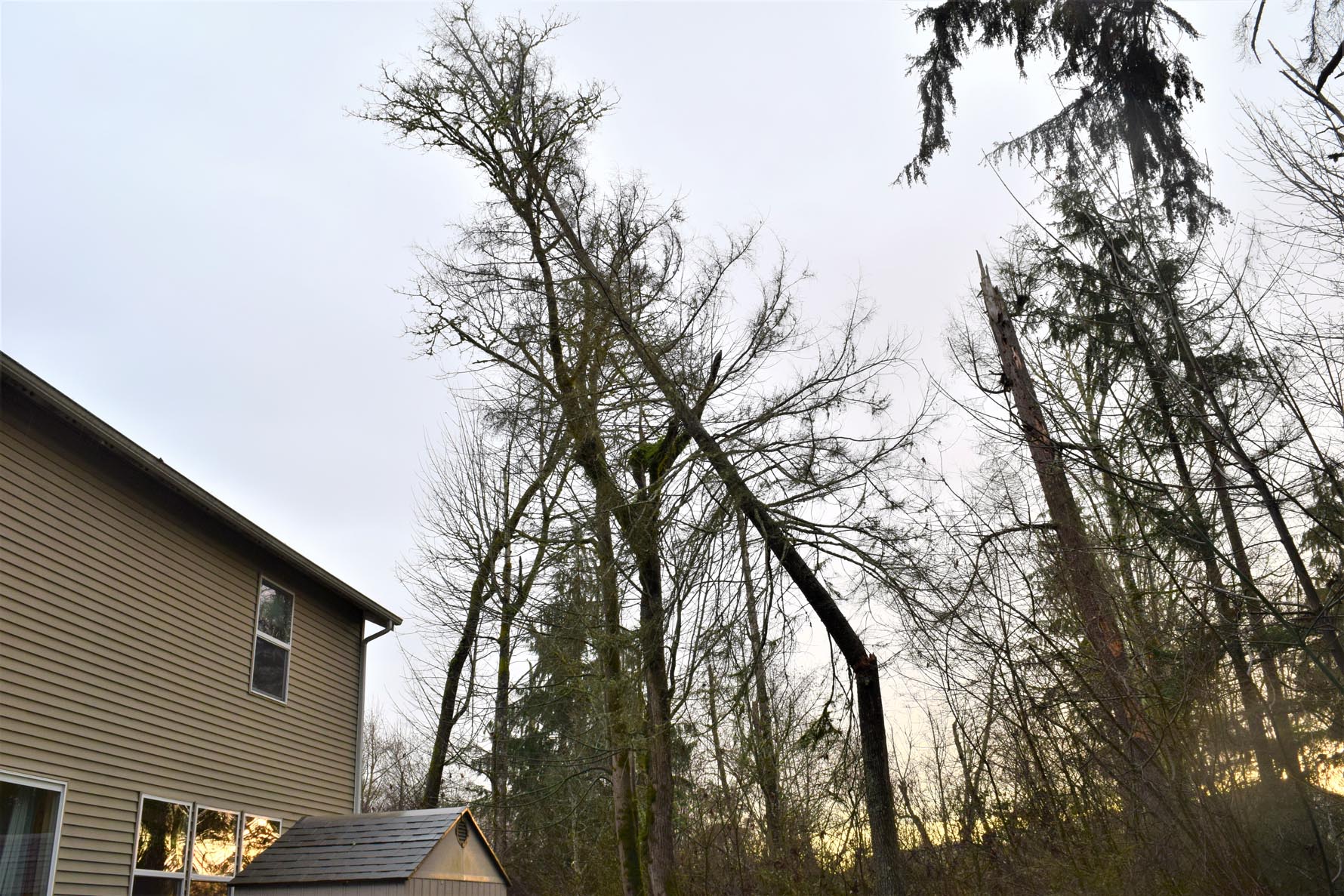
• A tree partially failed in a storm and is hung up in another tree or against a structure.
• Visible new lean with soil heaving on one side of the root plate.
• Large dead limb suspended in the canopy directly over a target — what arborists call a “widowmaker.”
• Recent bark beetle kill on a conifer within striking distance of a house.
• Cracks in the main stem extending vertically.
These situations move into storm damage and emergency tree response work. Most credible South Sound arborists keep emergency capacity available — but the response window is always shorter than what a homeowner would prefer, which is exactly why pre-season assessment matters.
What to Expect from a Bid
A good hazard tree assessment bid clarifies a few things up front:
• Who walks the property. An ISA Certified Arborist with TRAQ credential or equivalent should be on-site, not a sales rep. The Trees Are Good: Find an Arborist directory lists credentialed arborists by ZIP.
• What’s documented. Verbal recommendations are fine for a quick walk-through. A written report with photos and prioritized recommendations is the standard when documentation matters.
• How recommendations are priced. The assessment fee is often credited toward subsequent work. Bids for follow-up pruning, removal, or PHC should itemize each tree and the specific action.
• Insurance and L&I status. General liability and Washington L&I workers’ compensation should be current and verifiable.
Pacific Arboriculture serves homeowners across Kent, Tukwila, and Renton — and the broader South Sound including Auburn, Tacoma, Federal Way, Burien, Covington, Maple Valley, Lake Tapps, and Des Moines — with hazard tree assessments performed by ISA Certified Arborists who document what they find and explain what each finding means for the property.
The Bottom Line
The trees most likely to fail this storm season are already showing the signs. June is the window — full foliage, drought stress visible, schedule capacity available, mitigation work plannable rather than reactive. A documented hazard tree assessment is a small line item compared to the cost of a tree through a roof, and the homeowners who do them annually rarely face the worst-case scenario. For everyone else, the next windstorm or fire-weather event is the deadline.
Frequently Asked Questions
How often should a hazard tree assessment be done?
Annual assessments are common on properties with mature trees over structures. Every two to three years is reasonable for properties with younger trees or fewer hazard targets. After any major storm event, a fresh assessment is the safe move regardless of when the last one happened.
Do I need a hazard tree assessment if the tree looks healthy?
A tree that looks healthy from the ground can still have internal decay, root issues, or structural defects invisible from the curb. The whole point of a professional assessment is to identify what an untrained eye misses. Looking healthy is not the same as being structurally sound.
Is a hazard tree assessment required for tree removal permits?
It depends on the city. Several South Sound municipalities allow expedited tree removal permits for hazard trees documented by a credentialed arborist. Checking the city’s tree code before scheduling work is the safe move — and the documented assessment is often a prerequisite.
What’s the difference between a tree risk assessment and an arborist report?
A tree risk assessment focuses on failure likelihood and target consequences. An arborist report is the broader written document — often including risk assessment plus species identification, condition rating, valuation, or remediation recommendations. Many assessments produce a short report as part of the work.
Can a hazard tree be saved instead of removed?
Often, yes. Structural pruning, cabling and bracing, root zone restoration, and target mitigation (moving a structure or play area) can reduce risk without removing the tree. Removal is the option when the defect can’t be reasonably mitigated and the consequence of failure is severe.