Washington is in its fourth consecutive summer drought emergency, and most established trees in the South Sound are getting exactly the wrong kind of water. Lawn sprinklers wet the top two inches of soil, evaporate off the grass canopy, and never reach the deep feeder roots that keep a mature Douglas-fir or bigleaf maple alive through August. This guide covers how much, how often, and why sprinklers do not count — with practical targets for Edgewood, Sumner, and Fife yards.
Why sprinklers fail established trees
Established trees — those more than three years in the ground — pull most of their water from feeder roots 8–18 inches deep, extending well past the trunk to the drip line and beyond. Lawn irrigation systems are designed for grass roots, which live in the top 4 inches. According to Oregon State University Extension guidance, dumping a bucket of water at the trunk or running a 10-minute sprinkler cycle only wets the surface, then evaporates before roots can absorb it.
Three things go wrong when a homeowner assumes the lawn system is watering the trees:
- Shallow roots migrate up: Trees follow water. Frequent shallow irrigation trains roots to stay in the top 4 inches, making the tree more vulnerable to next year’s drought and more likely to fail in wind.
- Trunk wetting invites disease: Sprinklers hitting the trunk keep bark constantly damp, which encourages Phytophthora root rot and cankers.
- The math does not work: A typical residential sprinkler zone delivers 0.4–0.6 inches of water per 20-minute cycle. Two cycles per week gives grass what it needs — and gives a 12-inch-diameter maple roughly 5% of what it actually needs.

How much water an established tree actually needs
The industry rule of thumb, backed by Arbor Day Foundation research and ISA’s Trees Are Good homeowner resource: 10 gallons per inch of trunk diameter, per deep watering.
Measure trunk diameter at 4.5 feet above the ground (breast height). A 6-inch maple needs 60 gallons per session. A 15-inch Douglas-fir needs 150 gallons. That sounds extreme until compared against a sprinkler cycle: 60 gallons is about 12 minutes of moderate garden-hose flow (5 gallons per minute), applied slowly enough to soak in rather than run off.
Frequency in the South Sound
During a typical dry stretch from mid-June to mid-September:
- Established trees (3+ years): One deep soaking every 10–14 days if there is no meaningful rainfall (defined as ≥0.5 inch in a single event).
- Recently established (year 2–3): Every 7–10 days.
- Newly planted (year 1): Every 3–5 days. See the summer care checklist for young-tree specifics.
Drought-adapted natives — Garry oak, madrone, ponderosa pine — need less. Non-natives from wetter regions — bigleaf maple in a full-sun lawn, western red cedar in compacted clay, dogwoods — need more. See early drought-stress signs in PNW cedars, hemlocks, and dogwoods for species-specific thresholds, and cedar flagging for the distinctive drought pattern on western red cedar.
How to deliver deep root water
Four methods work. Pick based on how many trees are on the lot and how much time is available.
1. Soaker hose in a spiral
Wrap a soaker hose in a spiral from the trunk out to the drip line, then run it for 60–90 minutes. Delivers water slowly enough to soak down 12 inches. Best all-purpose method for suburban lots.
2. Slow garden-hose trickle
Set a garden hose at pencil-thin flow, place it 3–4 feet from the trunk, and move it around the drip line every 30 minutes. Delivers the target 60–150 gallons in 90–180 minutes without runoff. Requires timer alarms.
3. Root-zone watering bags (Treegator or Ooze Tube)
Zippered bags that hold 15–25 gallons and drip out over 4–8 hours. Best for young trees and for property owners managing 6+ trees. Available at most PNW nurseries.
4. Deep-root injection (professional service)
A soil probe injects water and dissolved nutrients 8–12 inches deep in a grid around the tree. Used for high-value specimens, trees on slopes, or trees in compacted urban soils. Part of Pacific Arboriculture’s plant healthcare program.

Mulch is half the answer
Deep watering only pays off if the moisture stays in the soil. A 3-inch ring of arborist-chip mulch, extending from 6 inches off the trunk out to the drip line, cuts summer soil evaporation by roughly 50%. Do not pile mulch against the trunk — see why mulch volcanoes kill trees — and refresh the ring every 12–18 months as it decomposes.
When drought stress becomes an arborist issue
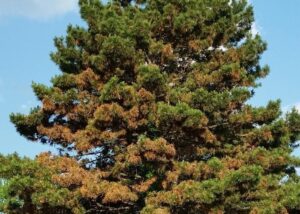
Watch for these signs in Edgewood, Sumner, and Fife yards this month:
- Leaf scorch (brown edges on maples, dogwoods, magnolias)
- Early leaf drop in July or August
- Sudden dieback of one branch or one side of the crown
- Bark cracking or peeling in strips
- Whole-tree wilt that does not recover overnight
Once these signs appear, watering alone rarely reverses the trajectory. A certified arborist can distinguish drought damage from Verticillium wilt, root rot, or root damage — three conditions that look similar but require different treatments. Pacific Arboriculture provides ISA Certified Arborist consultations across the South Sound. State-level context on the current drought: Washington Department of Ecology water supply update.
Frequently asked questions
Can I water my trees with the lawn sprinklers if I run them longer?
Not effectively. Even a 60-minute sprinkler cycle only wets the top 4–6 inches. Trees need water 8–18 inches deep. Longer cycles waste water to evaporation and runoff. Use a soaker hose or slow garden-hose trickle instead, and turn off the sprinkler zone near the tree during that session.
Do I need to water my established trees during a normal Pacific Northwest summer?
Yes, in 2026 and forward. The PNW is in its fourth consecutive drought year, and even native species like western red cedar and Douglas-fir are showing chronic decline. Plan on one deep watering every 10–14 days from mid-June through mid-September unless a meaningful rain event happens.
How do I know if my deep watering is actually working?
Push a long screwdriver into the soil under the drip line 24 hours after watering. If it slides in easily 6–8 inches deep, the session worked. If it stops at 2–3 inches, water applied faster than the soil could absorb it — slow the flow and lengthen the session.
Will overwatering hurt an established tree?
Yes, but the threshold is much higher than most homeowners assume. Overwatering usually happens when a lawn system runs daily and the tree also gets deep watering. In PNW clay soils, watering more than once a week can suffocate roots and encourage Phytophthora root rot. Space deep waterings 10–14 days apart during dry stretches.