Every summer, homeowners in Edgewood, Renton, and Lake Tapps stare up at a tree in the yard and ask the same question: Is that thing going to come down on its own, or should I have it taken down? It’s rarely an easy call. Mature trees add value to property, provide shade during heat waves, and can take decades to replace. But a tree that fails in a windstorm can crush a roof, a car, or worse.
After four consecutive years of declared drought in Washington and a summer forecast that once again favors above-normal heat, the pool of borderline trees is bigger than it has been in a decade. This is a decision framework an ISA Certified Arborist would recognize from a site visit.

Start with the Target: What Would the Tree Hit?
Arborists don’t grade trees in isolation — they grade risk to a specific target. A dead tree in the back corner of a five-acre lot with nothing under it is a wildlife tree. The same dead tree ten feet from a bedroom is an emergency. The CDC’s occupational fatality data shows tree-related incidents remain a leading cause of home-repair injury, and homeowner insurance carriers use “target proximity” as a primary claim-review criterion.
Walk the tree with three questions in mind: what’s within one tree-length in every direction, what’s the most likely fall zone based on lean and prevailing wind, and how often are people or vehicles in that fall zone. A tree over the driveway sees traffic every day. A tree over the back fence line may see nothing for months. When property damage is likely, an emergency storm response after failure costs far more than proactive assessment.
The Four Visible Signs That Change the Decision
Not every dying tree is dangerous, and not every dangerous tree looks dead. Four visible signs elevate a borderline tree into “schedule the removal now” territory:
- Basal decay or fungal fruiting bodies. Mushrooms at the root flare, especially Armillaria or Ganoderma, mean structural wood is compromised below ground. The WSU Extension tracks common PNW wood-decay fungi and their host trees.
- Cracks, splits, or included bark in a major union. V-shaped forks where stems meet at a tight angle fail predictably in wind, especially on maples and cottonwoods.
- Sudden lean or heaving soil on the uphill side. A tree that was straight last year and is not straight this year has moved because its roots did. That’s an imminent failure signal — the USDA Forest Service guide to tree hazards flags root-plate movement as one of the highest-severity failure indicators.
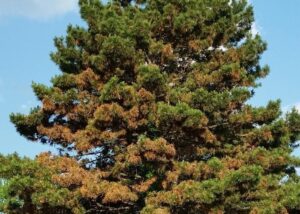
- Dead top or more than 40% crown dieback. Under drought stress, cedars, hemlocks, and some maples cross a recovery threshold. Once the top is dead, the rest often follows within two seasons — a pattern documented in recent cedar flagging across the South Sound.

When Removal Isn’t the Right Answer
Plenty of concerning-looking trees can be kept. A mature Douglas fir with one dead branch is not the same as a fir with a dead top. A big-leaf maple with light aphid damage is not the same as one with basal decay. Cabling, crown reduction, and targeted structural pruning can add ten to twenty years to a borderline tree when the underlying wood is sound. Long-term plant health care — deep watering, mulch, and soil work — also gives stressed trees a real recovery window.
The judgment call sits with a certified arborist who has actually walked the site. Pattern-matching from a phone photo — even a good one — misses the smell of decay at the base, the sound of a hollow trunk, and the way the ground moves when the tree flexes in a light breeze.
What a Certified Arborist Actually Checks
A proper hazard assessment follows the ISA Tree Risk Assessment Qualification protocol. Per the ISA TRAQ program, the arborist evaluates likelihood of failure, likelihood of impact, and consequence of impact — then combines those into a documented risk rating.
On the ground, that means sounding the trunk with a mallet to detect internal cavities, probing the root flare for decay, measuring lean with a clinometer, examining unions for included bark, and checking the crown for die-back percentage. Complex or high-value cases sometimes get a resistance drill or sonic tomography measurement. When documentation matters — for a permit, an HOA, or an insurance claim — the assessment becomes an arborist report. When removal is the call and the tree sits near structures, crane-assisted removal often keeps roofs and fences intact.

Frequently Asked Questions
How do I know if a leaning tree is dangerous?
Not all leans are dangerous. A tree that has always leaned and shows no fresh soil movement is usually stable. A sudden new lean, or lean combined with cracked or heaved soil on the uphill side, means roots have failed and the tree can come down without warning. Get an on-site assessment within days, not months.
Can a dying tree be saved instead of removed?
Sometimes. Trees with less than 25% crown dieback, no basal decay, and no major structural cracks often respond to soil work, deep watering, and reduced turf competition. Trees past 40% dieback or with fungal fruiting at the base rarely recover, and removal is usually the safer path.
Do I need a permit to remove a hazard tree in King or Pierce County?
Rules vary by city. Unincorporated King County generally does not require a permit for a confirmed hazard tree, but documentation from an ISA Certified Arborist is strongly recommended. Renton, Edgewood, and Lake Tapps each have local tree codes — check with the city planning department before scheduling work.
How much does professional tree removal cost in Western Washington?
Removal cost depends on tree size, access, and target proximity. Straightforward mid-size removals in an open yard typically run less than removals near power lines, structures, or with limited crane access. A written estimate from a certified arborist is the only reliable way to price a specific tree.
When to Schedule the Assessment
Homeowners with borderline trees should schedule an assessment before the fall wind season, not after. September through January storms take down trees already compromised by the summer’s drought — and by then the emergency-call queue is long and expensive. For a professional hazard tree assessment across Edgewood, Renton, Lake Tapps, and the wider South Sound, contact Pacific Arboriculture for an ISA Certified Arborist visit.