
A tree in a forest recycles its own leaf litter and grows in an undisturbed root zone. A tree in a Puget Sound yard usually has neither — the litter gets raked, the root zone was compacted during construction, and the roots are confined by hardscape. Fertilization and mulching are how that gap gets closed. Applied correctly they are two of the highest-value, lowest-risk things you can do for an established tree. Applied wrongly they are among the most common ways trees get damaged.
Free on-site consultation · Wood chip delivery available in our service area
Not every tree needs feeding. Many trees showing decline are short of water, air or root space, and fertilizing those trees can make matters worse by pushing top growth a damaged root system cannot support.
Nutrients are placed into the root zone across the area the roots actually occupy, not in a ring at the trunk. Rate is set by trunk diameter and canopy spread rather than by a bag label written for turf.
Yellowing leaves with green veins on maple, birch and oak usually mean iron or manganese is unavailable rather than absent. Targeted micronutrient treatment addresses the symptom while we deal with the drainage or pH condition behind it.
Humic amendments and root-stimulating treatments are used on compacted root zones and on newly planted trees, where the limiting factor is root establishment rather than nutrient supply.
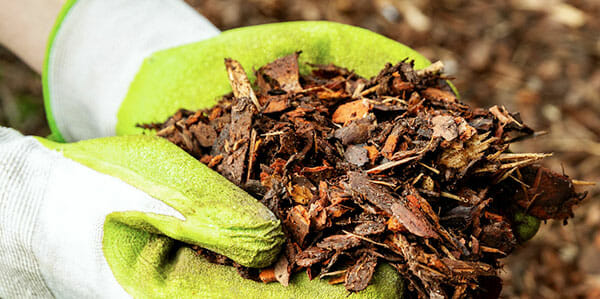
Four to six inches of arborist wood chips, spread wide, pulled back off the trunk. Mulch is the foundation of the root zone and fertilization builds on it — and volcano mulching piled against the trunk undoes both.



Both lists below matter more than product choice. Most of the harm we are called out to correct came from good intentions applied incorrectly.
Depth. Four to six inches of arborist wood chips. Less than that dries out and stops suppressing weeds. Much more than that can restrict oxygen reaching the roots underneath.
Spread. As wide as you can reasonably go. Mulch out to the edge of the canopy is far more useful than a deep circle at the base, because the roots that matter extend well beyond the trunk.
Keep it off the trunk. Mulch piled against the bark holds moisture on tissue that is not built for it, invites decay, and encourages roots to grow around the base instead of outward. Leave the root flare visible — the shape you want is a doughnut, not a volcano.
Never use chips as backfill or dug into the planting hole. Wood chips belong on the surface. Mixed into soil around a new planting they tie up nitrogen as they break down.
Arborist chips are a better material for this than bagged, dyed mulch: they are a mix of wood, bark and leaf material that breaks down into a genuine layer of organic matter over a couple of seasons. We deliver them — see wood chip delivery.
Fertilizer treats a nutrient deficiency. It does not treat any of the four things that most commonly cause tree decline on developed property in this region.
Compaction from construction equipment or foot traffic removes the pore space roots need for oxygen. Poor drainage on the region’s heavier soils suffocates roots in winter and sets up root disease. Planting too deep, or a root flare buried under years of accumulated soil and mulch, slowly strangles a tree and is one of the most common problems we find. Late-summer drought is a bigger factor here than most people expect, because our dry August and September follow a wet spring that trees have grown into.
Feeding a tree while one of those is unaddressed puts more canopy on a root system that cannot support it, so we check them first and then build the program around what we find — root-zone treatment, mulch over the root area, and fertilization dosed to the tree. Handled together they work; handled in isolation they disappoint.
If the inspection finds the problem is structural or drainage-based rather than nutritional, the recommendation will say so and we will not sell you a feeding program.
An ISA Certified Arborist checks the root flare, the existing mulch depth, the drainage, and how much of the root zone is actually available to the tree.
We establish what is actually limiting the tree, which sets what the program treats and how the rate is calculated.
Rate is calculated from trunk diameter and canopy spread, with the application method and timing specified.
Nutrients go into the root zone across the area the roots occupy. Mulch is spread to depth, pulled back off the trunk, and existing over-deep mulch is thinned out.
We look at the following season’s growth and leaf color and set the interval from what the tree actually does — some trees are on an annual program, others go longer between applications.
Treatment is quoted per tree after an on-site inspection — species, trunk diameter, the number of trees, and access all change the number. The consultation and the written quote are free.
Fertilization is priced by the number of trees and the size of the root zone being treated. Mulching is priced by the area covered and whether existing over-deep mulch has to be pulled back first. Arborist wood chips themselves are a byproduct of our own work and we deliver them within the service area for a flat $50 delivery fee — see wood chip delivery.
Every certification number below links to that arborist’s credential record with the International Society of Arboriculture, so you can verify it before anyone sets foot on your property.
Washington L&I Contractor License PACIFA*813KG · WSDA Pesticide Applicator #109480 · $1M liability insured
Tell us the trees and what you are seeing — thin canopy, pale leaves, poor growth since construction. An arborist will check the root zone and tell you what is actually limiting the tree.


