A cracked driveway or lifted sidewalk usually gets blamed on the nearest tree. Sometimes the tree is guilty. Often, it is not — and removing the tree does nothing about the concrete. This guide separates real root-caused hardscape damage from soil settling and freeze-thaw, with practical next steps for Des Moines, Renton, and Covington yards where big-canopy trees meet aging driveways.
How tree roots actually damage concrete
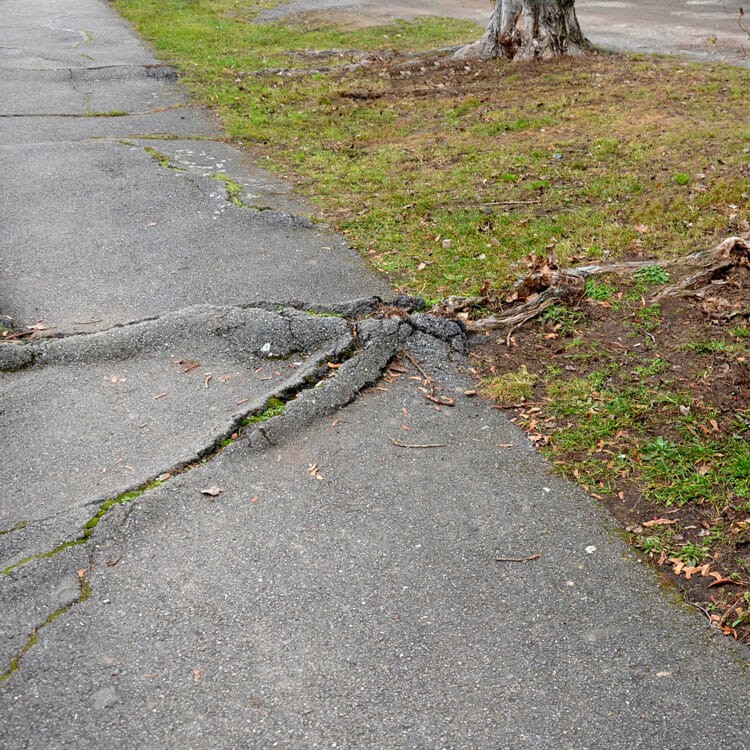
Feeder roots do not push through solid concrete. What they do is grow along the underside of a slab, add wood every year, and lift the slab as they thicken. The ISA reference on reducing infrastructure damage by tree roots notes three specific mechanisms:
- Girdling growth under the slab: A root grows through soft, moist soil under the concrete. Each growing season, it adds a ring of secondary xylem. Ten seasons of quarter-inch growth equals two-and-a-half inches of lift on a slab designed with zero clearance.
- Soil displacement: Large surface roots — common on maples, poplars, and cottonwoods — push soil upward and outward as they expand, causing cracks radiating from the trunk.
- Moisture cycling: Trees pull water from soil under slabs during dry summers. In clay-heavy South Sound soils, that cyclic wetting and drying causes the underlying soil to shrink and swell, cracking the slab from below.

When the tree is not actually the culprit
Before spending $8,000 on tree removal, rule out these common look-alikes:
- Freeze-thaw cracking: Diagonal cracks that widen each winter and shrink each summer. No root involvement. Common on driveways poured before 1995 without proper base compaction.
- Settling from bad subgrade: A slab pouring failure. The corner nearest the downspout or drainage low point sinks first. The tree at the far corner gets blamed anyway.
- Frost heave near buried utilities: Water lines, gas lines, and sewer laterals under a driveway create differential settlement. Cracks follow the utility trench.
- Vehicle load damage: Delivery trucks and RVs on a residential driveway not rated for their weight. Cracks radiate from the wheel path, not from any tree.
A useful diagnostic: dig a small test hole at the crack. If a live root more than 1.5 inches in diameter runs directly beneath the crack line, the tree is at least partly responsible. If there is no root, or only fine feeder roots, the tree is not the cause.
What to do when a root actually is the problem
Removing the tree is one option, rarely the best one — especially for mature specimens that add $10,000–$40,000 in property value. Three intermediate options work:
1. Root pruning + physical root barrier
A certified arborist cuts the offending root cleanly at the slab edge, then installs a 24-inch deep HDPE root barrier vertically along the slab. This redirects future root growth downward instead of horizontally. Works well for trees under 20 inches in diameter. Requires an assessment first because cutting a major structural root can destabilize the tree — see Pacific Arboriculture’s arborist reports and consultations for the safe-cut threshold on each species.
2. Hardscape repair by a concrete contractor
Lifted slabs get released, and either the concrete gets re-poured with root-tolerant expansion joints and a flexible pavement, or the section gets replaced with rubberized pavers that flex over minor root growth. This is concrete and paving work handled by a hardscape contractor — Pacific Arboriculture does not perform slab or concrete repair — but paired with a root barrier install it often buys 15–20 years.
3. Air-spade root inspection first
An air-spade uses compressed air to expose roots without cutting them. This lets an arborist map the actual root architecture before making any cut decision. Standard practice for high-value trees. Detailed guidance in Arbor Day Foundation’s tree-sidewalk conflict guide and ISA’s Trees Are Good homeowner resource.
When removal is the right answer
Some situations do call for removal — usually when the tree species is naturally a bad neighbor for hardscape, or the tree already has structural defects independent of the root problem. Species with aggressive shallow root systems:
- Silver maple (Acer saccharinum) — worst offender in the South Sound
- Cottonwood (Populus trichocarpa) — combined with tall-tree fall risk
- Willow (Salix spp.) — aggressive water-seeking roots
- American elm (Ulmus americana) — shallow rooting in compacted urban soils
- Poplar and aspen hybrids — planted as fast privacy trees, become hardscape problems
A silver maple at the edge of a driveway that is already lifted is worth removing. A native Douglas-fir or Garry oak in the same position is worth saving with root pruning and a barrier. For the removal case, especially with mature trees over 60 feet, see crane-assisted tree removal — safer and cheaper than climbing removal for large-canopy trees near structures. For species identification help, see the 5 most dangerous tree species on a western Washington property. Broader oversight guidance: Oregon State University Extension.
Property risk beyond the concrete
Root-damaged hardscape is often a symptom. If roots have lifted a slab, they may also be cracking sewer laterals (older clay pipe is especially vulnerable), compromising retaining wall drainage, creating trip hazards on public sidewalks (a homeowner liability in most Washington municipalities), or sitting inside utility easements where the city has cut rights.
A single arborist visit that assesses the tree, roots, and adjacent hardscape usually pays for itself against trial-and-error concrete work. See trees near power lines for utility-easement parallels and tree encroachment and boundary disputes if the tree is near a property line.
Frequently asked questions
Do I need permission to remove a tree that’s damaging my driveway?
In most South Sound cities, removing a private tree on private property does not require a permit unless the tree is inside a critical area, exceeds a diameter threshold (often 6–12 inches DBH), or is a heritage-designated species. Auburn, Puyallup, and Federal Way each set slightly different thresholds. Check the local code before booking removal, or request a permit review as part of an arborist consultation.
Can I just cut the surface root that’s lifting my sidewalk?
Sometimes, but only after a certified arborist confirms the cut will not destabilize the tree. As a general rule, no more than 25% of a tree’s structural roots should be cut in a single season, and never within a distance equal to three times the trunk diameter. Cutting the wrong root on a mature Douglas-fir can create a windthrow hazard within one storm season.
Will removing the tree stop the damage?
Only if the root is the actual cause. Roots decay slowly — dead roots keep decomposing for 5–8 years after removal, which can create voids and additional settlement. If the concrete damage is from settling or freeze-thaw, removing the tree changes nothing about the concrete.
How much does an arborist consultation cost for a hardscape issue?
In the South Sound, a written arborist report from an ISA Certified Arborist typically runs $300–$650 depending on the number of trees, whether an air-spade inspection is needed, and whether a formal risk assessment is included. The report often saves more than it costs by preventing unnecessary tree removal or targeting the actual repair.