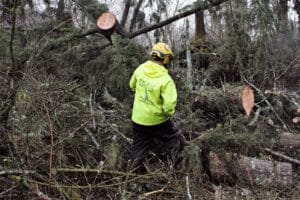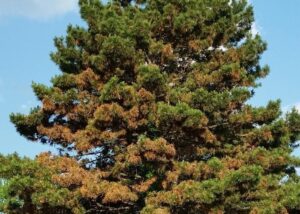

A Douglas-fir leaning toward a service drop. A maple whose top branches have grown into a high-voltage line. A windstorm that drops a cedar across a neighborhood feeder. Trees and overhead power lines share the same airspace across most of the Pacific Northwest, and that overlap creates one of the most dangerous, most confusing situations homeowners face: a tree problem that is partly an arborist’s job, partly a utility’s job, and partly a question of who pays for what.
This guide explains how to think about trees growing near power lines around Auburn, Kent, Federal Way, Renton, Tacoma, Puyallup, and the rest of the south King and Pierce County service area Pacific Arboriculture covers. It walks through the clearance rules, who is responsible for which span of wire, what counts as a true emergency, and where an ISA Certified Arborist’s role starts and ends. Nothing in this article should be taken as legal or utility-engineering advice — for line-specific questions, always confirm with Puget Sound Energy, Tacoma Public Utilities, or the relevant municipal utility.
Why Trees and Power Lines Are a PNW-Specific Problem
The Pacific Northwest grows huge trees fast. Douglas-fir, western red cedar, big-leaf maple, and black cottonwood routinely top 80 to 120 feet on residential lots that were carved out of forest fifty years ago. Many of those lots were platted before utilities upgraded to higher-capacity lines, and the result is mature canopy growing inches — sometimes feet — past the ideal clearance envelope around primary and secondary conductors.
Add the PNW’s signature weather to the mix and the risk compounds quickly:
• Saturated soil after weeks of winter rain reduces a tree’s anchorage just as the November–February windstorms arrive.
• Wet snow in December and January loads conifer branches with hundreds of extra pounds of weight, snapping limbs into lines below.
• Summer drought stress weakens already-compromised trees, increasing the odds of a sudden failure in the fall.
According to Puget Sound Energy’s tree and power line guidance, trees and tree limbs are the most common cause of power outages in the region. That single fact reshapes how homeowners should think about pruning, removal, and emergency response near overhead wires.
Puget Sound Energy: Trees and Power
Know Which Wire You Are Looking At
Not every overhead line carries the same voltage, and the risk profile changes dramatically depending on what is running through it. Before judging whether a tree is “too close” to a line, homeowners should learn what the lines around their property actually are.
Service Drop (Customer-Owned in Many Cases)
The service drop is the lowest wire on a typical residential pole — the one that runs from the utility’s pole to the weatherhead on a house. It typically carries 120/240 volts. In most PSE and Tacoma Public Utilities service territories, the wire from the meter into the house (and sometimes from the weatherhead inward) is the property owner’s responsibility, while the wire from the pole to the weatherhead is the utility’s responsibility. The split varies by utility, so confirm in writing before any work.
Secondary Lines
Secondary lines run pole-to-pole at house-eave height and feed the service drops on a block. They are usually 120/240 or 240/480 volts. They are still extremely dangerous — direct contact can be fatal — but they are not the high-voltage primary above them.
Primary Lines (Top of Pole)
Primary distribution lines sit at the top of the pole and carry 7,200 to 34,500 volts or more in most south King and Pierce County neighborhoods. These are the lines a property owner must never approach, never trim around, and never assume are de-energized after a storm. A tree growing into a primary line is an immediate call to the utility — not to a tree service.
Communication Lines
Phone, cable, and fiber lines run below the electric lines on the same poles. They do not carry lethal voltage, but they can still entangle climbers and falling limbs. Most utilities will treat damage to communication lines as a separate billing issue from electric service.
According to OSHA’s overview of electrical hazards, electrocution is one of the leading causes of fatalities in the tree care industry, which is why federal regulations and Washington L&I requirements draw a firm line between “qualified line clearance” work and general arboriculture.
OSHA: Electrical Safety in Tree Work
What Clearance Rules Actually Say
There is no single national clearance number that applies to every line and every tree. Clearance distances are governed by a mix of the National Electrical Safety Code (NESC), utility-specific tariffs filed with the Washington Utilities and Transportation Commission, and the American National Standards Institute’s ANSI A300 (Part 1) pruning standard for line clearance work.
The practical takeaways for a homeowner in Sumner, Lake Tapps, Bonney Lake, or Edgewood:
• Utilities maintain a “right-of-way” or “wire zone” around primary distribution lines. The exact width varies by voltage and span length, but ten feet of clearance around the wire is a common minimum target for new growth.
• Service drops at the house get less clearance attention from utilities because they are lower voltage. That does not mean a tree touching a service drop is safe — it means the utility may not proactively trim it.
• “Vegetation management” pruning performed by line-clearance contractors is allowed to make cuts that would never be recommended on an ornamental tree (topping, directional pruning away from wires, large-diameter heading cuts). Those cuts protect the line first and the tree second.
Homeowners often see a utility crew leave their tree looking lopsided after a clearance pass. That is by design — the goal is keeping the wires clear through the next growth cycle, not preserving the tree’s natural form. A separate visit from an independent ISA Certified Arborist can sometimes restore balance through corrective pruning on the non-line side, but only after the utility’s clearance work is complete.
ANSI A300 (Part 1): Pruning Standard
Who Is Responsible for Which Tree?
This is the question that generates the most phone calls. The short answer is: it depends on which wire the tree is threatening and where the tree is growing. Here is a practical framework Pacific Arboriculture uses when triaging homeowner calls in Federal Way, Tacoma, Puyallup, Covington, and Maple Valley:
Tree in the Primary Line (Top of Pole)
Call the utility. PSE, Tacoma Power, Lakeview Light & Power, and other local providers maintain crews specifically trained and equipped for line-clearance tree work. They will not charge the homeowner for clearance pruning in the public right-of-way. Most utilities have an online form or a phone line specifically for “tree touching a power line” reports.
Tree in the Secondary or Service Drop
Call the utility first. If the utility declines to act (often the case when the wire is on private property between the meter and the house), then a qualified line-clearance arborist can be retained to do the work after the utility temporarily de-energizes and reconnects the drop. This is sometimes called a “service drop drop” — the utility drops the wire, the arborist does the tree work, and the utility re-attaches.
Tree on Private Property But Near a Line
The property owner is responsible for hiring qualified help to manage the tree, but the work itself must be done by a crew with proper line-clearance training when any part of the tree, the climber, or the equipment can come within the minimum approach distance of an energized conductor. Standard residential tree services that are not line-clearance qualified should refuse this work — and homeowners should refuse to hire any company willing to do it without proper credentials.

When a Crane-Assisted Removal Is the Right Answer
Some trees near power lines can be pruned. Some must be removed. And some can only be removed safely with a crane, because every conventional climbing or felling option carries unacceptable risk of contact with the wire.
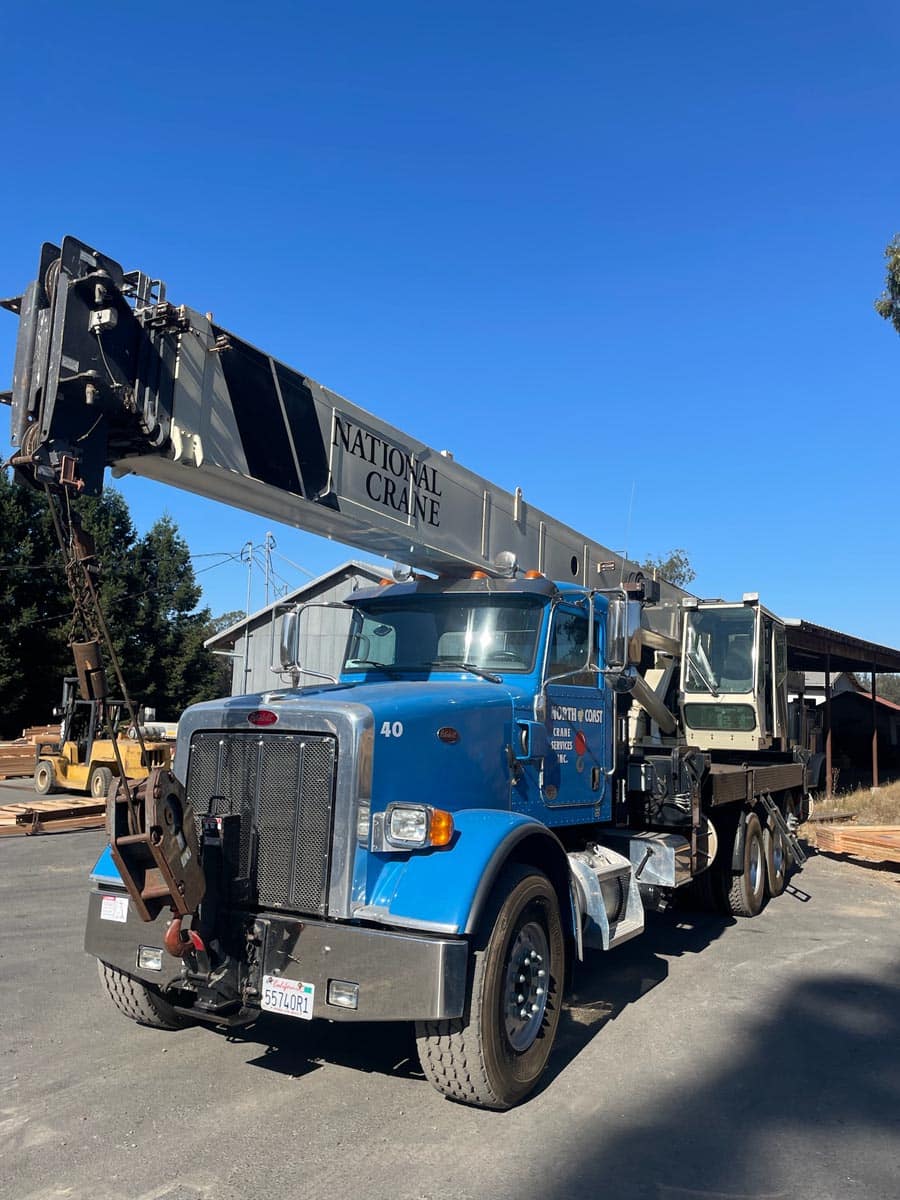
A crane-assisted tree removal works by lifting individual sections of the tree up and away from obstacles before any cut is made, then setting them in a clear landing zone. For a leaning Douglas-fir over a service drop in Tacoma, or a multi-stem cottonwood whose canopy has grown through a secondary line in Pacific, a crane can often complete the job in a single visit without the utility ever needing to de-energize the line — because no part of the tree, the climber, or the saw ever swings toward the conductor.
Indicators that a crane is the right call:
• The tree cannot be safely felled in any direction without hitting a structure, road, or wire.
• Climbing the tree would put the climber within minimum approach distance of an energized line.
• The tree is dead, decayed, or otherwise structurally unsound — climbing is unsafe regardless of the line.
• Access for traditional rigging is blocked by fencing, neighboring structures, or steep terrain common in Renton, Burien, and Des Moines.
According to the International Society of Arboriculture’s best management practices, the safest approach to high-risk removals is the one that keeps the work crew, the public, and the surrounding infrastructure out of the failure zone — and for trees near power lines, that increasingly means a crane.
ISA: Best Management Practices
Planting and Replanting Near Power Lines
The most cost-effective way to manage trees near power lines is to plant the right tree in the right place to begin with. The Arbor Day Foundation and most regional utilities publish a “right tree, right place” diagram that splits planting zones by mature height and distance from the wire.
The General Rule
Within 15 feet of a power line, only plant species that mature under 15 to 25 feet — vine maple, dogwood, kousa dogwood, serviceberry, hawthorn, or compact crabapple varieties. From 15 to 40 feet out, medium-sized trees that mature at 25 to 40 feet are appropriate, such as Japanese maple, Stewartia, or smaller cultivars of katsura. Tall conifers and big shade trees like Douglas-fir, western red cedar, tulip poplar, or big-leaf maple belong well outside the wire zone — 40 feet or more from the conductor at minimum.
The PNW Reality
A lot of properties in Auburn, Kent, and Tukwila were planted before “right tree, right place” guidance existed. Mature trees that obviously belong somewhere else are common. Replacing a problem tree with a species-appropriate alternative is one of the cheapest long-term moves a homeowner can make — both for outage prevention and for the property’s tree canopy in twenty years.
For an evaluation of which trees on a property are likely to become line conflicts in the next decade, an ISA Certified Arborist can provide a written consultation or arborist report identifying high-risk specimens and recommending replacement candidates.
Arbor Day Foundation: Right Tree, Right Place
Storm Response When a Tree Hits a Line
In a Pacific Northwest windstorm or ice event, the worst-case combination is a large conifer down across an energized line. The instinct is to clear the driveway or check the damage. The correct response is the opposite.
The protocol an ISA Certified Arborist will reinforce on every storm-damage call:
1. Treat every downed wire as energized, regardless of whether sparks or arcing are visible. Assume the power is on until the utility confirms otherwise.
2. Stay at least 35 feet away from the tree and any part of the wire it is touching. Step-potential — current traveling through the ground — can kill at distance even without direct contact.
3. Call 911 if anyone is injured, and report the downed line to the utility immediately. PSE outage reporting and Tacoma Power outage reporting both accept text and online reports as well as phone.
4. Do not attempt to free a vehicle, pet, or person from a tree resting on a wire. If a person is in a vehicle in contact with a wire, the safest action is to stay in the vehicle and wait for the utility unless the vehicle catches fire.
5. After the utility clears the scene, an arborist can begin removal. Until then, no part of the tree should be cut, even sections that appear to be far from the wire.
For broader storm-response guidance, see Pacific Arboriculture’s earlier guide on what to do when a tree falls on a house, which covers insurance documentation, structural triage, and arborist coordination.

Pruning Trees Near Power Lines: The Boundaries
Routine pruning is one of the most common services Pacific Arboriculture performs, but pruning near power lines has constraints that homeowners rarely think about until a quote arrives that looks different from a standard pruning bid.
What General Arborists Can and Cannot Do
Under Washington L&I rules and OSHA’s qualified-line-clearance-arborist regulations, a non-line-qualified arborist must maintain a minimum approach distance from energized conductors. For typical residential distribution lines, that distance is several feet — meaning any branch within that zone of the wire cannot legally be pruned by a general arborist. Homeowners should expect a competent crew to explain this rather than push the limit.
Coordinated Work With the Utility
For larger projects on private property, an arborist will sometimes coordinate a “line drop” or temporary de-energization with the utility. The utility cuts power, drops the service wire, the arborist completes the work, and the utility re-attaches. This is most commonly done for service drops, less often for secondary lines, and effectively never for primary lines — primary work belongs to the utility’s own line-clearance crews.
Avoid Topping
A common homeowner request is “just top the tree so it stays under the wire.” Topping is one of the most damaging cuts that can be made to a mature tree. It triggers vigorous, weakly-attached regrowth that often exceeds the original height within a few years, multiplying the line conflict. For a tree that genuinely cannot coexist with a wire long-term, removal and replanting with a species-appropriate tree is almost always the better answer than topping.
ISA: Why Topping Hurts Trees
What an ISA Certified Arborist Brings to the Conversation
Trees near power lines sit at the intersection of biology, engineering, and regulation. An ISA Certified Arborist brings species-specific knowledge of failure modes (which trees are prone to summer branch drop, which species develop included bark crotches, how root architecture handles the saturated PNW winter), familiarity with the standards that govern line-clearance work, and the ability to write a documented assessment a utility, insurer, or city code official will accept.
In practice, that documentation matters. Whether the conversation is with the utility about right-of-way access, with an insurer about a claim, or with a city arborist about a permit for removing a “significant tree” in Auburn or Tacoma, an ISA-certified write-up moves the conversation forward.
Pacific Arboriculture serves Auburn, Kent, Federal Way, Tacoma, Renton, Puyallup, Sumner, Bonney Lake, Lake Tapps, Maple Valley, Covington, and the rest of south King and Pierce County.
Frequently Asked Questions
Can a homeowner trim a branch touching the service drop from the house?
No. Even though the service drop is “only” 120/240 volts, contact can be fatal, and Washington L&I treats this as line-clearance work that requires qualified personnel. The right move is to call the utility, ask whether they will drop the wire, and either have the utility’s crew or a qualified line-clearance arborist do the cut.
Does PSE charge for removing a tree that fell on a primary line?
Generally, PSE clears the wire and removes the portion of the tree blocking the line at no cost to the homeowner. The remaining portion of the tree on the homeowner’s property is the homeowner’s responsibility. Many storm-damage cleanups in the PNW involve exactly this split — the utility clears the wire, and an arborist completes the rest of the removal.
How close to a power line can a tree be planted?
For a primary distribution line, plant trees that will mature under 25 feet within 15 feet of the wire, and keep tall-growing species at least 40 feet from the conductor. For service drops at the house, prioritize species whose mature spread will not reach the wire as the tree grows toward the southern exposure most homeowners want to plant near.
Do I need a permit to remove a tree that is touching a power line?
In most south King and Pierce County jurisdictions, hazard trees and trees in direct line conflict are exempt from standard significant-tree removal permits, but the exemption usually requires documentation from an ISA Certified Arborist or a notice from the utility. Auburn, Kent, Federal Way, and Tacoma each have slightly different code language, so the safest move is to ask the city arborist’s office before scheduling the work.
Will topping a tree keep it under the wire?
Topping creates fast-growing, weakly-attached water sprouts that frequently exceed the original tree height within three to five years, multiplying the line conflict and adding storm-failure risk. For a tree that genuinely cannot coexist with a line, removal and replanting with a smaller-growing species is the durable solution.
Next Steps
For an evaluation of trees growing toward power lines on a south King or Pierce County property, the practical sequence is straightforward. First, identify which line is in question — primary, secondary, or service drop. Second, call the utility for anything touching or near a primary line. Third, for trees on private property near secondary or service lines, schedule an inspection with a qualified arborist who can document the situation and coordinate any utility involvement that is needed.
Pacific Arboriculture’s ISA Certified Arborists provide written assessments, structural pruning, removal, and crane-assisted removal for trees near power lines across Auburn, Kent, Federal Way, Tacoma, Renton, Puyallup, Sumner, Pacific, Edgewood, Fife, SeaTac, Burien, Des Moines, Tukwila, Covington, Maple Valley, Bonney Lake, Lake Tapps, Fairwood, and Normandy Park. To schedule an evaluation, reach out to Pacific Arboriculture with the property address and a photo or two of the tree in question.