
Few homeowner conversations in the Pacific Northwest get tense as quickly as the one about a tree on the property line. Maybe a neighbor’s bigleaf maple is dropping branches over a Bonney Lake fence. Maybe a row of Western Red Cedars planted twenty years ago has roots lifting a Puyallup driveway. Maybe an Edgewood property owner is staring up at a leaning Douglas Fir and wondering whether the trunk on the other side of the lot line means they have to live with the risk. These situations sit at the intersection of horticulture, property law, and neighbor diplomacy — and they almost always go better when the homeowner understands the rules before the saw comes out.
This guide walks Western Washington property owners through the practical and legal framework for tree encroachment: who owns what, what can legally be pruned or removed, when liability kicks in, when an ISA Certified Arborist needs to be involved, and how to handle the conversation with the neighbor without ending up in small claims court. Pacific Arboriculture serves homeowners across Bonney Lake, Puyallup, and Edgewood — and the same rules apply across the wider South Sound.

Who Owns the Tree? The Question That Decides Everything
In Washington State, the location of the trunk at ground level determines ownership of the tree. Not the branches, not the roots, not the canopy — the trunk. If the entire trunk sits on one side of the property line, that landowner is the sole owner. If the trunk straddles the line, the tree is jointly owned by both neighbors and decisions about it (especially removal) generally require mutual consent.
This single rule is the foundation for every encroachment question that follows. It means a Bonney Lake homeowner whose neighbor’s cedar drops needles all over their roof every fall doesn’t own the cedar even when 60% of the canopy is hanging over their yard. It also means a Puyallup property owner can’t unilaterally cut down a boundary tree just because its roots are inconvenient. Understanding this rule upfront prevents most of the disputes Pacific Arboriculture sees in the field.
Washington State Attorney General: Neighbor Law Resources
The Self-Help Rule — What You Can Legally Prune
Washington recognizes what’s commonly called the self-help doctrine: a property owner has the right to prune branches and roots from a neighbor’s tree that cross the property line, but only up to the property line itself and only at the owner’s own expense. This is well-settled in case law going back decades. A homeowner in Edgewood doesn’t need permission to trim back the maple branches dangling over their fence — but the cut must stop at the boundary, and the work must not damage the health or structural stability of the tree.
Three real-world limits homeowners should understand before climbing a ladder:
1. The “no harm” test. If the pruning kills the tree, weakens it structurally, or causes it to fail, the trimming neighbor is liable for the damage — including the full replacement value of the tree, which in Washington can easily exceed $5,000 for a mature specimen. Courts have ruled against homeowners who hacked back so aggressively that the tree died within 18 months. Self-help is not a license for vengeance pruning.
2. The “property line” line. Cuts must stop at the vertical plane of the boundary. Leaning a ladder onto the neighbor’s side, crossing the line with a chainsaw, or accessing the work from their yard without consent is a trespass — even if the goal is legitimate trimming.
3. The reasonableness standard. “Reasonable” is the recurring word in Washington tree law. Removing 80% of a tree’s canopy is not reasonable. Cutting major scaffold limbs that support the tree’s structural integrity is not reasonable. The general rule of thumb in arboriculture is to never remove more than 25% of live wood in a single year, and that standard applies whether the homeowner is pruning their own tree or trimming a neighbor’s branches at the line.
International Society of Arboriculture: Why ISA Certification Matters
Roots, Driveways, and Hardscape Damage
Roots get less attention than branches in encroachment conversations but cause more dollar damage. A mature tree’s root zone typically extends 1.5 to 3 times the canopy radius, which means a 40-foot maple has a root system reaching 60 to 120 feet from the trunk. Those roots routinely cross property lines, lift sidewalks, crack driveways, infiltrate sewer laterals, and push against foundation walls — and the legal framework is identical to branches.
A Puyallup homeowner whose driveway is being heaved by a neighbor’s Norway Maple roots has the right to cut those roots at the property line. But the same caveats apply — the cut cannot destabilize the tree, and cutting major structural roots within the dripline can do exactly that. ISA Certified Arborists in the Pacific Northwest see this regularly: a contractor severs anchoring roots during a driveway repair, the tree leans toward the neighbor’s house six months later, and now there’s a liability question.
The right move when roots are causing hardscape damage is rarely “cut the roots.” It’s:
• Get a professional arborist report documenting the situation before any work begins
• Use root pruning techniques (air-spading, sharp clean cuts, proper depth) that minimize structural impact
• Install root barriers along the line to prevent recurrence
• Repair the hardscape using flexible materials or expanded jointing that accommodates future growth
Hazard Trees on the Other Side of the Fence
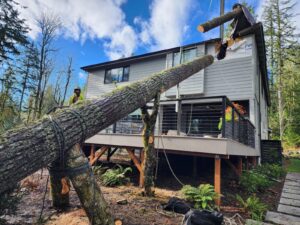
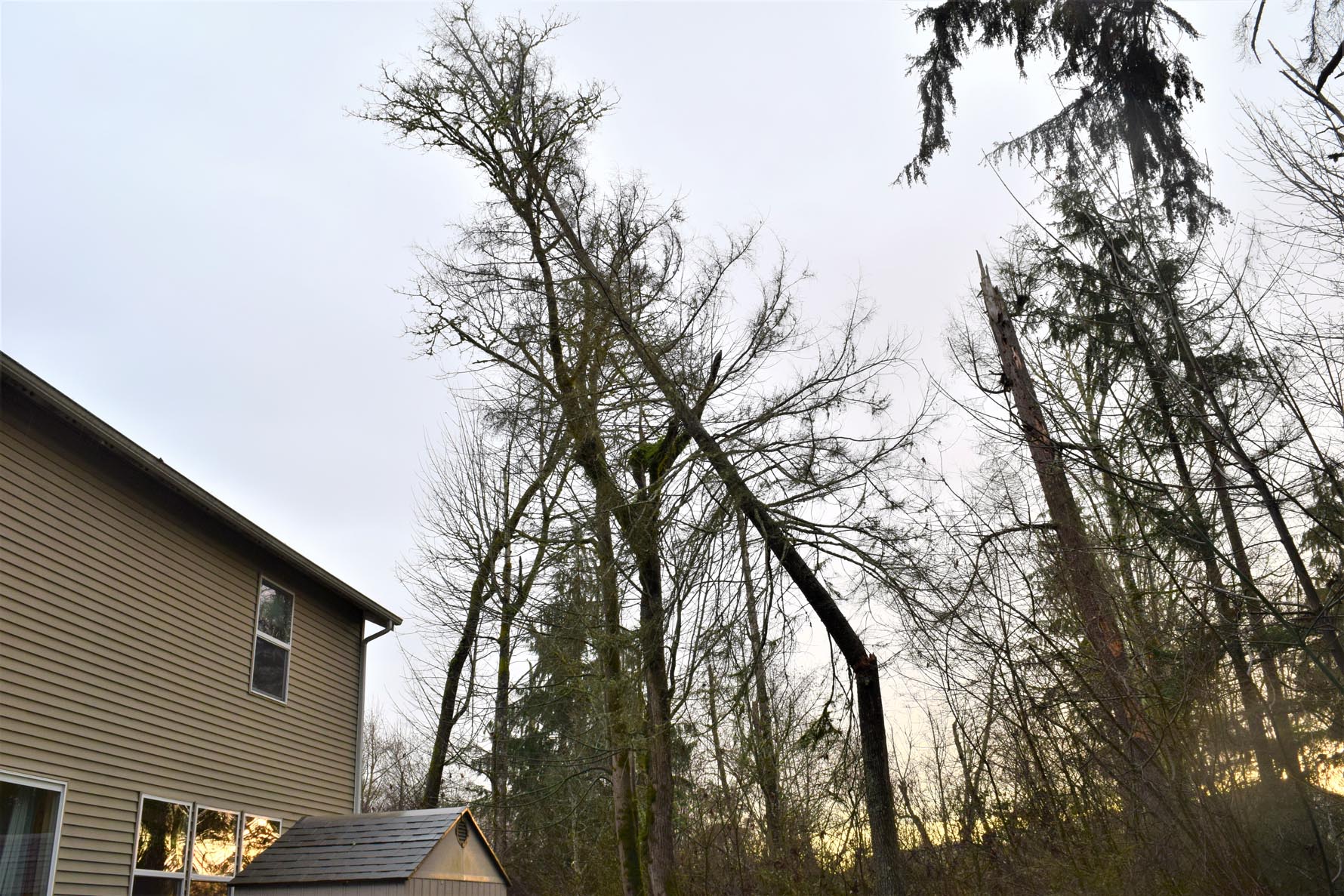
The hardest encroachment situation isn’t a nuisance — it’s a hazard. A Douglas Fir leaning over a Bonney Lake bedroom. A storm-damaged hemlock with hung-up limbs above an Edgewood patio. A diseased birch on the neighbor’s side showing fruiting bodies at the base. In Washington, the legal standard shifts when a tree on adjacent property poses a foreseeable risk of harm.
Once a property owner has been notified in writing that their tree is a hazard, and they fail to take reasonable steps to address it, they can be held liable for damage when the tree fails. This is why the first move when a neighbor’s tree looks dangerous is rarely to grab a chainsaw — it’s to document, notify, and escalate. Specifically:
Document. Photograph the tree from multiple angles. Note the date. Capture the symptoms — leaning angle, root plate lifting, mushrooms at the base, cracks in major scaffold limbs, recent dieback in the canopy. Pacific Arboriculture has worked alongside Maple Valley and Federal Way homeowners who saved themselves from major liability by having dated photos when a tree eventually failed.
Notify in writing. A polite letter to the neighbor describing the hazard, ideally with photos and the recommendation that a Certified Arborist evaluate the tree. Email works; certified mail is stronger. The point is to create a paper trail that proves the owner was on notice.
Get an independent arborist assessment. An ISA Certified Arborist can perform a formal arborist report using the Tree Risk Assessment Qualification (TRAQ) framework. The report grades the likelihood of failure, the consequences of failure, and the overall risk rating. This document is admissible in mediation, small claims, or insurance proceedings.
Escalate if necessary. If the neighbor refuses to act after written notice and a documented hazard assessment, options include municipal code enforcement (especially in cities like Renton, Tacoma, and Tukwila that have urban forestry codes), a homeowner’s insurance claim, or in extreme cases a civil action.
i-Tree by USDA Forest Service: Tree Benefits and Risk Tools
Washington L&I: Tree Care Safety Standards
Who Pays When a Tree Falls?
Washington follows the general rule that the property where the damage occurs is responsible for the cleanup and repair, regardless of which yard the tree originated in — unless the tree was a known hazard and the owner failed to act. A healthy tree that falls during a windstorm and lands on a Tacoma neighbor’s roof is treated as an “act of God.” The neighbor’s homeowner’s insurance covers the roof, and the tree owner’s insurance covers their side.
But when a dead, diseased, or visibly hazardous tree fails after the owner was put on notice, the calculus changes. The tree owner can be liable for the full damage to the neighbor’s property. This is the single biggest reason Pacific Arboriculture recommends getting a professional risk assessment when a neighbor raises a concern — the inspection itself is a fraction of the cost of a contested insurance claim, and a clean bill of health from a Certified Arborist is solid documentation that the owner acted reasonably.
Trees in Easements, Right-of-Way, and Utility Corridors
Property line disputes get an extra layer of complexity when a tree sits in an easement. Utility easements (often 10 feet on either side of a power line), drainage easements, access easements, and municipal right-of-way strips along Federal Way, Auburn, and Sumner streets all create zones where the homeowner may technically own the soil but the easement holder controls what can be planted or removed.
Three practical guidelines:
• A homeowner generally cannot remove a tree in a public right-of-way without permission from the city — and many South Sound cities require a permit application and arborist report. Auburn, Tacoma, Renton, and Federal Way all have urban forestry ordinances that govern street trees and ROW vegetation.
• A utility company (Puget Sound Energy, Tacoma Power, Lakehaven Water, etc.) generally has the right to prune or remove trees within their easement to maintain service reliability — without homeowner consent. This is why PSE crews can show up and top a tree near a transmission line.
• Drainage and access easements typically restrict planting of any tree species that will grow large enough to interfere with the easement’s purpose. This is worth checking before planting near a property line.
For specifics on local removal permits, the King and Pierce County tree removal permit guide walks through which municipalities require permits and what the process looks like.

The Diplomatic Playbook: How to Talk to a Neighbor About a Tree
Most encroachment cases never need a lawyer or a code officer — they get resolved at the property line over a cup of coffee. But the conversation matters. Homeowners who walk over with a chainsaw in hand rarely get a productive result. The approach that consistently works in Western Washington neighborhoods:
Lead with facts, not feelings. “The maple is dropping branches that are damaging the roof. Here are three photos from the last six months.” Specific, dated, photographed.
Bring a third-party perspective. A homeowner who arrives with a written arborist report typically gets a very different reception than one who arrives with a complaint. Pacific Arboriculture provides written assessments that homeowners can share with neighbors verbatim. An ISA Certified Arborist report depoliticizes the conversation. It’s no longer “your tree is a problem;” it’s “the certified expert flagged this.”
Offer a path forward. Splitting the cost of professional pruning, scheduling the work together, agreeing on a maintenance cadence. Many homeowners in Covington, Kent, Renton, and Burien have resolved long-running disputes by simply jointly hiring an arborist twice a year for ongoing canopy management.
Keep the paper trail. Whatever is agreed should be confirmed in a follow-up email or text. If the neighbor refuses to engage, the documented attempt strengthens any later case.
WSU Extension: Trees and Turf Resources for Western Washington
Washington DNR: Urban and Community Forestry Program
When to Get an ISA Certified Arborist Involved
Most encroachment disputes warrant a professional opinion at some point. Signs that the situation has moved beyond a do-it-yourself conversation:
• The tree is over 30 feet tall or has scaffold limbs over a structure
• Roots are damaging a foundation, sewer lateral, or major driveway
• There are visible signs of decay — conks, hollow areas, dieback, recent lean
• The tree sits in an easement or right-of-way
• A neighbor has formally objected to planned work
• The trunk straddles the boundary
• An insurance claim, code enforcement action, or legal dispute is pending or possible
An ISA Certified Arborist with TRAQ qualification can produce documentation that holds up in mediation and court — and just as importantly, can identify pruning approaches that solve the encroachment without creating new problems. Pacific Arboriculture handles these consultations across Bonney Lake, Puyallup, Edgewood, and the wider South Sound, including Lake Tapps, Sumner, Fife, Pacific, and SeaTac.
What this costs and what to expect
Arborist consultations for encroachment situations in the Western Washington market generally run between $250 and $600 for a written report, depending on the number of trees, the depth of analysis, and whether risk assessment scoring is required. Full TRAQ assessments for hazard-tree disputes run higher. The cost is almost always a fraction of the eventual remediation — and a small fraction of the potential liability if a hazardous tree fails after the owner was on notice. The Trees Are Good public-education site from the ISA covers what to expect from a qualified arborist visit.
For practical situations where homeowners are simply trying to manage a boundary canopy responsibly, a regular pruning maintenance visit every 2-3 years is the most cost-effective long-term play. Trees that are pruned correctly on a schedule rarely become encroachment disputes in the first place. The same logic applies to plant healthcare on aging trees — a boundary tree that’s actively managed for pests and decay is far less likely to become a hazard claim.
Frequently Asked Questions
Can a homeowner cut down a tree if half the trunk is on their property?
No. Under Washington law, a tree with a trunk straddling the property line is jointly owned, and removal generally requires the consent of both owners. Unilateral removal of a boundary tree exposes the cutting party to liability for the tree’s full replacement value, which can be substantial for a mature specimen. The right path is a written agreement (or, if the neighbor refuses, an ISA Certified Arborist report supporting the case for removal and, if necessary, formal mediation).
Do homeowners need a permit to remove a tree in their own yard in Washington?
It depends on the city. Auburn, Tacoma, Renton, Federal Way, and several other South Sound municipalities have tree removal ordinances that apply to certain species, sizes, locations (especially critical areas, slopes, and shorelines), and easements. The tree removal permit guide for King and Pierce County covers the specifics.
Should a homeowner tell the neighbor before pruning overhanging branches?
It’s not legally required for branches that cross the line and are pruned at the boundary, but it is strongly advised. A heads-up conversation prevents the surprise factor, gives the neighbor a chance to weigh in, and creates a paper trail showing the work was done in good faith. It also opens the door to a joint arborist visit — often the cheapest long-term solution.
Who is liable if a neighbor’s tree falls on a house?
If the tree was healthy and failed in a storm, the damaged property’s insurance generally covers it (“act of God” rule). If the tree was a known hazard and the owner failed to act after written notice, the tree owner can be liable. This is the single biggest reason to document concerns in writing and get an independent arborist assessment.
Can a homeowner sue a neighbor for tree debris in the yard?
Generally no for ordinary leaf and needle drop — that’s part of living near trees in the Pacific Northwest. But repeated heavy debris from a poorly maintained tree, especially after a documented request for the owner to address it, can support a nuisance claim in some circumstances. The bar is high and the better path is almost always negotiated maintenance.
Bottom line: Tree encroachment in Western Washington is rarely a black-and-white legal question — it’s a mix of property rights, arboriculture, and neighbor diplomacy. The homeowners who handle it best document early, communicate clearly, bring in an ISA Certified Arborist when the stakes rise, and avoid the unilateral chainsaw move that turns a small issue into a small-claims case. Pacific Arboriculture provides arborist reports, risk assessments, and removal services across Auburn, Kent, Renton, Tacoma, Federal Way, Burien, Puyallup, Bonney Lake, Edgewood, Lake Tapps, Maple Valley, Covington, Des Moines, Tukwila, Sumner, Fife, Pacific, Fairwood, SeaTac, and Normandy Park — and the right next step on a boundary tree is almost always a phone call before a chainsaw.
For a property-line tree assessment or written arborist report, homeowners can request a consultation with Pacific Arboriculture. The Pacific Arboriculture resource library covers related topics like leaning trees, compacted soil, and bark beetle treatment for South Sound homeowners.