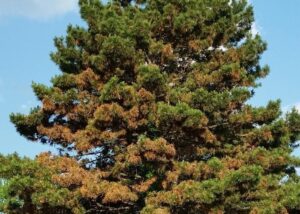
Late June in Western Washington is when tree leaves start showing problems. Spots appear. Edges curl. Powdery coatings dust the surface. Branches in the lower canopy thin out while the rest of the tree looks fine. Most homeowners assume the worst — an immediate removal call, a spray schedule, or panic over a “dying” tree. The reality is more nuanced. Many leaf diseases in the Pacific Northwest are cosmetic, self-limiting, and rarely fatal to mature trees. A few are serious. The trick is telling them apart fast enough to act on the ones that matter.
This field guide covers the leaf-disease signs that show up across Auburn, Tukwila, and Sumner yards every June: anthracnose, powdery mildew, leaf spot, shot hole, and a handful of look-alikes. Each section breaks down what the symptoms look like in real life, which species are affected most, whether treatment is warranted, and when a paid arborist consultation actually pays off. Pacific Arboriculture’s ISA Certified Arborists diagnose these issues across the South Sound every week — the goal here is to give homeowners enough information to know whether what they’re seeing on the leaves is a five-dollar problem or a five-thousand-dollar one.

Why June Is Peak Leaf-Disease Season in Western Washington
Leaf diseases need three things: a host plant, a pathogen, and the right environmental window. Western Washington’s spring delivers all three at once. Wet, cool weather from March through May lets fungal spores germinate on emerging leaves. Then the first warm, humid stretch of June pushes those infections into visible symptoms — usually two to four weeks after the actual infection event. By the time a homeowner notices spots, the damage was done weeks earlier and the fungus has already moved on.
That timing matters because the most common response — racing to spray fungicide in late June — almost always misses the infection window. Most fungal leaf diseases on mature trees are controlled by sanitation (cleaning up fallen leaves) and structural pruning for airflow, not by reactive sprays. The exceptions are worth knowing.
Anthracnose: The Most Common Leaf Disease in the South Sound
Anthracnose is a family of fungal diseases that hit big-leaf maple, sycamore, dogwood, ash, and oak hardest. It’s the disease most homeowners in Tukwila and Auburn are looking at when they see brown blotches along leaf veins, irregular dead patches, or curled, crispy edges on what was a healthy-looking leaf two weeks ago. Severe years cause premature leaf drop in June and July, which looks alarming but rarely kills the tree.
What anthracnose looks like
- Irregular brown or tan blotches that follow leaf veins instead of forming neat circles
- Curling, cupping, or distortion of young leaves
- Premature defoliation — especially in the lower and inner canopy
- Twig dieback on dogwoods and sycamores (this is the symptom that matters)
- Black or dark-brown lesions on petioles (leaf stems)
When anthracnose is serious
On a mature big-leaf maple, anthracnose is almost always cosmetic — the tree may shed a portion of its early canopy and re-leaf in July. On a flowering dogwood (especially Cornus florida), anthracnose can be lethal because the fungus moves from leaves into twigs and branches. Dogwood anthracnose has killed entire populations of wild flowering dogwood across the eastern U.S. and is established in parts of Western Washington. Pacific Coast natives like Cornus nuttallii are particularly vulnerable.
The WSU Hortsense database documents anthracnose distribution across PNW host species, and the ISA TreesAreGood factsheet on anthracnose is the homeowner-level reference. For a structural diagnosis on a high-value dogwood or specimen tree, an arborist report and consultation documents the disease severity and treatment options.
What to do about anthracnose
- Rake and remove fallen leaves in autumn — they harbor overwintering spores. Do not compost diseased leaves.
- Prune for airflow in the dormant season. Crown cleaning (removing dead/diseased wood) and selective thinning reduce humidity inside the canopy where the fungus thrives. See the tree pruning service page for the South Sound pruning calendar.
- Skip the sprays on mature trees. Fungicides only work preventatively (applied at bud break), and the spray equipment needed to reach a 40-foot canopy is rarely worth the cost or risk for a cosmetic disease.
- Replace lethal-host dogwoods with resistant hybrids (Cornus kousa, Cornus × rutgersensis) if the tree is in decline.
Powdery Mildew: White Dust on Maple, Dogwood, and Oak Leaves
Powdery mildew is the easiest leaf disease to identify — a white or gray powdery coating on the upper leaf surface that looks exactly like flour. It hits big-leaf maple, vine maple, dogwood, oak, and a long list of ornamental shrubs. Unlike most fungi, powdery mildew thrives in dry weather with high humidity at night — Western Washington’s late June and July climate is ideal. June outbreaks across Auburn and Sumner usually peak in early August.
What powdery mildew looks like
- White-to-gray powdery coating on the upper leaf surface
- Affected leaves may yellow, curl, or drop early
- New growth at branch tips often shows symptoms first
- Twigs and shoots can become distorted on highly susceptible species
When powdery mildew matters
On established trees, powdery mildew is essentially never fatal. The fungus lives on the leaf surface and doesn’t penetrate deeply into plant tissue. It can stunt growth on young trees and severely impact ornamental shrubs, but mature maples and oaks tolerate it without long-term damage. The exception is on stressed trees — drought-stressed maples with powdery mildew may show accelerated decline because the leaf surface area available for photosynthesis is reduced when the tree most needs energy reserves. Combining powdery mildew with summer drought stress is one of the slow declines an arborist watches for during a plant healthcare assessment.
Leaf Spot, Shot Hole, and Apple Scab: The “Brown Spot” Diseases
Once anthracnose and powdery mildew are ruled out, the next big category is the leaf spot complex — a loose group of fungal and bacterial pathogens that produce small, defined spots on leaves. Telling them apart matters because management differs significantly.
Leaf spot (Septoria, Phyllosticta, others)
Small, circular spots — usually 1/8 to 1/4 inch — with dark borders and lighter centers. Often shows up first on the lower canopy after extended wet weather. Common on maple, ash, hawthorn, oak, and many ornamentals. Cosmetic on mature trees; sanitation (raking and removing leaves) is the only intervention warranted.
Shot hole disease
Specific to Prunus species — cherry, plum, peach, and ornamental cherries. Small brown spots appear on leaves, then the dead tissue falls out, leaving holes that look like the leaf was peppered with a shotgun. Caused by either Wilsonomyces carpophilus (fungus) or Xanthomonas bacteria. Severe in wet springs, often dramatic to look at, rarely lethal on established trees. Affected ornamental cherries in Tukwila and Pacific Northwest yards routinely show shot hole every June. Sanitation and pruning out heavily infected branches are the standard response.
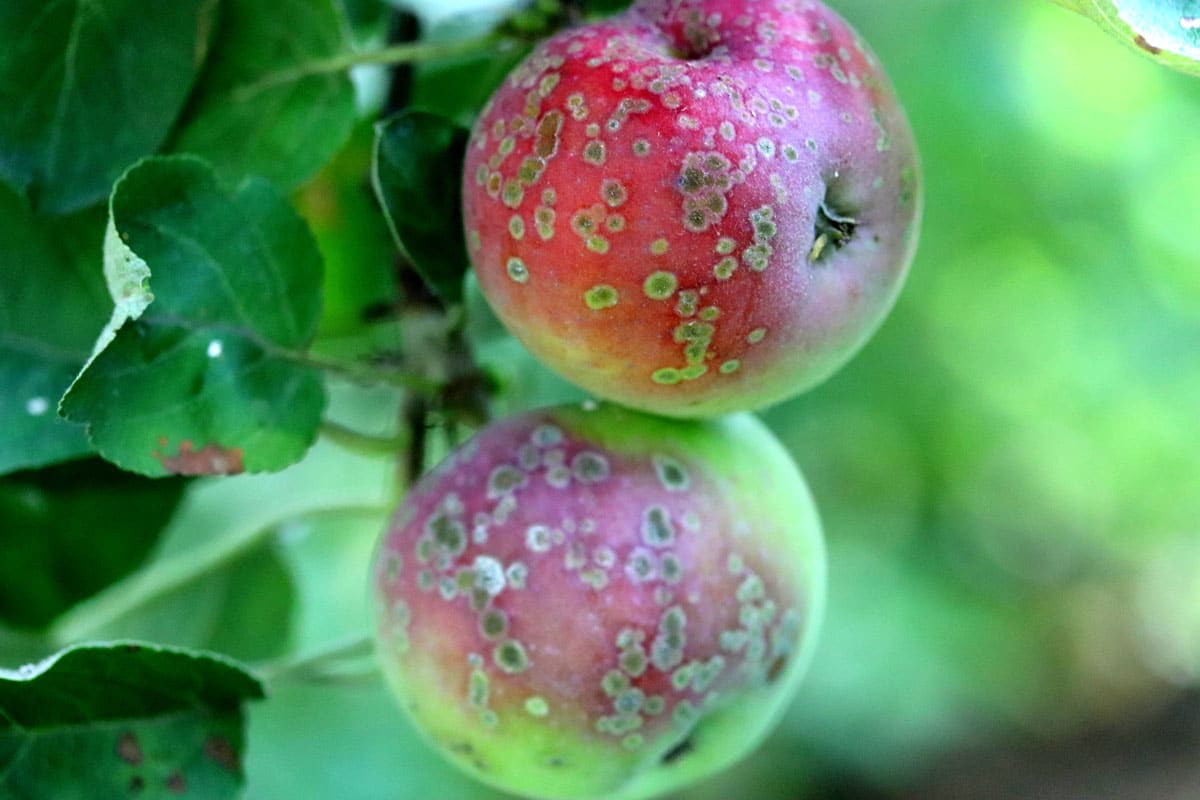
Apple scab
Affects apple, crabapple, and pear. Olive-green to brown velvety spots on leaves and fruit. Heavily infected fruit becomes cracked, distorted, and inedible. The most aggressively managed of the leaf-spot diseases because of fruit impact — most orchard programs use scheduled fungicide sprays from bud break through petal fall. For ornamental crabapples, planting scab-resistant cultivars (Prairifire, Sugar Tyme, Adirondack) is more practical than spray programs. The USDA Plant Health resources publish current cultivar resistance ratings.
Two Diseases That Are Often Misdiagnosed as Leaf Disease
Verticillium wilt
Verticillium is a soil-borne fungus that enters tree roots and clogs the water-conducting xylem from the inside out. It looks like a leaf disease — wilting, scorching, and dieback on one branch or one side of the tree — but the cause is vascular blockage, not a foliar pathogen. Maple, ash, smoketree, redbud, and many shrubs are susceptible. There is no cure. Diagnosis requires lab confirmation of a wood sample. Pacific Arboriculture has seen Verticillium incorrectly treated as anthracnose for years before the tree was sampled and confirmed. The previous article on Verticillium wilt in Western Washington maples details the diagnostic process.
Drought scorch and heat damage
Brown crispy leaf edges that look like a leaf disease are often physiological — the tree ran out of water and the leaf margins (furthest from the water-conducting tissue) died first. Drought scorch is symmetrical across the canopy; fungal diseases usually start in one zone. Mid-June through August scorch in Auburn and Sumner is increasingly common as the region trends toward hotter, drier summers. See the recent article on heat wave tree survival for the watering protocol that prevents most scorch issues.
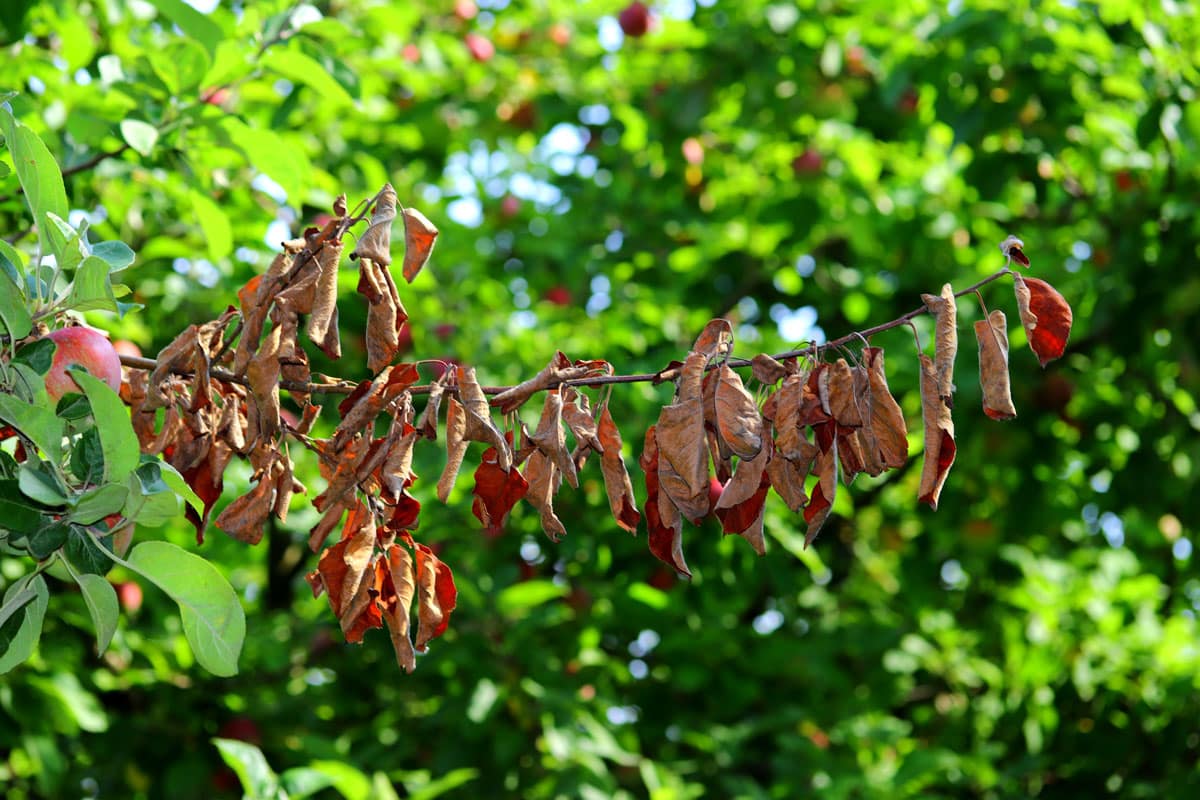
The One Bacterial Disease Worth Calling an Arborist Over: Fire Blight
Fire blight (Erwinia amylovora) is the exception to the “most leaf diseases are cosmetic” rule. It’s bacterial, fast-moving, and routinely kills pear, apple, ornamental pear (Bradford, Cleveland Select, Chanticleer), hawthorn, mountain ash, and serviceberry trees. The name comes from the appearance — affected shoots look as if they were scorched by fire. Leaves turn brown or black but stay attached to the branch instead of falling. Shoot tips bend into a “shepherd’s crook.” Cankers ooze a tan or amber bacterial slime in warm weather.
Fire blight spreads during bloom through pollinators and rain splash. Once a tree shows symptoms, the bacteria are already systemic in the affected branches. Treatment requires aggressive pruning — cutting at least 8 to 12 inches below visible symptoms, sterilizing tools between every cut, and removing infected wood from the property entirely. On valuable trees, copper-based bactericides applied at bloom are preventative; once symptoms appear, sprays do not help.
If ornamental pears or fruit trees show suspected fire blight, the right next step is an ISA Certified Arborist consultation — fire blight pruning done wrong (dirty tools, insufficient cut depth) can spread the disease throughout the tree faster than doing nothing.
How to Tell If a Tree Disease Warrants an Arborist Visit
Most leaf-disease calls Pacific Arboriculture receives between June and August fall into one of three categories: cosmetic disease on a mature tree (no visit needed), genuinely declining tree (full risk assessment warranted), or something the homeowner isn’t sure about (consultation makes sense). The decision tree:
- Leaves spotted but tree looks otherwise healthy — sanitation only, no visit needed.
- Significant defoliation, dieback in upper canopy, or one whole branch affected — schedule an assessment. Could be Verticillium, fire blight, or a non-foliar disease showing as leaf symptoms.
- Suspected fire blight on pear/apple/hawthorn — same day or next-day consultation. Aggressive pruning timing matters.
- Multiple trees on the property showing the same symptom — site assessment. Could indicate environmental factor, irrigation issue, or transmission pattern.
- Tree near structures, walkways, or play areas with branch dieback — risk assessment regardless of disease. Dead wood in the canopy is a hazard. See the recent piece on dangerous tree species and property risk.
Sanitation: The Underrated Step Most Homeowners Skip
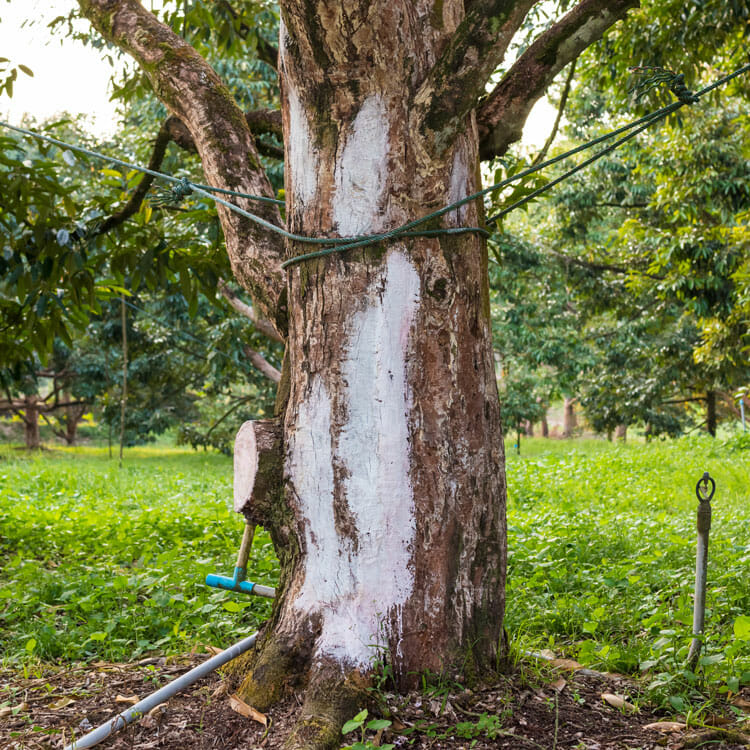
Most foliar diseases overwinter in fallen leaves and twigs on the ground beneath the tree. The single highest-impact intervention for next year’s leaf-disease severity is removing this litter in the fall — raking, bagging, and disposing of infected leaves rather than mulching them back into the bed. Pacific Arboriculture sees the difference clearly: properties that practice fall sanitation typically have 50-70% less disease pressure the following spring.
This applies most strongly to:
- Dogwoods (anthracnose)
- Big-leaf maples (anthracnose, leaf spot, powdery mildew)
- Cherries and Prunus species (shot hole)
- Apples and crabapples (apple scab)
- Ornamental pears (fire blight)
The WSU Extension publishes detailed home-orchard sanitation calendars worth bookmarking.
Pruning for Disease Prevention: Airflow Beats Sprays
The second-highest-impact intervention is structural pruning to improve airflow through the canopy. Fungal spores need moisture on the leaf surface for several hours to germinate. A canopy that dries quickly after morning dew or rain dramatically reduces successful infection events. Crown thinning (selective removal of live secondary branches, capped at 25% canopy per ISA standards) is the standard approach. For details, the recent crown pruning methods guide covers thinning, cleaning, and reduction.
Pruning timing matters too. Most leaf-disease pruning should happen during dormancy (November through February) — pruning during active disease can spread spores. The exception is fire blight, where infected wood should be removed as soon as it’s identified, regardless of season, with tools sterilized between every cut.
When Tree Disease Means the Tree Should Be Removed
Leaf-disease symptoms alone almost never warrant removal. A tree gets considered for removal when it shows:
- Advanced canopy dieback (>50% dead wood) regardless of disease cause
- Fire blight that has reached the central leader or main scaffold branches
- Verticillium wilt with progressive vascular collapse season over season
- Conks (fruiting bodies) of decay fungi at the base or on the trunk — see the fungal disease field guide for visual ID
- Structural defects combined with disease pressure that make rehabilitation uneconomical
For these cases, Pacific Arboriculture’s tree removal services and, where access requires it, crane-assisted tree removal are the right path. Removal decisions are made after a written arborist assessment, not on the basis of one summer’s leaf symptoms.
Service Area: Where Pacific Arboriculture Handles Disease Diagnosis
Pacific Arboriculture’s ISA Certified Arborists handle leaf-disease diagnosis, plant healthcare consultations, structural pruning for disease prevention, and disease-related removals across the South Sound — including Auburn, Tukwila, and Sumner. The service area also covers Kent, Federal Way, Renton, Tacoma, Puyallup, Covington, Maple Valley, Lake Tapps, Edgewood, Bonney Lake, Des Moines, Burien, Normandy Park, Fife, SeaTac, Fairwood, and Pacific. Auburn, Tukwila, and other city-level service information is available on the site.
Arborist consultations are licensed and bonded under Washington L&I requirements. ISA Certified Arborist credentials can be verified through the ISA Find-an-Arborist directory.
FAQ: Leaf Diseases on Western Washington Trees
Do I need to spray my tree if I see brown spots on the leaves?
Almost never on a mature tree. Most foliar fungal diseases are controlled through sanitation (cleaning up fallen leaves in autumn) and structural pruning for airflow. Fungicide sprays only work preventatively, must be applied at bud break before symptoms appear, and the equipment needed to reach a mature canopy is rarely worth the cost for a cosmetic disease. The major exception is apple scab on fruit-bearing orchard trees.
Can I tell anthracnose from leaf spot just by looking?
Often yes. Anthracnose tends to produce irregular blotches that follow leaf veins, with curling and distortion of young leaves. True leaf spot diseases (Septoria, Phyllosticta) produce small, defined circular spots with clear borders. If the spots are 1/8 to 1/4 inch with dark edges, it’s leaf spot. If the brown areas are irregular and follow the leaf veins, it’s anthracnose. Field photos with a smartphone are usually enough for an arborist to confirm.
Is powdery mildew going to kill my tree?
On a mature, established tree — no. Powdery mildew lives on the leaf surface and doesn’t penetrate the plant deeply. It can stunt growth on young trees and is more damaging on ornamental shrubs. The bigger concern is the combination of powdery mildew and drought stress on the same tree, which accelerates decline. Established maples and oaks tolerate annual powdery mildew without long-term harm.
What’s the difference between fire blight and other leaf diseases?
Fire blight is bacterial, not fungal — and it’s the one foliar disease that can kill a tree quickly. Affected shoots look scorched (hence “fire” blight), with blackened leaves that stay attached to the branch. Shoot tips often bend into a shepherd’s crook shape. Cankers may ooze tan or amber bacterial slime in warm weather. Pear, apple, ornamental pear, hawthorn, mountain ash, and serviceberry are the main hosts. Suspected fire blight should be diagnosed by an ISA Certified Arborist promptly.
Can I prune diseased branches in summer?
For most diseases, no — summer pruning spreads spores and stresses the tree during active growth. The major exception is fire blight, where infected wood should be removed immediately regardless of season, with tools sterilized between every cut and the wood removed from the property. For all other foliar diseases, structural pruning should wait for dormancy (November through February).
The Bottom Line on June Leaf Diseases
Most leaf-disease calls in Auburn, Tukwila, and Sumner this month will resolve themselves with autumn sanitation and patience. A few are serious and warrant intervention. The difference is whether the symptoms are foliar-only on a mature tree (cosmetic, no action needed beyond clean-up) or whether there’s branch dieback, one-sided wilting, blackened scorched-looking shoots, or rapid decline (genuine diagnostic event). When in doubt, photos sent to an ISA Certified Arborist beat a guess at the garden center every time.
For homeowners across Auburn, Tukwila, and Sumner who want a trained eye on a tree that’s showing summer leaf problems, Pacific Arboriculture’s arborist reports and plant healthcare consultations document the diagnosis in writing and outline the realistic options. Most calls end without a recommendation for sprays or removal — and that’s the right answer most of the time.