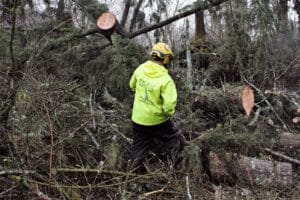

Western Washington does not get many thunderstorms, and that is exactly why a lightning strike catches homeowners off guard. The state averages roughly 20,000 lightning flashes a year, a modest number next to the Midwest or the Southeast. But a single strike can ruin a mature Douglas fir in less than a second.
A strike superheats the moisture inside the wood. That moisture flashes to steam, expands violently, and splits the tree from the inside out. Some of the damage is obvious. Much of it is not, and the hidden damage is what makes a struck tree unpredictable for months afterward.
Washington State Climate Office: Thunderstorms in WA State
How to Tell If a Tree Was Struck by Lightning
Strike damage usually follows the path of least resistance down the outside of the trunk. Look for:
- A vertical strip of bark blown off the trunk, often spiraling from the crown toward the base
- Deep vertical cracks in the trunk or in major limbs
- Split or shattered branch unions
- Scorched or blackened bark along the strike path
- Wood and bark fragments thrown well out into the yard
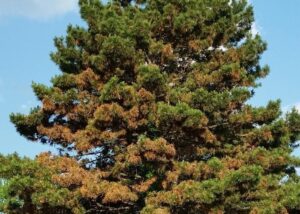
- Sudden wilting or browning across the whole crown in the days that follow
Sometimes the only visible clue is a narrow scar. Interior damage from the discharge can run the full height of the trunk and down into the root plate without ever breaking the surface, which is why a quick glance from the driveway is not an assessment.

What to Do in the First 24 Hours
Safety comes before diagnosis. Treat every downed limb near a power line as energized and call the utility or 911 rather than approaching it. Pacific Arboriculture does not perform line clearance work, and no homeowner should attempt it either.
Once the area is safe, keep people, cars, and equipment out from under the crown. Photograph the tree and any property damage from several angles while the evidence is fresh, since insurers ask for it later. Then have the tree looked at by a qualified professional before anyone cuts anything. A certified arborist can tell the difference between cosmetic scarring and a trunk that has lost its structural integrity.
If the tree is leaning over a house, blocking a driveway, or dropping limbs, that is an emergency tree service call, not a next-week appointment. The same urgency test used for storm emergencies in Auburn applies to lightning damage.
National Weather Service: Lightning Safety
Will the Tree Survive?
Outcomes vary more than most homeowners expect. Trees that lose a narrow strip of bark on one side frequently recover and wall off the wound on their own. Trees that lose bark around more than half the circumference have lost the vascular tissue that moves water and sugars, and those rarely recover.
Species matters, and so does the condition of the tree before the strike. A drought-stressed conifer has far less in reserve than a vigorous one, which is the same principle behind summer hazard tree assessment. Wounded, stressed wood also attracts secondary attackers, so watch for bark beetle activity and decay fungi over the following two seasons.
International Society of Arboriculture: Mature Tree Care
When a Lightning-Struck Tree Has to Come Down
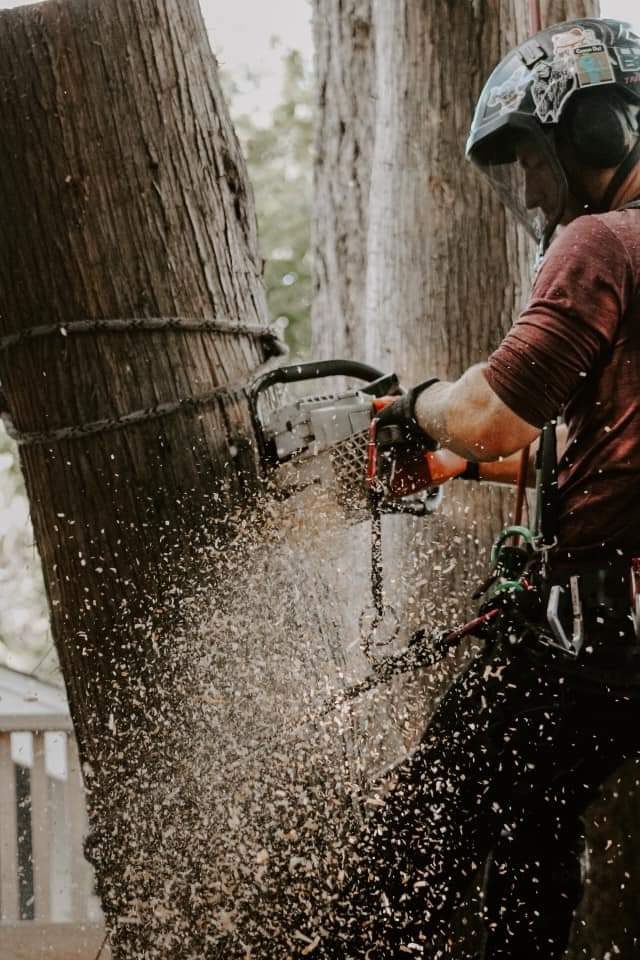
Removal becomes the right answer when the structure of the tree is gone rather than merely marked. The usual triggers are a crack that runs through the trunk, bark loss around most of the circumference, a root plate that has lifted, or crown dieback that worsens month over month. A tree standing over a bedroom raises the stakes on all of it.
A compromised trunk changes how the work gets done. Climbing a tree with unseen internal cracks is not acceptable, so crane-assisted removal is often the safer method for lightning-damaged conifers. For the broader judgment call, this damaged tree decision framework walks through the same criteria.
Permits still apply. Many South Sound jurisdictions require approval even for a hazardous tree, though most have an emergency provision. Check the King and Pierce County permit rules before scheduling non-emergency tree removal.

Protecting High-Value Trees From the Next Strike
Tall, isolated, or heritage trees near a house can be fitted with a lightning protection system: a copper conductor run from the upper crown down the trunk to a ground rod set away from the root zone. Installed to the ANSI A300 Part 4 standard, these systems are effective, and they are worth considering for a specimen tree that would be expensive or impossible to replace.
Storm calls arrive from across the South Sound every summer, and Pacific Arboriculture handles lightning-damaged trees in Maple Valley, Des Moines, and Fairwood along with the rest of the service area.
ISA: ANSI A300 Tree Care Standards
Washington DNR: Urban and Community Forestry
Frequently Asked Questions
Can a tree survive being struck by lightning?
Many do. Relatively few trees are shattered outright by a strike. Survival depends on how much of the cambium was destroyed, whether the root plate was involved, and how healthy the tree was beforehand. A vigorous tree with a narrow scar often recovers over two or three growing seasons.
How long does it take to know if a lightning-struck tree will die?
Plan on watching through at least one full growing season, and ideally two. Some trees leaf out normally the following spring and then decline sharply in the second year as root and vascular damage catches up. Progressive crown dieback is the clearest warning sign.
Is a lightning-struck tree dangerous to be around?
It can be. The electrical discharge can crack wood deep inside the trunk without breaking the surface, so a tree that looks intact may have lost much of its structural strength. Keep people and vehicles clear until a qualified arborist has inspected it.
Should a damaged tree be fertilized right after a strike?
No. Heavy nitrogen pushes out new growth the tree cannot support while it is busy repairing wounds and walling off decay. Deep, infrequent watering through the dry summer months does far more good for a recovering tree. Any treatment plan should follow a proper inspection rather than come before one.
Think a tree on the property took a hit? Have it inspected before the next windstorm tests it. Pacific Arboriculture provides ISA Certified Arborist assessments across the South Sound — call 206-909-2170 to schedule one.