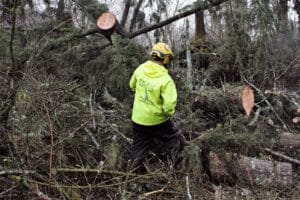
Leyland cypress is the most common privacy-hedge mistake in the South Sound. Fast-growing, cheap at the garden center, popular on TikTok — and structurally wrong for wet winters, dry summers, and clay soils across Edgewood, Federal Way, and Puyallup. Once the roots hit compacted fill or the crown catches a 40-mph gust off the Puget lowlands, homeowners end up calling a certified arborist for removal instead of pruning.
This guide covers what actually fails, why, and six better options a Pacific Arboriculture certified arborist will recommend for a screening hedge that lasts thirty years instead of eight.
Why Leyland cypress fails in the South Sound
Leyland cypress (×Cupressocyparis leylandii) was bred in the UK for temperate maritime conditions with steady moisture year-round. Western Washington gets wet winters and increasingly dry summers, and that mismatch shows up three ways.
Wind and root failure
Leylands are shallow-rooted and grow 3–4 feet per year. That combination is a lever waiting for wind. According to Alabama Cooperative Extension research on Leyland cypress canker and dieback, shallow rooting combined with hot dry summers is the strongest predictor of failure, and the same pattern shows up across the maritime PNW. In moderate summer wind — the kind that hits Edgewood ridges most July afternoons — a mature Leyland with wet feet is a hazard tree.
Laminated root rot and Seiridium canker
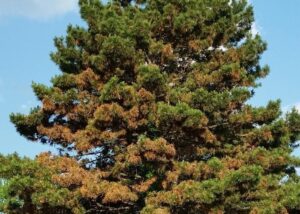
South Sound clay soils hold laminated root rot spores that Leylands are not resistant to. Add Seiridium canker — the copper-brown dieback most homeowners mistake for drought — and a hedge that was solid at year 5 is patchy at year 8. Once canker takes hold, removal is the only fix. WSU Hortsense documents Seiridium canker across the region, and the PNW Plant Disease Handbook lists resistant alternatives including western red cedar.
Overplanting
Most Leyland hedges are planted 6–8 feet apart. Mature spread is 15–25 feet. Within a decade the crowns fuse, airflow drops, fungal pressure spikes, and the interior needles die back. There is no pruning fix for a hedge planted twice as dense as it should be.

Six better privacy trees for South Sound yards
These species are matched to PNW soils, drought tolerance, and wind exposure. Every one is available at regional nurseries and installable by Pacific Arboriculture.
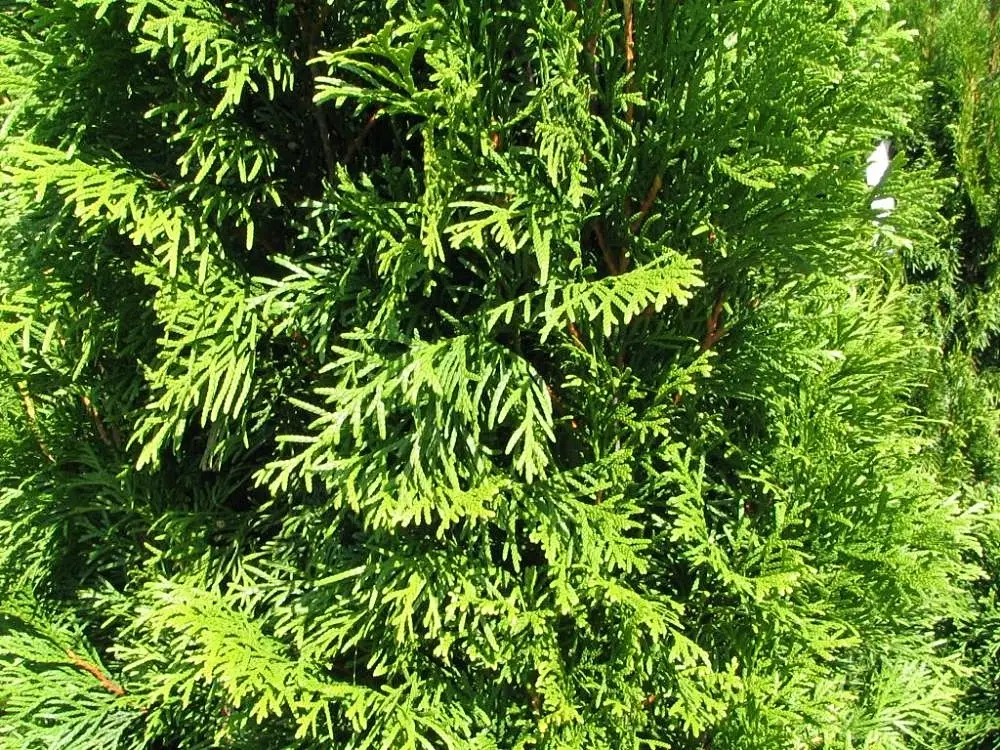
1. Emerald Green arborvitae (Thuja occidentalis ‘Smaragd’)
Narrow columnar habit, 12–15 feet tall, 3–4 feet wide. Deer-resistant when established, tolerates clay, and holds green color through winter. Space 3 feet on-center for a solid screen in 5 years. See the arborvitae care sheet for planting depth and mulch specs.
2. Western red cedar (Thuja plicata) — ‘Excelsa’ cultivar
Native to the PNW and unmatched at handling wet winters. The ‘Excelsa’ cultivar stays narrower than wild-form cedars, hitting 20–30 feet without dominating a suburban lot. Requires deep watering during summer drought — see cedar flagging and drought recovery.
3. Hinoki cypress (Chamaecyparis obtusa)
Slower-growing (6–10 inches per year) but virtually disease-free in western Washington. Reaches 15–20 feet in twenty years with elegant layered foliage. Best pick for a hedge that will outlast the mortgage. Details on the Hinoki cypress reference page.
4. Incense cedar (Calocedrus decurrens)
Fire-resistant, drought-tolerant once established, and structurally sound in wind. Grows 30–50 feet — better as a specimen or corner screen than a boundary hedge. Pairs well with hazard assessment for summer storm and wildfire season.
5. Portuguese laurel (Prunus lusitanica)
Broadleaf evergreen, denser and cleaner than English laurel, less invasive, tolerates hard pruning. 10–15 feet with regular shaping. A strong option where a formal look matters.
6. Skip laurel (Prunus laurocerasus ‘Schipkaensis’)
Faster than Portuguese laurel, more cold-tolerant, and shade-adapted. 10–18 feet. Works along shaded property lines where arborvitae would thin out.
What to check before planting
Species selection is only half the outcome. Site conditions decide the other half.
- Soil drainage: Dig a 12-inch test hole, fill with water, and time the drain. Anything over 6 hours means clay-adapted species only.
- Wind exposure: Ridge lots in Edgewood and Bonney Lake need deeper-rooted species (western red cedar, incense cedar) instead of arborvitae.
- Underground utilities: Call 811 at least 48 hours before digging. Every year Pacific Arboriculture pulls trees planted directly over gas or fiber lines.
- Setbacks: Most South Sound cities require 3–5 feet from property lines. Check the MRSC development-regulations index for the specific city.
When to call a certified arborist
For a screen under 8 feet with clear soil and no utility conflicts, most homeowners can plant themselves. Bring in an ISA Certified Arborist when the site involves clay soils, slope, existing hazard trees, boundary disputes, or a project budget over $3,000. An arborist consultation runs $200–350 and typically saves 3–5x that on planting mistakes.
Pacific Arboriculture services Edgewood, Federal Way, and Puyallup with tree installation, hazard assessment, and long-term care planning. Related reading: Top 5 low-maintenance evergreens for privacy.
Frequently asked questions
Can I keep an existing Leyland cypress hedge alive longer?
Yes, with early intervention. Thin every third tree to restore airflow, treat Seiridium canker branches by pruning 6 inches below the canker, and mulch a 3-inch ring out to the drip line. Expect 3–5 additional years, not decades. A hedge already past 10 years is usually easier to replace than restore.
Do arborvitae attract deer in the South Sound?
Emerald Green arborvitae is browse-resistant once established (2+ years), but young plants get hit hard in winter. Deer pressure is highest in Bonney Lake, Lake Tapps, and rural Puyallup. A 6-foot temporary fence for the first two winters protects the investment.
How close to a fence should a privacy tree go?
Most South Sound cities require 3–5 feet from a property line, depending on mature size. Fence 6 feet from an arborvitae, 8–10 feet from a western red cedar, and 15 feet from an incense cedar. Roots need room even when the crown is narrow.
Will a certified arborist recommend Leyland cypress at all?
Rarely, and only for very specific sites — well-drained sandy soil, protected from prevailing wind, planted at correct 12-foot spacing, and with a clear replacement plan at year 15. The species is not inherently bad, but the way it is typically planted in the South Sound sets it up to fail.