Emerald ash borer (EAB) is the most destructive tree pest in North American history. It has killed hundreds of millions of ash trees since arriving in Michigan in 2002, and Washington State officially confirmed its arrival in Forest Grove, Oregon in 2022 — just 150 miles south of Edgewood, Des Moines, and Bonney Lake. Every ash tree in the region is now on the clock.
Here is what a Pacific Northwest homeowner with ash trees on the property needs to know: how to identify the pest, what infestation looks like, and the treatment window that decides whether a tree can be saved.
Why EAB Is Different From Other PNW Pests
Native ash borers, bark beetles, and even the destructive bronze birch borer target stressed or dying trees. Emerald ash borer attacks healthy, vigorous ash trees. It does not need a stressed host. Once EAB establishes in an area, the local ash mortality rate approaches 99 percent within 8 to 10 years without intervention.
The pest is a metallic-green beetle roughly the size of a grain of rice. The adults are visible from May through August. The real damage happens under the bark, where larvae carve S-shaped tunnels through the tree’s cambium — the layer that transports water and nutrients. Once enough tunnels girdle the tree, the crown dies from the top down.

How to Identify an Ash Tree
Not every tree with “ash” in the name is a true ash. EAB attacks the Fraxinus genus: green ash, white ash, black ash, blue ash, and Oregon ash (the native PNW species). Mountain ash, though similarly named, is Sorbus and is not a host.
True ash identification markers:
- Compound leaves with 5 to 11 leaflets arranged opposite each other along a central stem
- Opposite branching — branches grow in pairs directly across from each other (rare in PNW trees, mainly maples and dogwoods share this)
- Diamond-pattern bark on mature trees, deep ridges forming an X pattern
- Winged seeds (“samaras”) in clusters, single-winged and paddle-shaped (not helicopter pairs like maple)
Oregon ash is the native species most common in low-lying and riparian areas across the South Sound. Green ash and white ash appear in urban plantings, particularly along streets and in commercial landscapes planted in the 1980s and 90s.
Signs of Active Infestation
Early EAB damage is subtle. By the time obvious symptoms appear, the tree is often past saving. Watch for these signs in order of severity:
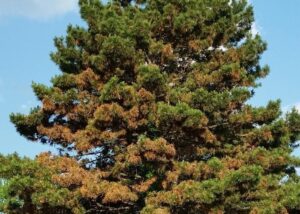
- Canopy dieback from the top down — the classic first sign, usually appearing 2 to 4 years after initial infestation
- Epicormic sprouting — clusters of small shoots emerging from the trunk or root flare, a stress response to canopy loss
- Bark splits revealing S-shaped larval galleries underneath
- D-shaped exit holes about 1/8 inch wide — the distinctive shape of adult EAB emergence
- Increased woodpecker activity — flaking, patchy bark loss where birds are hunting larvae
The bronze birch borer creates similar damage patterns on birches, but the D-shaped exit hole is the key EAB signature. A magnifying glass and careful bark inspection can confirm.

Treatment Options and the 30 Percent Rule
Ash trees can be saved with systemic insecticide treatments if caught early. The industry benchmark: trees with less than 30 percent canopy dieback respond well to treatment. Trees with 30 to 50 percent dieback have mixed outcomes. Trees over 50 percent dieback are usually removed rather than treated.
Treatment options for viable ash trees:
- Systemic trunk injection — the gold standard, applied every 2 to 3 years by a licensed arborist. Effective across the tree’s full canopy.
- Soil drench — homeowner-accessible but less effective on large trees, requires annual application
- Bark spray — fast-acting but shorter residual, professional application only
A certified plant healthcare specialist can assess canopy dieback percentage and recommend the right chemistry. Untreated ash trees over 25 feet tall often require crane-assisted removal once mortality sets in, because the wood becomes brittle and dangerous to climb.
What to Do Right Now if There Is an Ash Tree on the Property
First, confirm identification using the compound-leaf and opposite-branching markers above. Second, inspect for the early warning signs. Third, decide whether the tree is worth preserving. High-value ash — mature specimens providing significant shade, screening, or property value — are strong candidates for preventive treatment. Small ash or those already in decline are candidates for professional removal and replacement with a non-host species like oak, maple, or Douglas fir.
The Washington State Department of Agriculture maintains active EAB surveillance and publishes county-by-county detection updates. Penn State Extension and the Arbor Day Foundation publish detailed treatment decision guides. For confirmed detection in a specific tree, WSU Hortsense is the PNW-specific reference.
Frequently Asked Questions
How long does an untreated ash tree survive after EAB infestation?
Most ash trees die within 2 to 5 years of visible symptoms appearing. Because damage progresses under the bark before symptoms show, the actual infestation may be 3 to 5 years old by the time canopy dieback is noticeable. Prompt treatment when dieback is under 30 percent gives the best survival odds.
Can I treat an ash tree myself?
Homeowner-grade soil drench products are legal in Washington and work for ash trees under 20 feet tall with light infestation pressure. Larger trees and confirmed infestations require trunk-injection products that are restricted to licensed applicators. A certified arborist consultation clarifies which route fits the situation.
Should I preemptively remove all ash trees on the property?
No. Preemptive removal of healthy ash makes sense only in high-risk areas with confirmed local EAB detections. In most of Washington, protective treatment of high-value ash is more cost-effective than removal and replacement. An ISA Certified Arborist assessment determines the best strategy for each tree.
Are there ash tree replacements resistant to EAB?
Yes. Oak, maple, Douglas fir, western red cedar, and native Pacific dogwood are all non-host species. For similar shade characteristics to ash, red maple or bigleaf maple work well in South Sound climates and are not susceptible to EAB.
Suspect EAB on an ash tree? Pacific Arboriculture’s ISA Certified Arborists serve Edgewood, Des Moines, and Bonney Lake with EAB identification, canopy assessment, and treatment planning — book a consultation before dieback exceeds the 30 percent treatment threshold.