
Tree work in Washington is one of the easiest service categories for unqualified operators to enter and one of the hardest for homeowners to evaluate. Three different “arborists” can quote a single Japanese maple in Auburn at $400, $1,200, and $3,500 — and most homeowners default to the middle price without ever checking what credentials, insurance, and registrations separate the three operators. The cheapest quote is often a door-knocker with a borrowed chainsaw; the highest quote is sometimes a fully insured ISA Certified Arborist crew with crane access and a six-figure liability policy. Without knowing how to read the difference, every hire is a coin flip — and homeowners in Kent, Federal Way, Renton, and Tacoma carry the legal liability if an uninsured operator gets hurt on the property.
This guide walks PNW homeowners through the four things to verify before signing anything, the public databases that confirm credentials in under five minutes, the right questions to ask on a site visit, and the red flags that almost always mean trouble. Pacific Arboriculture publishes this as a neutral educational resource — the goal is informed hiring across South King and Pierce County, not a sales pitch.
The Four Things Every PNW Homeowner Should Verify
Before any tree service touches a single branch, four separate items need confirmation. These are not interchangeable — a company can have one and lack the other three, which is far more common than most homeowners realize.
1. ISA Certified Arborist credential. The individual performing or supervising the work — not the company logo, not the truck wrap — must hold a current International Society of Arboriculture certification. ISA certification is the only North American credential that signals tested knowledge of tree biology, pruning standards (ANSI A300), and risk assessment fundamentals.
2. Washington L&I tree-service contractor registration. Tree services in Washington must register with the Department of Labor & Industries as contractors. Registration triggers bond and workers’ comp requirements that protect both workers and the property owner. Hiring an unregistered contractor in WA is technically a violation that can shift liability to the homeowner.
3. General liability insurance — current, with limits matching the job. “We have insurance” is not enough. Homeowners should see a certificate of insurance (COI) naming the property as an additional insured for the day of work, with a general liability limit of at least $1 million for residential pruning and $2 million for removals near structures.
4. TRAQ qualification for any risk pruning or hazard assessment. Tree Risk Assessment Qualified is a separate ISA credential beyond the basic Certified Arborist. If a tree near a house, a power line, or a driveway needs a defensible safety opinion — or if an insurance claim, permit, or HOA dispute is involved — the report needs a TRAQ signature to carry weight.
Each of these four is verifiable independently in a public database. Owning all four is the baseline for any serious arboriculture company serving Auburn, Burien, Puyallup, or the rest of South King and Pierce County. The sections below explain how to confirm each one.
ISA Certified Arborist — What the Credential Actually Means
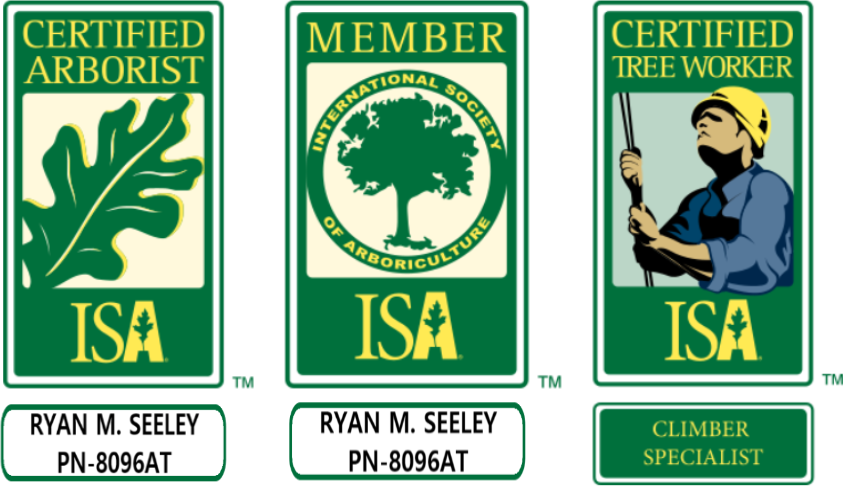
The International Society of Arboriculture (ISA) certification is the most widely recognized professional credential in tree care. Achieving it requires three years of documented full-time tree-work experience (or a degree plus less experience), passing a 200-question exam covering tree biology, soil science, pruning practices, diagnosis, climbing safety, and risk assessment, and recertifying every three years through continuing education credits.
The certification is held by an individual, not the company. A tree service that advertises “ISA Certified Arborist on staff” needs to be able to name the person and produce the certification number. Many companies in the South Sound advertise the credential loosely without any certified individual on payroll — the badge is in the website footer, but the crew arriving in Tacoma or Sumner has no one with formal arboriculture training.
How to verify an ISA Certified Arborist in under two minutes
ISA maintains two public directories. The first is the consumer-facing Trees Are Good lookup. The second is the official ISA credential database, which returns active status, certification number, and any additional ISA credentials (TRAQ, Municipal Specialist, Utility Specialist, Board Certified Master Arborist).
ISA: Find a Certified Arborist
ISA: Verify a Credentialed Arborist
On a site visit, homeowners should ask the arborist for the certification number directly and check it on the spot. A certified arborist will not be insulted by this — verification requests are routine in commercial and municipal contracts. An evasive answer, a number that does not match the name in the database, or “expired” status are all hard stops.
Washington L&I Registration — Why It Is Mandatory
Washington State requires every tree-service contractor to register with the Department of Labor & Industries (L&I). Registration is not optional, not a “nice to have,” and not waived because the company is small. The registration confirms that the contractor carries a contractor’s bond (currently $12,000 for general contractors, $6,000 for specialty), workers’ compensation coverage on every employee, and a current UBI tax registration.
The homeowner risk for hiring an unregistered tree contractor is real and legal. If an uninsured worker is hurt on the property — a fall from a Douglas fir in Covington, a chainsaw injury during a removal in Maple Valley — the homeowner can be held responsible for medical costs and lost wages because no workers’ comp policy exists to absorb them. WA L&I publishes guidance specifically warning property owners about this scenario.
How to verify a WA L&I contractor registration
L&I provides a public “Verify a Contractor” lookup that returns registration status, expiration, bond information, workers’ comp account status, and any open infractions or unpaid judgments. The search works by company name or contractor registration number.
Washington L&I: Verify a Contractor
A clean L&I lookup shows status Active, expiration well in the future, bond present, and workers’ comp account Active. Status Expired, Suspended, or Inactive are stop signs. A history of unpaid judgments is a red flag worth a follow-up question. The L&I number should appear on every written estimate; a written estimate with no L&I number is a written estimate that should be rejected.
General Liability and Workers’ Compensation — Reading a Certificate of Insurance
Insurance is the layer that protects the property and the homeowner from accident liability. Tree work is statistically one of the most dangerous occupations in the United States — Bureau of Labor Statistics data ranks tree trimmers and arborists among the highest fatal-injury rates in any trade. The probability of a property-damage claim or a worker injury on any given job is low, but the cost when it happens is high enough that homeowners cannot afford to assume a tree service “probably has insurance.”
What to ask for
Homeowners should request a certificate of insurance (COI) issued directly from the contractor’s insurance agent, naming the property address as an additional insured for the day of work. The COI is a one-page document showing the carrier, policy number, effective and expiration dates, and the coverage limits. Acceptable minimums for residential PNW work:
• General liability — $1,000,000 per occurrence / $2,000,000 aggregate for standard pruning. Bump to $2,000,000 / $4,000,000 if the work involves removals near structures, crane operations, or any tree taller than 60 feet.
• Workers’ compensation — confirmed via the L&I lookup above; the COI alone is not enough because WA requires state-fund or self-insured coverage.
• Automobile liability — relevant if a chip truck or crane will be parked on the street or in the driveway.
Verbal assurance is not insurance. Photos of a policy page are not insurance. A vague statement about being covered is not insurance. A properly issued COI is insurance. If the contractor cannot produce one within 24 hours, the conversation is over.
U.S. Bureau of Labor Statistics: Census of Fatal Occupational Injuries
TRAQ Qualification — When Risk Assessment Is in the Job
Tree Risk Assessment Qualified (TRAQ) is a specialized ISA credential beyond the base Certified Arborist. It requires a separate training course and exam focused on the ISA Best Management Practices for Tree Risk Assessment. TRAQ-qualified arborists produce defensible risk reports — the kind a homeowner needs for an insurance dispute, a permit application contesting a hazard tree, an HOA disagreement, or a real-estate transaction with a questionable tree on the lot line.
TRAQ matters when the job is not “remove this clearly dead tree” but rather “should this tree be removed at all, and what is the documented risk if it stays?” Examples include a leaning Douglas fir over a Fairwood house, a multi-stem big-leaf maple with included bark next to a Des Moines driveway, or a fungus-flushed bigleaf in a Normandy Park backyard. A standard ISA Certified Arborist can offer an opinion; a TRAQ-qualified arborist can produce a written assessment that holds up in front of a building department, an insurance adjuster, or a small-claims judge.
ISA: Tree Risk Assessment Qualification overview
Not every tree job needs TRAQ. A scheduled pruning on a healthy ornamental maple does not. A hazard removal next to a power line, a permit-required removal of a heritage tree in Burien, or any assessment going into a written report should have a TRAQ name and number on it. Always ask. Pacific Arboriculture’s arborist reports and consultations page outlines when a formal report is appropriate.
The Site-Visit Questions That Separate Real Arborists From Chemical-Mill Operations
Once the paperwork side checks out, the in-person site visit reveals the rest. Homeowners do not need to be tree experts to ask the right questions — competent arborists give specific, technical answers; sketchy operators talk in generalities and pivot to price.

Ten questions worth asking on the walk-through
1. What is the structural goal of this pruning? A real arborist describes pruning targets in ANSI A300 terms — cleaning, thinning, structural pruning, reduction, restoration. “We’re going to top it” or “we’ll cut it back” are not acceptable answers on a mature tree.
2. Where will the cuts be made on this branch? Look for references to the branch collar, three-cut method, and avoidance of flush cuts or stub cuts.
3. What percentage of the live canopy are you removing? ANSI A300 caps healthy-tree live-canopy removal at 25% per year, less on mature trees. An arborist who casually says “we’ll take off about half” is signaling either inexperience or topping.
4. Will you use spikes (gaffs) for this pruning? Spikes are appropriate for removals only. Using spikes on a tree that is staying creates permanent wounds. The right answer for a pruning job is “no — only on removals.”
5. How will the crane (or rigging) be set up to protect the lawn and driveway? Specific answers about plywood mats, outrigger pads, and access routes. Vague answers usually mean lawn damage and surprise driveway repairs.
6. Who is the ISA Certified Arborist on this job and will they be on site? The certified arborist supervising and the climber doing the work may be different people. Both names matter.
7. What is the cleanup standard? Hauled vs. chipped on site, stump grinding depth, soil restoration, lawn raking. Get specifics.
8. What is your written scope of work? Anything not in writing is not in the job.
9. What is your warranty on the work itself? Not the tree’s survival (no one warranties biology) — the workmanship. A 30- to 90-day callback warranty for issues like a missed crossing branch is reasonable.
10. What does the contract say about change orders? Discovery of decay or rot mid-removal is common. A fair contract spells out what triggers a change order and how it is priced.
Red Flags: When to End the Conversation
Some signals are reliable enough to be deal-breakers on their own. None of the following is acceptable from a tree service operating legally in Washington:
• Door-knockers. “Doing a job next door — noticed your tree” is the oldest pitch in the trade. Reputable arborists rarely cold-knock; they are booked weeks out from referrals and search.
• Topping pitched as a safety improvement. Topping is the single most damaging pruning practice in arboriculture. ISA, ANSI A300, and every accredited training program rejects topping as a method on amenity trees. An estimator who proposes topping to make a tree safer is announcing inexperience.
• Cash-only deals. A cash-only operation is almost always an operation that does not report income, does not carry insurance, and does not pay L&I premiums. The savings are not real — they are the homeowner taking the risk.
• No written estimate. A handshake number scrawled on a business card is not a contract. Anything serious is documented.
• Pressure to decide today. A pitch that leans on the crew already being on site and a special price that expires immediately is a closer’s tactic, not an arborist’s. A legitimate arborist is on a schedule, not racing to close before the homeowner can compare. The right move is to wait 24 hours and get one more written quote.
• The price is dramatically lower than two other written bids. The low quote is the quote where the corners have been cut — usually insurance, L&I, disposal fees, or proper rigging.
• No certificate of insurance offered without prompting. The conversation about insurance should come from the contractor, not the homeowner.
In any of these scenarios, the right move is to thank the estimator politely, request that no work begin, and call another company. Homeowners in Edgewood, Bonney Lake, Fife, and Lake Tapps have all reported door-knocker scams in recent storm seasons. The pattern repeats every fall.
A Two-Page Verification Checklist Homeowners Can Print
For homeowners preparing to hire, a structured checklist beats memory every time. Print this list, fill it out for each estimator, and keep the page with the estimate paperwork:
Company information
• Company legal name (must match L&I record)
• L&I contractor registration number
• UBI number
• Years in business in WA
• Physical address (not just a P.O. box)
Credentials
• ISA Certified Arborist name and certification number
• Confirmation that the certified arborist will be on site
• TRAQ qualification (if risk assessment is part of the job)
• TCIA Accreditation (yes/no — bonus, not required)
Insurance
• Certificate of insurance received (yes/no)
• General liability per-occurrence limit ($1M minimum)
• Aggregate limit
• Workers’ compensation status confirmed on L&I lookup
• Property listed as additional insured for the work date
Scope and contract
• Written scope describes work in ANSI A300 terms
• Cleanup standard described in writing
• Change-order policy in writing
• Workmanship warranty terms
• Payment schedule (deposit, milestones, final)
References
• Two local references provided
• At least one reference for similar scope (e.g., crane removal, hazard pruning)
• Online review profile reviewed (Google Business Profile, Yelp, NextDoor)
A homeowner who collects this information from three estimators in Auburn, Kent, or Federal Way will see the difference between a real arboriculture business and an opportunistic operation within an hour. The price column is often the least informative one on the sheet.
How Pacific Arboriculture Measures on This Checklist
For full transparency — this article is published by Pacific Arboriculture, so a quick statement of where the company stands on each of the four items above is appropriate. Pacific Arboriculture is an Auburn, WA based tree service operating across South King and Pierce County. The company carries ISA Certified Arborists on staff, current WA L&I contractor registration, general liability and workers’ compensation insurance, and serves Auburn, Kent, Federal Way, Renton, Tacoma, Puyallup, Burien, Covington, and the rest of the Pacific Arboriculture service area.
Service pages with full scope detail: tree removal, crane-assisted tree removal, tree pruning and trimming, tree health management and plant healthcare, arborist reports and consultations, and storm cleanup and emergency tree removal. The verification information above applies the same way for Pacific Arboriculture as for any other contractor — request the documents, check the databases, compare against the checklist. Informed homeowners are good for the entire arboriculture trade in the PNW.
Frequently Asked Questions
What is an ISA Certified Arborist and how do I check the credential?
An ISA Certified Arborist is an individual who has passed the International Society of Arboriculture’s certification exam after documenting three years of full-time tree-work experience. The certification covers tree biology, pruning standards, diagnosis, climbing safety, and risk assessment, and requires recertification every three years. Verification takes under two minutes through the ISA public directory at treesaregood.org or the official ISA credential lookup. Search by the arborist’s name; the result shows certification number, status, and any additional credentials.
Why does L&I registration matter for tree work in Washington?
Washington State requires every contractor — including tree-service contractors — to register with the Department of Labor & Industries. The registration triggers bond requirements, workers’ compensation coverage, and tax compliance. Hiring an unregistered contractor exposes the property owner to liability if a worker is injured on the property without active workers’ comp coverage. Verification is free and public at the WA L&I “Verify a Contractor” lookup.
Should I get more than one estimate?
Three written estimates is the standard professional practice. The goal is not to find the cheapest number — it is to see the same scope described three different ways and compare apples to apples. A $400 quote and a $1,400 quote on the same Japanese maple usually describes two completely different scopes; the conversation worth having is what each estimator includes and excludes.
What is TRAQ and when does my job need it?
TRAQ stands for Tree Risk Assessment Qualified — a specialized ISA credential earned through additional training and a separate exam. It matters when a written risk assessment is needed for a permit, an insurance claim, an HOA dispute, or a real-estate transaction. A standard ISA Certified Arborist can render an opinion; a TRAQ-qualified arborist can produce a defensible written report.
Is the cheapest quote usually the safest choice?
Almost never. The cheapest quote on a tree job is typically the quote where insurance, L&I premiums, proper rigging equipment, or disposal fees have been cut. The homeowner does not save money in those cases — the homeowner absorbs the risk that would otherwise be priced into the bid. The middle quote on a three-quote comparison is more often the truthful one; the lowest is usually a corner-cutter, and the highest is sometimes scope-padded.
What to Do Next
Homeowners preparing to hire a tree service in Auburn, Kent, Federal Way, Renton, Tacoma, Puyallup, Sumner, Burien, Covington, Maple Valley, Des Moines, Edgewood, Bonney Lake, Lake Tapps, Fife, Tukwila, SeaTac, Pacific, Fairwood, or Normandy Park can use the checklist above to filter three written estimates down to one real arborist. Five minutes on the ISA lookup and the L&I “Verify a Contractor” page eliminates the majority of unqualified bidders before any chainsaw starts.
For an arborist consultation or written assessment, request a quote through Pacific Arboriculture’s free quote form or review available services on the services hub.