
A tree comes down, and a stump is left behind. Sometimes it is a four-inch ornamental remnant nestled in a flower bed; other times it is a forty-inch Douglas fir base with a root flare wider than a wheelbarrow. The next question almost always lands in the same place: should the stump be ground, or should it be fully removed? The two are different procedures, with different costs, different timelines, different surface results, and different downstream impacts on Pacific Northwest soil. This guide walks Auburn, Kent, Federal Way, Renton, Puyallup, Tacoma, and Bonney Lake homeowners through how to decide — and when an ISA Certified Arborist should be involved in the call.
Stump Grinding vs. Stump Removal: The Short Answer
Stump grinding uses a horizontal cutting wheel to chip the visible stump down to six to twelve inches below grade. The wheel grinds the wood into fine chips, the surface roots within reach get severed, and the hole is backfilled with the chip mulch or with topsoil. The remaining root system stays in the ground and decomposes over the next five to ten years.
Stump removal goes further: the entire stump and the major structural root plate are excavated out of the ground, typically with a mini-excavator. The crater left behind is large, often four to six feet across and three to four feet deep, and the site requires substantial topsoil, grading, and compaction before anything can be planted, paved, or built on top.
For most South King and Pierce County properties, grinding is the right answer. Full removal is reserved for a specific subset of situations — usually tied to construction, replanting in the exact same spot, or persistent suckering species. The decision framework below explains when each is appropriate.
How Stump Grinding Actually Works
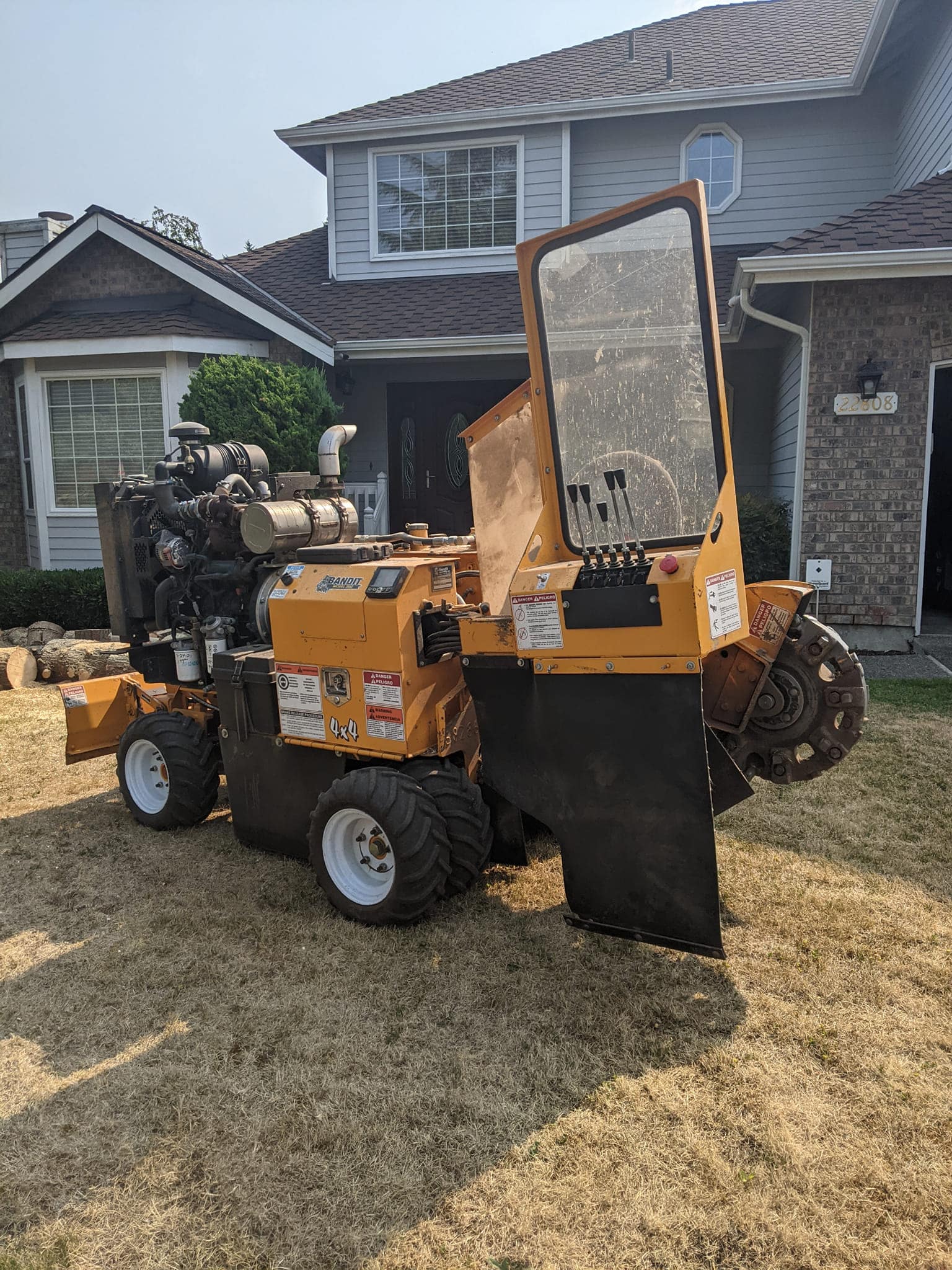
A stump grinder is a self-propelled or tow-behind machine fitted with a high-torque rotating wheel studded with carbide cutting teeth. Smaller units like a 25-horsepower compact grinder fit through a 36-inch gate, which matters in tight Tukwila, Burien, and SeaTac backyards. Larger track-mounted grinders — Bandit, Vermeer, and Carlton being the common brands in Western Washington — handle 40-inch-plus stumps quickly when access allows.
The Grinding Sequence
A typical grind looks like this:
1. Site protection — tarps over flower beds and gravel paths, plywood over irrigation heads, marking of any nearby utility valves.
2. Initial pass — the operator lowers the wheel onto the top of the stump and grinds in horizontal sweeps, chipping the wood roughly two to three inches per pass.
3. Below-grade pass — the wheel is dropped progressively below ground level, usually to a target of eight to twelve inches deep, sometimes deeper for replanting plans.
4. Lateral root chasing — surface roots radiating from the stump are followed outward and chipped down within reach. Distant roots (beyond six to eight feet) are typically left intact, as they will decompose without consequence.
5. Cleanup — chips are either left in the hole as a mound to settle over time, hauled off to a green-waste site, or used as mulch around other landscape areas.
What Stump Grinding Does Not Do
Grinding does not remove the deeper taproot or the major lateral root system. Those stay in the soil and break down through fungal and microbial decomposition, releasing nutrients back into the ground over roughly five to ten years for a mid-sized hardwood and longer for large conifers. For most homeowners in Maple Valley, Covington, and Lake Tapps this is a non-issue — the buried wood is below the lawn and root zone, and the property looks completely normal within a season.
ISA: ANSI A300 Standards for Tree Care Operations
How Full Stump Removal Works
Full removal is excavation work. A mini-excavator with a stump bucket or grapple is positioned next to the stump and used to dig around the root plate, sever lateral roots with cutting bars or the bucket edge, and lever the entire root mass out of the ground. The resulting pit is typically four to six feet across and three to four feet deep, and the displaced stump-and-root assembly often weighs as much as the original tree above ground.
What Happens After Full Removal
A pulled stump leaves a sizable hole that must be:
• Cleared of remaining root fragments and debris
• Backfilled with mineral soil — not pure topsoil, because pure topsoil compresses and creates a settling depression
• Compacted in lifts (six to eight inches at a time) to prevent future sinking
• Topped with finish topsoil and either sod, seed, or hardscape
Settling is the biggest after-effect. Even with careful compaction, the disturbed area can settle one to three inches over the first one to two years, requiring a top-up of soil. For this reason, full removal followed immediately by paving or concrete should always include engineered fill and proper compaction testing.

When Grinding Is the Right Choice for South Sound Homes
For roughly nine out of ten residential situations in the South Sound, grinding is the right call. The specific scenarios where grinding wins:
Lawn or Garden Bed Restoration
If the goal is simply to make the stump disappear so a lawn can be reseeded, a flower bed can be expanded, or a mulch ring can be smoothed over, grinding is the cleaner, cheaper, and less disruptive option. Within a week of grinding, the area looks like normal landscape soil. Within a month of seeding, the lawn typically fills in.
Tight-Access Sites
Many Tacoma, Burien, and Des Moines lots have narrow side gates, raised garden beds, fence corners, or driveway slabs that make excavator access impossible. A compact stump grinder can be walked through a 36-inch gate and operated entirely from one side; an excavator cannot. In these cases grinding is not just preferable — it is the only realistic option.
Cost-Sensitive Projects
Grinding is consistently the lower-cost option. Across South King and Pierce Counties, residential grinding ranges from roughly $150 for a small ornamental stump up to $800 for a large conifer, with most jobs landing between $250 and $500. Full removal costs two to four times that figure once excavation, debris haul-off, and backfill are accounted for. For a Normandy Park or Fairwood homeowner clearing a single backyard stump, grinding is usually the financially obvious choice.
Trees That Do Not Aggressively Sucker
Most PNW conifers — Douglas fir, Western red cedar, Western hemlock, grand fir — do not regenerate from cut stumps. Once the trunk is severed, the root system is biologically done. Grinding the surface stump effectively ends the tree. The same is true for most large hardwoods including maples (with some exceptions noted below), oaks, and birches.
When Full Removal Is Worth the Extra Cost
Full stump removal makes sense in a narrower set of situations. The qualifying scenarios:
Replanting in the Exact Same Spot
If the plan is to plant a new tree directly where the old one stood, full removal is usually preferred. A ground stump leaves a dense web of decomposing roots that competes with new root development, harbors decay organisms (notably Armillaria and Heterobasidion root rots common in Western Washington conifers), and creates an irregular planting hole. Offsetting the new tree four to six feet from the old stump is the easier workaround and typically the recommendation from a Pacific Arboriculture arborist — but when offsetting is not possible, full removal is the cleanest answer.
Forest Pathology: Laminated Root Rot in Western Conifers
Construction Footprint
If the stump sits under a future foundation, retaining wall, driveway, patio, or pool, full removal is non-negotiable. Decomposing wood under structural fill causes settlement that buckles concrete and cracks foundations. Engineered fill specifications for new construction in King and Pierce County typically require organic-free subgrade, which means the stump and major roots must go.
Aggressive Suckering Species
A handful of trees regenerate from severed roots after grinding. Black locust, tree of heaven (Ailanthus), poplar, and some willow species can send up new shoots from buried roots for years after the trunk is gone. Big-leaf maple and certain alders can do this as well, though less aggressively. For these species, full removal of the major root mass is often the only way to stop the cycle of mowing or treating suckers indefinitely. If the original tree was a known sucker-prone species, a Pacific Arboriculture arborist consultation can confirm whether full removal is warranted before the work begins.
Severe Disease or Pest Infestation
If the original tree came down because of an aggressive root disease — laminated root rot, Armillaria root rot, Phytophthora — leaving the diseased root system in the ground risks spreading the pathogen to nearby trees. In Pierce County conifer stands with documented laminated root rot, full removal of infected stumps is sometimes part of a broader site sanitation plan recommended after a Pacific Arboriculture plant healthcare assessment.
WSU Hortsense: Plant Pest and Disease Database
Stump Work Costs, Permits, and Site Considerations
Pricing for stump work in the South Sound depends on six factors:
• Diameter at grade — measured across the cut surface, not the original trunk diameter.
• Species and wood density — Douglas fir and Western red cedar are softer and grind faster than oak or madrone, which slow the wheel significantly.
• Access — backyard stumps behind tight gates take longer than driveway-accessible stumps.
• Depth target — six inches is standard, twelve inches or more for replanting plans.
• Surface root chasing — extensive surface roots add time, especially on maples and cottonwoods.
• Cleanup scope — chips left in place vs. hauled off-site changes the line item.
Typical 2026 ranges across Pacific Arboriculture’s stump grinding service area:
• Small ornamental stump (under 12″ diameter): $150–$300
• Mid-size hardwood or conifer (12″–24″): $300–$550
• Large mature stump (24″–40″): $500–$800
• Oversized or multi-stump jobs: project bid
Full removal — when warranted — typically runs two to four times the grinding figure once excavation, debris haul-off, and backfill are included. For broader removal pricing context, the Pacific Arboriculture tree removal cost guide walks through the upstream variables.
Permits, HOA Rules, and Utility Locates
Most stump grinding and removal work on private residential property in the South Sound does not require a municipal permit, because the tree has already been removed. The permitting question typically applies to the original tree removal, not the follow-up stump work. That said, there are a few exceptions worth flagging:
• HOA rules — Lake Tapps and parts of Maple Valley, Covington, and Bonney Lake have community covenants that govern landscape work and may require notification before excavation.
• Critical areas — stumps within designated wetland buffers, steep slopes, or shoreline jurisdictions in cities like Burien, Des Moines, and Normandy Park may have grading restrictions.
• Utility locates — Washington law requires a free 811 utility locate before any excavation that goes deeper than twelve inches. Full stump removal always triggers this; deep grinding sometimes does. Pacific Arboriculture handles the locate call as part of the project workflow.
Washington 811: Call Before You Dig
Chip Disposition and Replanting
A typical mid-size stump grind produces enough chips to fill a wheelbarrow several times over. The chips are fresh, slightly acidic, and inconsistent in size — usable, but with some caveats. The good options:
Backfill the Hole
The simplest end-state is to leave the chips in the ground, mound them slightly to allow for settling, and let them break down in place. Over six to twelve months the mound flattens out, and within two years the area is indistinguishable from surrounding soil.
Use as Mulch — With a Caution
Fresh stump chips can be spread as mulch around established trees and shrubs, where the slow nitrogen release matches the gradual decomposition of the wood. Avoid using fresh chips around annuals or vegetables, which compete with the decomposing wood for available nitrogen and can show yellowing as a result. For lawns and ornamentals, fresh chips are fine. For vegetable beds, compost the chips for six to twelve months first.
OSU Extension: Should I Use Wood Chips as Mulch?
Replanting After a Grind
A common follow-up question: can a new tree be planted where the old stump was ground? The buried root mass and decomposing chip backfill create a temporarily nutrient-deficient and biologically active zone. New roots planted directly into that environment can struggle.
The recommended approaches:
• Offset by four to six feet — the simplest and most reliable option. The new tree has clean soil to establish in, and the old root mass continues to decompose harmlessly to the side.
• Wait twelve to eighteen months — if the new tree must go in the exact same spot, waiting a season or two allows the most aggressive decomposition to finish and lets the backfill settle. Top up with mineral soil before planting.
• Choose full removal first — if same-spot replanting is the immediate goal and offsetting is not possible, full removal is the cleaner long-term answer. The investment up front avoids years of slow-growth disappointment.
For homeowners weighing what to plant after a removal, Pacific Arboriculture’s Best Trees to Plant in Washington State guide covers species recommendations for South Sound soils.

When to Bring in an Arborist Before Deciding
Most stump decisions are straightforward and can be made over a phone call or a quick photo exchange. A few situations warrant an in-person ISA Certified Arborist consultation first:
• Multiple stumps from a hazard-tree removal where root disease is suspected
• Stumps inside a development footprint with engineered fill requirements
• Stumps near retaining walls, septic systems, or utility easements
• Properties with documented laminated root rot or Armillaria infections
• Heritage or significant trees governed by city tree preservation ordinances in Tacoma, Federal Way, Renton, or Auburn
An arborist assessment in those situations typically pays for itself by surfacing risks — or removing imagined ones — before excavation begins.
Tree Care Industry Association: Safety Standards
How Pacific Arboriculture Approaches Stump Work
Pacific Arboriculture is an ISA Certified Arborist–led tree care company based in Auburn, serving Fife, Kent, Auburn, Burien, Renton, SeaTac, Sumner, Tacoma, Pacific, Tukwila, Edgewood, Puyallup, Covington, Des Moines, Lake Tapps, Federal Way, Fairwood, Bonney Lake, Maple Valley, and Normandy Park. Stump grinding is offered as a standalone service and as a follow-up to tree removal and crane-assisted tree removal projects. Full stump removal is offered when site conditions or post-removal plans require it. Every estimate includes a clear scope: stump dimensions, grind depth, chip disposition, surface root chasing, and access notes. Pacific Arboriculture is fully insured and Washington L&I licensed, and follows ANSI A300 standards on every site.
FAQ: Stump Grinding vs. Stump Removal
How deep does stump grinding go?
Standard grind depth is six to twelve inches below grade. If the plan includes replanting or installing sod, deeper grinds (twelve to eighteen inches) give the new root zone more clean soil to work with.
Will the roots keep growing after grinding?
For most PNW conifers and hardwoods, no — once the trunk is severed and the surface stump is ground, the tree is biologically finished. The exceptions are aggressive suckering species like black locust, tree of heaven, poplar, and some maples and alders, where surviving roots can send up shoots. For those species, full removal or follow-up sucker management is sometimes recommended.
Do I need a permit to grind or remove a stump in King or Pierce County?
Stump work on previously-removed trees typically does not require a permit on residential property. Permits attach to the original tree removal, not the stump follow-up. HOA notification, critical-area buffers, and 811 utility locates may still apply.
How long does the grind itself take?
A small ornamental stump can be ground in fifteen to thirty minutes. A mid-size hardwood or conifer takes thirty to ninety minutes. A large mature conifer with extensive surface roots can take two to four hours. Cleanup adds another fifteen to thirty minutes.
Is full stump removal worth the extra cost?
For most residential situations, no. Grinding is faster, cheaper, less disruptive, and gives an identical visual result. Full removal is worth the extra cost when the site will be built on, paved over, or replanted in the exact same spot, or when the species is an aggressive sucker producer.
Can I plant a new tree in the same spot after grinding?
It is possible but not ideal. The decomposing root mass and chip backfill create a temporarily nutrient-poor zone. Offsetting the new tree by four to six feet is the more reliable option. If same-spot replanting is required, full removal first is the cleanest path.
What do I do with the wood chips?
Three good options: backfill the hole and let them decompose, spread as mulch around established trees and shrubs (not vegetable beds), or have them hauled off to a green-waste facility as a line-item add-on.
Get a Stump Grinding or Removal Estimate
Pacific Arboriculture provides free, no-pressure estimates for stump grinding and full stump removal across the South Sound. To request a quote or schedule a site visit with an ISA Certified Arborist, visit the stump grinding service page or the main contact page. Photos of the stump (with a tape measure or a coin in the shot for scale) make remote quoting fast and accurate.