Many Kent homeowners can name two or three of the trees on their property — the big-leaf maple in the back corner, the cedar near the fence, maybe a Douglas-fir that came with the house. The other six or seven? Best guess. That guesswork stops mattering the moment one of those trees starts dropping limbs, leaning, or browning out — because the species name is the first piece of information any ISA Certified Arborist needs to assess risk, recommend treatment, or quote a removal.
This guide walks through the most common native and planted tree species in South Sound yards, what to look for to identify each one, and which species deserve special attention from a maintenance and risk standpoint. Pacific Arboriculture serves homeowners across Kent, Federal Way, and Puyallup, and the patterns below show up on properties across all three communities.

Why Tree Identification Matters for Homeowners
Tree identification is the foundation of every other decision a homeowner makes about a tree. Pruning timing, pest susceptibility, drought tolerance, structural failure modes, and removal complexity all flow from species. A native western red cedar has a completely different risk profile than a planted Italian cypress, and a 60-year-old big-leaf maple needs different care than a 15-year-old paperbark maple.
For homeowners in Kent, Federal Way, Tukwila, Renton, and Puyallup with mature trees on the property, knowing what species are growing — and where — gives the conversation with an arborist a productive starting point. It also helps homeowners spot the warning signs that are specific to each species. Top dieback means one thing on a cedar and something completely different on a maple.
Native PNW Conifers Found on South Sound Properties
Western Red Cedar (Thuja plicata)
The western red cedar is the signature native tree of the Pacific Northwest and the most common large conifer found in South Sound yards. Identification cues: scale-like foliage in flat sprays (not needles), reddish-brown stringy bark that peels in vertical strips, and a graceful drooping branch habit. Mature cedars reach 100 to 150 feet on undisturbed sites but typically top out shorter in yards due to drought stress and root constraints.
Cedars are currently the species under the most stress across the South Sound. Cumulative drought summers have produced widespread top dieback, thinning canopies, and increasing failure rates during winter storms. WA DNR’s western redcedar dieback resource documents the regional pattern. Any cedar with more than 30% top dieback within striking distance of a structure warrants an arborist assessment.
Douglas-fir (Pseudotsuga menziesii)

Douglas-fir is the tall, straight conifer that dominates the regional skyline and the second-most-common native large tree on South Sound properties. Identification cues: soft, flat needles arranged in spirals around the twig (not in flat sprays like cedar), and the distinctive cones with three-pointed bracts protruding between the scales — the “mouse tails and feet” pattern that locks in the ID.
Mature Douglas-firs in yards are usually 60 to 120 feet tall, frequently growing within 30 feet of structures because they were left as the original forest cover when neighborhoods were built. The species is generally drought-tolerant but vulnerable to Douglas-fir beetle when stressed, and the long bare trunk + heavy crown architecture creates a high-failure-risk profile in windstorms once decay sets in at the base.
Western Hemlock (Tsuga heterophylla)
The Washington State tree. Western hemlock is the more delicate-looking native conifer with short flat needles of irregular lengths along the twig and a drooping leader at the top (the easiest field ID cue). Hemlock prefers shade and moisture and frequently shows up as understory regeneration in older Kent and Maple Valley properties. Mature hemlocks in yards tend to be 70 to 100 feet. Watch for hemlock woolly adelgid — a white woolly substance on the undersides of needles — and root rot in disturbed soils. USDA Forest Service: Tsuga heterophylla species profile covers ecology, growth patterns, and pest susceptibility in detail.
Grand Fir, Pacific Silver Fir, and Shore Pine
Less common but still present on larger lots. Grand fir has flat needles in two distinct rows along the twig (looks combed) and a strong citrus scent when crushed. Shore pine is the only true pine native to the coastal PNW — short, twisted needles in bundles of two, often planted as ornamentals in Des Moines and Normandy Park coastal-adjacent yards.
Native PNW Hardwoods
Big-Leaf Maple (Acer macrophyllum)
The dominant native broadleaf tree in South Sound forests and a common volunteer in older yards. Identification: enormous palmately-lobed leaves (often 8 to 12 inches across, the largest of any maple species), thick branches with a moss-covered look, and the classic samaras (winged seeds) in spring. Big-leaf maples have notoriously weak wood and a tendency toward co-dominant stems with included bark — which makes them the most common storm-failure species in the region.
Pacific Madrone (Arbutus menziesii)
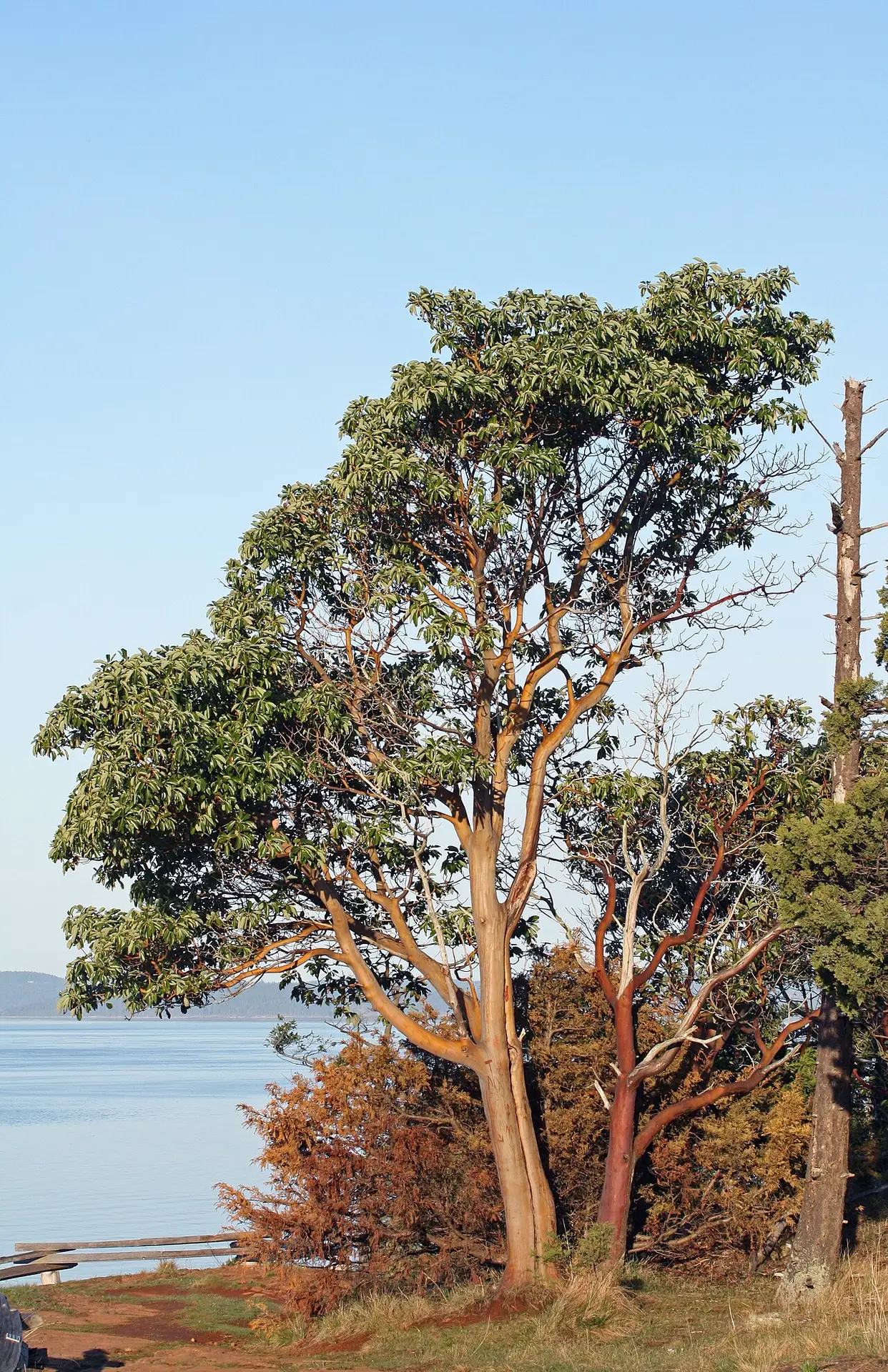
One of the most striking trees in the region and easy to identify once seen. Madrone has smooth, peeling cinnamon-red bark that exposes a green inner layer, broad evergreen leaves, and clusters of small white flowers in spring followed by orange-red berries. It’s native to drier sites and frequently struggles in irrigated yards — root rot from over-watering is the #1 cause of madrone decline on residential properties. Madrones found growing naturally on a slope should generally be left untouched; transplanting almost always fails.
Vine Maple (Acer circinatum)
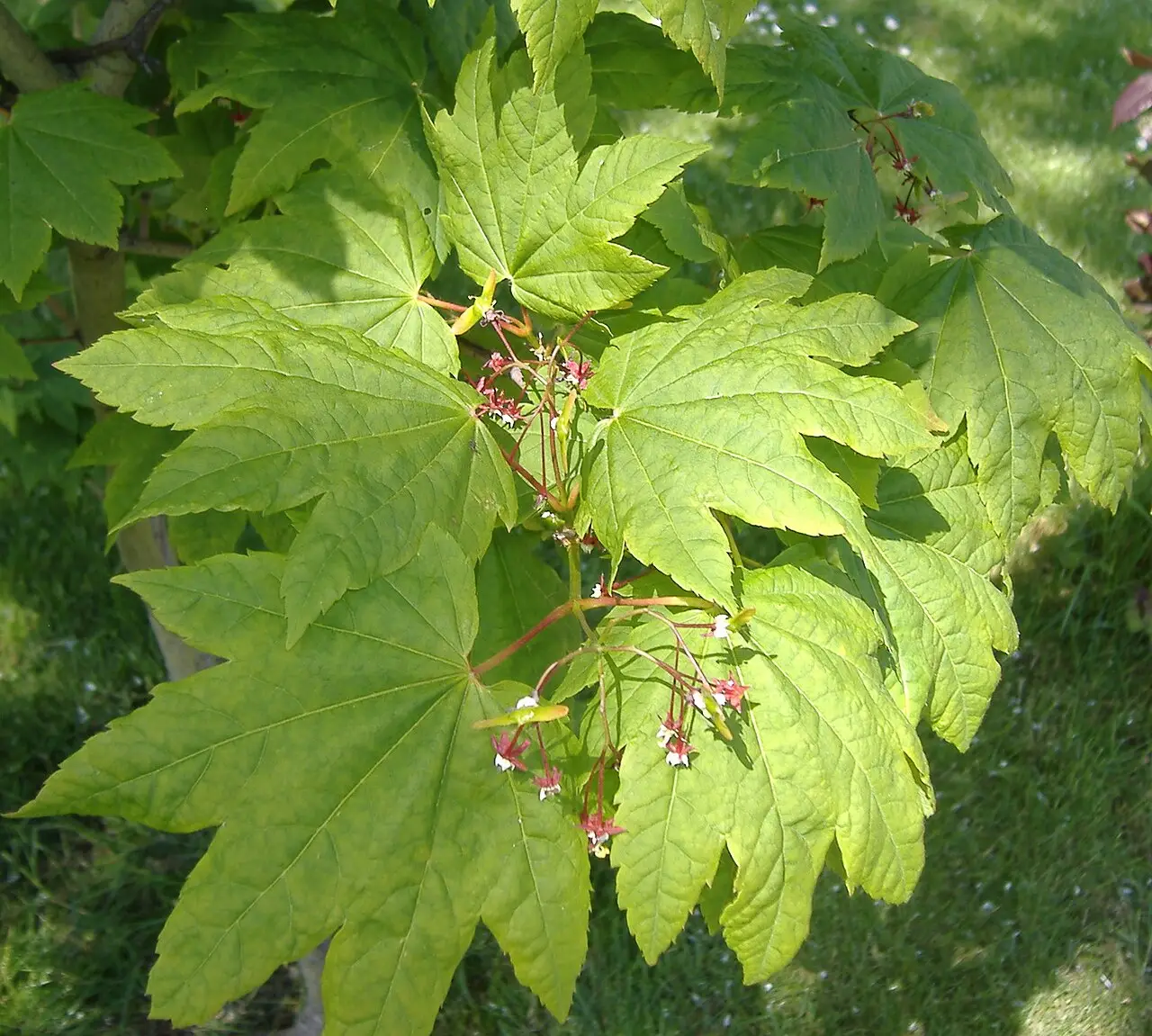
A multi-stem understory native, vine maple is the small graceful tree often growing under cedars and Douglas-firs on shaded edges of properties. Identification: rounded leaves with 7 to 9 lobes (more lobes than the planted Japanese maple), red twigs in winter, and a sprawling multi-stem habit. Vine maples are low-risk and ornamentally valuable — they rarely need work beyond clearing deadwood and selective canopy thinning.
Pacific Dogwood, Red Alder, and Black Cottonwood
Pacific dogwood (the white-bracted understory tree) is regionally declining due to dogwood anthracnose. Red alder is the fast-growing pioneer hardwood that fills in disturbed sites — short-lived (50 to 60 years) and prone to wind failure as it ages. Black cottonwood is the massive riparian hardwood often found near drainages in Sumner and Fife — easy to identify by its furrowed gray bark, balsam-scented spring buds, and tendency to drop very large branches without warning.
Common Planted Species in South Sound Yards
Japanese Maple Varieties
The most popular ornamental tree planted in Kent, Federal Way, and Renton yards over the past 30 years. Identification: small-statured (typically 15 to 25 feet), palmately-lobed leaves smaller than native maples, often with deep red or burgundy color. Common cultivars in the region include ‘Bloodgood’ (upright red), ‘Tamukeyama’ (weeping cutleaf), and the standard green Acer palmatum. Pacific Arboriculture has detailed species guides for the Bloodgood Japanese maple, Red Sunset maple, and Autumn Blaze maple for homeowners who want deeper species-specific information.
Blue Spruce, Hinoki Cypress, and Atlas Cedar
Three of the most common planted conifers in South Sound yards. The Colorado blue spruce has sharply-pointed silvery-blue needles and a stiff pyramidal habit. Hinoki cypress has soft scale-like foliage with white X-marks on the undersides and a more delicate texture than native cedar. Atlas cedar is the silvery-blue planted conifer with stiff needles in tufts — frequently confused with blue spruce but has a much more open, layered branch architecture.
Italian Cypress, Leyland Cypress, and Other Privacy Conifers
The narrow columnar Italian cypress and the fast-growing Leyland cypress are the two most common privacy-screen conifers planted in Tukwila, Federal Way, and Auburn yards. Both species are short-lived in the regional climate, prone to seiridium canker, and frequently outgrow the space they were planted in. Leyland cypress in particular has weak wood and a tendency to split at co-dominant stems — many properties end up needing planned removal within 20 to 30 years.
Identifying Trees by Bark Pattern
When foliage is out of reach or absent (winter ID), bark pattern is the next-best clue:
- Reddish-brown stringy bark in vertical strips → western red cedar.
- Thick deeply-furrowed gray-brown bark → Douglas-fir (and old-growth cedar at the base).
- Smooth peeling cinnamon-red bark → Pacific madrone (unmistakable).
- Smooth gray bark with horizontal lenticels → red alder or birch (look for catkin pattern to differentiate).
- Deeply furrowed gray bark with strong vertical pattern → black cottonwood.
- Smooth gray bark with moss coverage → big-leaf maple (especially older specimens).
Washington Native Plant Society’s native plant directory includes detailed photo references for every native PNW tree species discussed above and is a useful free resource for homeowners wanting to confirm an identification.
Identifying Trees by Leaf Shape
For broadleaf trees in summer, leaf shape gives an immediate answer:
- Huge palmate leaves (8-12 inches) → big-leaf maple.
- Small palmate leaves with deeply cut lobes → Japanese maple cultivar.
- Round multi-lobed leaves on a multi-stem tree → vine maple.
- Broad evergreen leaves with peeling red bark → Pacific madrone.
- Oval serrated leaves with smooth gray bark → red alder.
- Large heart-shaped leaves on a massive trunk → black cottonwood.
Which Species Need Arborist Attention Most Often?
Across thousands of South Sound assessments, certain species generate disproportionate work calls:
- Western red cedar — drought-driven top dieback and root rot in lawn-irrigated yards.
- Big-leaf maple — co-dominant stem failures, included bark, decay at old pruning wounds.
- Douglas-fir — Douglas-fir beetle on drought-stressed individuals, root-plate movement on tall specimens.
- Leyland cypress — seiridium canker, splitting at co-dominant stems, outgrown placement.
- Black cottonwood — large branch shedding without warning, especially in summer.
- Italian cypress — entire-tree decline from pressure of regional summer heat.
A documented species inventory of the trees on a property — done as part of an arborist consultation — gives homeowners a long-term care plan and surfaces hazards before they become emergencies. Pacific Arboriculture’s ISA Certified Arborists can perform a walkthrough that catalogs species, notes condition, and prioritizes maintenance or removal recommendations. Trees Are Good — the ISA’s homeowner resource includes free species fact sheets that pair well with a professional walkthrough.
Selecting New Trees for a South Sound Yard
Tree identification and tree selection are two sides of the same coin. Homeowners who understand what’s already growing well in their neighborhood — and what’s struggling — make better planting decisions. Native species like vine maple, Pacific dogwood (where anthracnose isn’t a problem), and Pacific madrone (on appropriate sites) generally outperform exotic plantings in long-term resilience. For larger conifer plantings, Douglas-fir on well-drained sites and western red cedar in moist areas continue to be the strongest performers. Avoid planting Leyland cypress and Italian cypress as long-term solutions — the maintenance and removal cost over 30 years rarely justifies the initial growth rate.
WSU Hortsense has species-specific guidance for the most common landscape trees planted in Washington, and the King County Master Gardener program offers free plant clinics where homeowners can bring leaf samples for identification. Pacific Arboriculture provides arborist consultations for homeowners who want a documented species inventory plus a care plan.
Internal Resources for South Sound Tree Care
Pacific Arboriculture maintains city-specific tree service pages and species guides for the South Sound. Homeowners who want deeper information on a specific city or species can start with the Kent tree service page, the Federal Way tree service page, the Puyallup tree service page, or the main tree services index. For health concerns related to specific species, the plant healthcare service page covers diagnostic and treatment workflows.
Frequently Asked Questions
How can a homeowner identify a tree on their property without a horticultural background?
Start with three observations: leaf shape (or scale/needle pattern for conifers), bark texture and color, and overall growth habit. The Washington Native Plant Society directory and WSU Hortsense both have free photo references covering every common species in the region. For trees outside the top 15 native and planted species, a phone photo sent to an arborist or a local master gardener clinic will usually produce a confident identification.
Do I need to know the species of a tree before scheduling a removal or pruning?
Not before scheduling — Pacific Arboriculture’s ISA Certified Arborists identify species during the on-site consultation. Homeowners providing the species name in advance does help with scoping and quoting accuracy, especially for removals where rigging plans and equipment selection depend on wood density and growth habit.
Are native PNW trees always better choices than planted ornamentals?
In most cases, yes — natives are adapted to regional rainfall patterns, soil conditions, and pest pressures. However, some non-native species (Japanese maples, ginkgo, certain ornamental cherries) perform well in residential yards and offer ornamental value that natives don’t always match. The decision should be based on the specific site, sun exposure, mature size, and long-term maintenance commitment.
What is the most commonly misidentified tree species in the South Sound?
Western red cedar and Atlas cedar (blue Atlas cedar in particular) are frequently confused with each other and with other ornamental conifers. The native western red cedar has flat sprays of scale-like foliage and reddish stringy bark; Atlas cedar has stiff blue-green needles in tufts and a much more open architecture. The two species have completely different care requirements and risk profiles.
Which tree species are most dangerous to leave unmaintained?
Big-leaf maple with co-dominant stems and included bark, Leyland cypress with splitting unions, mature Douglas-fir with root-plate movement, and black cottonwood with summer branch shedding are the four species most likely to cause property damage if left unmaintained. Any of these species within striking distance of a structure deserves an annual arborist walkthrough.
The Bottom Line on Tree Identification
Knowing what trees are growing on a property is the first step toward managing them intelligently. Native conifers like western red cedar, Douglas-fir, and western hemlock dominate the South Sound canopy. Native broadleaf trees like big-leaf maple and Pacific madrone show up on most properties. Planted species — Japanese maples, blue spruce, hinoki cypress, and the Leyland/Italian cypress privacy screens — fill in the ornamental layer. Each species has a specific care profile and a specific risk profile, and identification is what unlocks the right next step.
Pacific Arboriculture provides species-inclusive arborist consultations for homeowners across Kent, Federal Way, Puyallup, and the broader South Sound — including Auburn, Tacoma, Burien, Covington, Maple Valley, and Lake Tapps. A documented species inventory paired with condition notes is the single most useful long-term tree-care planning tool a homeowner can have on file.